EHC plans in independent special schools: what the standards require


Many leaders tell us that the EHC plan is the document they think about most and, sometimes, the one they feel least sure how to use well. It arrives written by someone else and carries high expectations from families and placing authorities. It’s understandable that it can end up in a folder rather than at the centre of a child’s school day.
From our experience, the independent special schools where pupils thrive treat the EHC plan as a living document. Its outcomes shape learning, teaching, therapy and the annual review. This guide explains what the standards ask, where section 41 approval and the SEND Code of Practice fit in, and how to make the plan work every day.
In short: For EHC plans, independent special schools must make sure the curriculum and teaching take account of each pupil’s needs, including those set out in their EHC plan, under Part 1 of the Independent School Standards. Part 6 adds information duties: particulars of provision for pupils with EHC plans, information the local authority needs for the annual review, and an annual account of income and expenditure for each funded pupil.
If you are new to the regulations, our guide to what the Independent School Standards are sets out all eight parts. This guide focuses on the requirements that touch EHC plans most directly.
What do the Independent School Standards say about EHC plans?
The standards expect the curriculum and teaching to take account of each pupil’s EHC plan, and Part 6 asks schools to give parents and local authorities information about the provision for those pupils.
The standards are set out in the Schedule to the Education (Independent School Standards) Regulations 2014. EHC plans appear in two places: in Part 1, the quality of education, and in Part 6, the provision of information.
| Where | What it asks, in plain English |
|---|---|
| Paragraph 2(1)(b)(i) | The written curriculum policy, plans and schemes of work take into account the ages, aptitudes and needs of all pupils, including those with an EHC plan |
| Paragraph 2(2)(h) | All pupils have the opportunity to learn and make progress |
| Paragraph 3(d) and 3(g) | Teaching shows a good understanding of pupils’ needs and prior attainment, takes them into account in planning, and uses assessment to help pupils progress |
| Paragraph 4 | A framework for evaluating pupil performance is in place |
| Paragraph 32(1)(h) | An annual account of income and expenditure for each pupil wholly or partly funded by a local authority goes to that authority |
| Paragraph 32(1)(i) | Information reasonably required for the annual review of a funded pupil’s EHC plan goes to the responsible local authority |
| Paragraph 32(3)(b) | Particulars of educational and welfare provision for pupils with EHC plans are made available to parents |
These requirements exist so that every child receives an education built around who they are. Our full guide to Part 1 and the quality of education covers the wider curriculum requirements.
How should an EHC plan shape the curriculum and teaching?
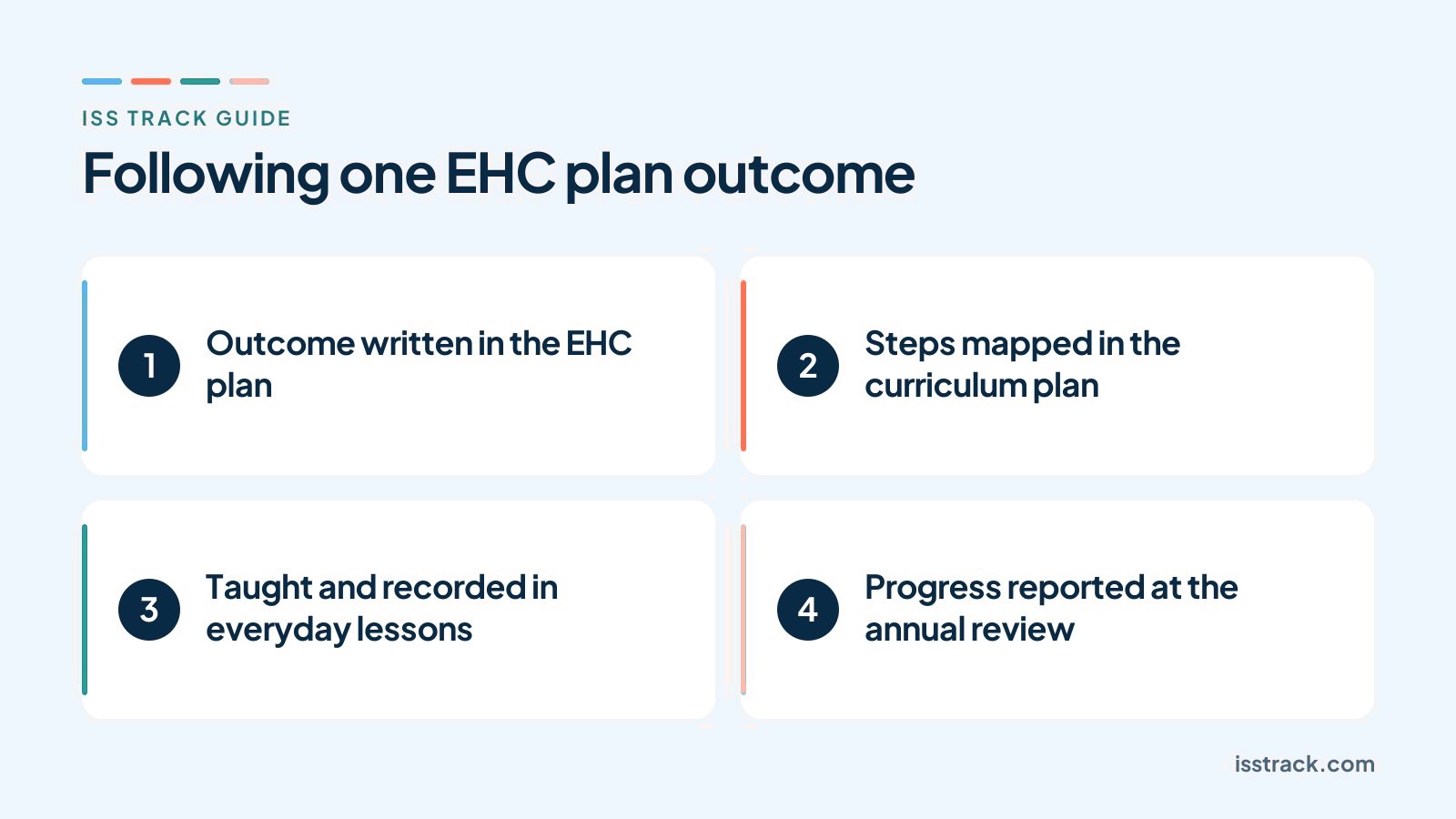
Paragraphs 2 and 3 ask for a curriculum and teaching planned around each pupil’s needs. In practice, that means the outcomes in section E of the plan, and the provision in section F that is meant to help a child achieve them, should be visible in four places:
- The curriculum plan. Each pupil’s pathway shows where their outcomes are taught, not only in a dedicated intervention.
- Lesson planning. Teachers and teaching assistants know each pupil’s current targets and plan for them across the day.
- Therapy. Speech and language, occupational therapy and other specialist input is planned with teachers, so skills are practised in real lessons.
- Assessment and review. Progress is measured against the outcomes, and the evidence feeds straight into the annual review.
Many leaders call this the golden thread: anyone can follow one outcome from the plan to the classroom and back again.
Common Misconception
“The EHC plan is the local authority’s document, so our job is just to deliver the hours.” The local authority maintains the plan, but the school is where it comes to life. Part 1 asks that your curriculum and teaching take account of each pupil’s needs, and the outcomes in the plan are the clearest description of those needs.
What does an EHC plan look like in practice? A worked example
The example below is illustrative. It is not a real pupil, but it reflects the kind of thread we look for when we review independent special schools.
The outcome in the EHC plan
Alex is 12 and autistic. One outcome in section E of their EHC plan reads: “By the end of Key Stage 3, Alex will ask an adult or peer for help when stuck, using words or a visual prompt, in most lessons.” Section F includes daily structured communication practice and termly speech and language therapy input.
The curriculum plan
The school’s communication strand runs through English, PSHE and tutor time. Alex’s pupil profile breaks the outcome into termly steps: first using a help card with an adult in two subjects, then in four subjects, then asking verbally with a peer.
A lesson
In a Year 8 science lesson, Alex has a help card on the desk. The teacher’s plan notes one point in the practical where pupils are likely to get stuck, and the teaching assistant waits a few seconds before stepping in, giving Alex the chance to use the card. The speech and language therapist modelled this wait time with the class team.
Evidence of progress
Staff record a brief note when Alex asks for help independently, using a simple tally on the profile. Across the autumn term, the notes show Alex using the card first in English and science, then in maths and food technology.
The annual review
The school’s report for the annual review describes this progress in plain language, includes Alex’s own view (“I use my card when I’m stuck and Miss comes”), and recommends that the outcome is amended to the next step: asking verbally in unfamiliar settings, such as work experience.
From Our Experience
We often see strong practice that is hard to show because the evidence lives in several places. Therapy notes sit with the therapist, lesson notes with the teacher and assessment in a separate system. Schools that recover well usually agree one short pupil profile that everyone uses, so the thread is visible without extra paperwork.
What is a section 41 approved independent special school?
A section 41 school is an independent special school the Secretary of State has approved, with the proprietor’s consent, so that families can ask for it to be named in an EHC plan in the same way as a maintained school.
Section 41 of the Children and Families Act 2014 allows the Secretary of State, with the proprietor’s consent, to approve an independent special school or special post-16 institution. The DfE publishes the current list of special schools and colleges approved under section 41, which was last updated on 31 August 2026. Schools apply in an annual window, and the DfE publishes separate guidance on applying.
Approval matters for three practical reasons:
- A parent or young person can ask for a section 41 approved school to be named in the EHC plan, in the same way as they could for a maintained school or academy.
- If a section 41 approved school is named in a child’s EHC plan, the proprietor must admit the child.
- The proprietor of a section 41 approved school is one of the bodies listed in section 77 of the Children and Families Act 2014 that must have regard to the SEND Code of Practice.
Independent special schools that are not on the list can still educate pupils with EHC plans, but the duties described above are tied to section 41 approval. Every school’s circumstances are different, so check your status on the current list.
How does the SEND Code of Practice apply to independent special schools?
If your school is section 41 approved, you must have regard to the SEND Code of Practice. If it is not, the Code still shapes how your placing local authorities work, so it is worth knowing well either way.
The SEND Code of Practice: 0 to 25 years is statutory guidance for the bodies named in section 77. If your school is section 41 approved, you must have regard to it, which means following it unless there is a good reason not to.
If your school is not section 41 approved, the Code is not addressed to you in the same way. It is still how your placing local authorities work, though, so its expectations will shape every review you take part in. From our experience, schools that know the Code well find conversations with local authorities easier.
What is the school’s role in the EHC plan annual review?
The school contributes advice and information to every annual review, and for a section 41 approved school the local authority can ask the headteacher to arrange and hold the review meeting.
The local authority must review each EHC plan at least once in every 12 months. The school’s role depends partly on its status.
Under regulation 20 of the Special Educational Needs and Disability Regulations 2014, where the pupil attends a section 41 approved independent school, the local authority can require the headteacher to arrange and hold the review meeting. Where that happens, broadly:
- the parent or young person, the local authority’s education, health and social care representatives and the school are invited, with at least two weeks’ notice
- advice and information are gathered and circulated at least two weeks before the meeting
- the meeting considers progress towards the outcomes, and from Year 9 onwards, preparation for adulthood and independent living
- the headteacher sends a report with recommendations to the local authority and everyone invited within two weeks of the meeting
For every independent school, paragraph 32(1)(i) of the standards requires the school to give the responsible local authority the information it reasonably needs for the annual review of a funded pupil’s EHC plan. Our guide to information independent schools must give local authorities explains this alongside the other Part 6 duties.
Good Practice
In strong schools, the annual review feels like a natural summary of the year rather than a separate event. The pupil’s voice is gathered in a way that suits them. Progress is described against each outcome with real examples. Recommendations are specific and followed up.
What information must independent schools give local authorities about pupils with EHC plans?
For a pupil a local authority funds, the school must send that authority an annual account of income and expenditure and the information it reasonably needs for the EHC plan annual review, and must make particulars of its EHC plan provision available to parents.
Part 6 sets out three duties that relate closely to EHC plans:
- An annual account of income and expenditure. Under paragraph 32(1)(h), where a pupil is wholly or partly funded by a local authority, the school provides that authority with an annual account of income received and expenditure incurred in respect of that pupil, and to the Secretary of State on request.
- Annual review information. Under paragraph 32(1)(i), the information reasonably required for the annual review goes to the responsible local authority.
- Particulars for parents. Under paragraph 32(3)(b), particulars of educational and welfare provision for pupils with EHC plans are made available to parents, usually on the website.
One of the most common challenges is the annual account. In a group it can fall between the school and the central finance team. A named owner and a fixed date in the calendar usually solve this.
How can we work well with placing local authorities?
Share clear progress information between reviews, raise changes in a pupil’s needs early, and agree any reduced timetable with the authority and parents.
Placing authorities are under real pressure, and many leaders tell us communication is the hardest part of the relationship. A few habits help:
- Share clear, outcome-focused progress information between reviews, not only once a year.
- Raise early if a pupil’s needs have changed and the plan no longer fits, rather than waiting for the review.
- Agree any reduced or part-time timetable with the authority and parents, with a clear plan back to full time.
When an authority can see that a placement is working, and why, trust grows, and the child benefits most.
How can we show we are meeting the standards for pupils with EHC plans?
The best evidence shows the thread in practice: pupil profiles, planning that refers to outcomes, progress evidence, review reports and a log of information sent to local authorities. Our guide to Independent School Standards evidence explains how to gather this without creating extra paperwork.
ISS Track breaks Part 1 and Part 6 into separate, checkable requirements, so leaders can see quickly whether the EHC plan duties are secure and where a little attention would help.
Questions for Leaders
- Could we follow one outcome from a pupil’s EHC plan into a lesson this week?
- Do teaching assistants and therapists know each pupil’s current targets?
- Are we section 41 approved, and do our staff understand what that means for us?
- Who prepares the annual account of income and expenditure for each funded pupil, and when was it last sent?
- Does each annual review report include the pupil’s own view, in a way that suits them?
- Have we published clear particulars of our provision for pupils with EHC plans?
Our Perspective
An EHC plan is a promise made to a child and their family. The Independent School Standards ask schools to make that promise real in the curriculum, in teaching and in honest reporting. When the plan shapes every part of the school day, children make progress that matters to them, and families and local authorities can see it. That is the goal, long before and long after any inspection.
Sources and further reading
- The Education (Independent School Standards) Regulations 2014, Schedule Part 1: Quality of education provided
- The Education (Independent School Standards) Regulations 2014, Schedule Part 6: Provision of information
- Independent special schools and colleges approved under section 41 (DfE)
- Children and Families Act 2014, section 77: code of practice
- SEND code of practice: 0 to 25 years (DfE)
- The Special Educational Needs and Disability Regulations 2014, regulation 20: review where the child or young person attends a school
Look up the requirements, paragraph by paragraph
Continue exploring
- Part 1: the quality of education, including curriculum policy and assessment
- Information independent schools must give local authorities, including the annual account
- Independent School Standards evidence that shows practice, not paperwork
- What the Independent School Standards are, across all eight parts
- What an independent school must publish on its website, including EHC plan provision
- The independent school accessibility plan: what the Equality Act asks of you, and how to keep the plan alive
- The most commonly unmet standards: what the official data shows, and how to stay ahead of it
- Part 2: SMSC and British values
- Part 3: Welfare, health and safety
- Part 3: KCSIE in independent schools
- Part 3: Restrictive interventions (16A and 32A)
- Part 4: The single central record (SCR)
- Part 5: Premises and accommodation
- Part 7: The complaints procedure
- Part 8: Leadership and proprietors
Elsewhere on ISS Track: see how the standards tracker helps with this, browse our free downloads, compare pricing, see ISS Track for groups or read every guide.
How can Jarvis Education help?
ISS Track is supported by Jarvis Education, an education consultancy led by a former HMI that supports independent schools, independent special schools and alternative provision.
If you would like an independent view of how well your EHC plans shape the curriculum, teaching and reviews, through a focused review, an ISS health check, CPD for staff or support for leaders, we would be glad to help. Our reviews are there to build confidence and strengthen practice, never to find fault. Get in touch and tell us about your school.
How can ISS Track help?
See how ISS Track breaks the EHC plan duties in Part 1 and Part 6 into clear, checkable requirements with evidence for each.
The curriculum, annual review and local authority requirements in one place, all year round.
Also useful:Watch the two minute tourView pricingBuy nowAll featuresFor groupsThe complete guide to the standards
ISS Track is supported by Jarvis Education
Support from Jarvis Education
Sometimes an experienced pair of eyes helps. These services and guides from the Jarvis Education team go further on this topic.