Independent School Standards changes in 2026: what leaders need to know


It’s understandable if 2026 has felt like a year of catching up. The Independent School Standards changes in 2026 came in quick succession: new standards arrived in April, the DfE refreshed its guidance in the same month, the rules on data protection complaints changed in June, and Ofsted’s renewed approach has bedded in. For leaders who are already stretched, each change can feel like another document to rewrite.
From our experience, most of these changes describe things good schools were already working towards. What they ask for is clarity: clear procedures, clear records, and clear communication with families. The work is real, but it is manageable when it is broken into steps.
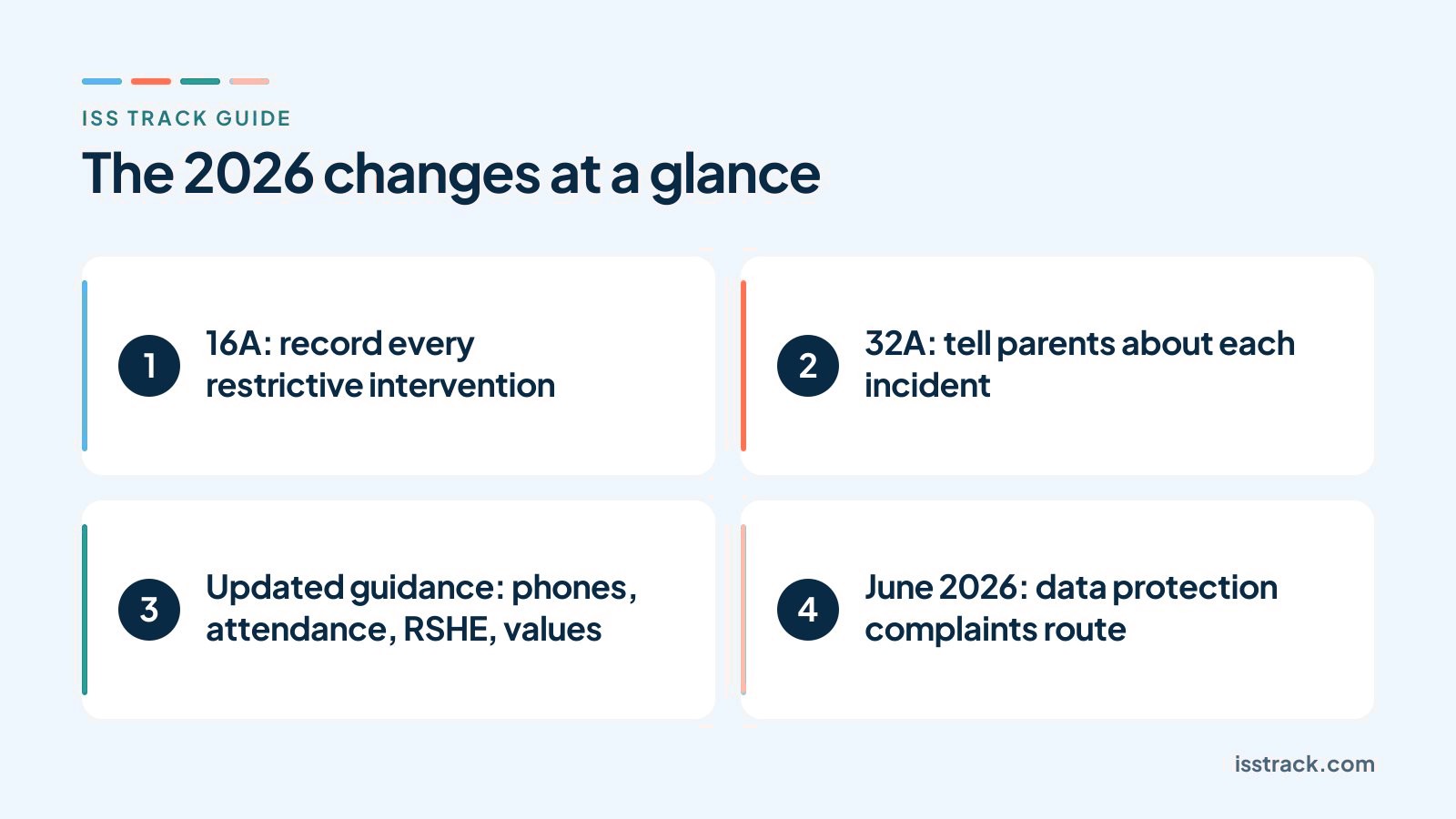
In short: The Independent School Standards changes in 2026 added two new paragraphs from April: 16A, on the use of restrictive interventions, and 32A, on telling parents about each one. The DfE updated its guidance on the standards the same month, including mobile phones, attendance and RSHE, and new rules on data protection complaints followed in June.
This guide walks through each 2026 change in plain English, explains why it matters for children and young people, and suggests practical first steps. If you would like the full picture of all eight parts first, start with our complete guide to the Independent School Standards.
What changed in the Independent School Standards in April 2026?
Two new paragraphs were added to the standards from 1 April 2026, through the Schools (Recording and Reporting of Seclusion and Restraint) (No. 2) (England) Regulations 2025.
- Paragraph 16A, in Part 3, is about recording. Schools need a procedure for recording use of force and a procedure for recording seclusion, restraint or immobilisation.
- Paragraph 32A, in Part 6, is about telling parents. Schools need a way of giving each parent information about each incident.
In the same month, the DfE published updated non-statutory guidance on the standards. It added more on fundamental British values, relationships and sex education, mobile phones, attendance, restrictive interventions and data protection complaints. Inspectors and the DfE have regard to that guidance, so it is worth reading alongside the regulations themselves.
| Change | Where it sits | What to look at first |
|---|---|---|
| Recording restrictive interventions | Part 3, paragraph 16A | Your recording procedures and forms |
| Informing parents | Part 6, paragraph 32A | How and when parents are told |
| Mobile phones | Part 3, behaviour | Your behaviour policy |
| Attendance | Part 3, registers | Registers and absence follow-up |
| RSHE and British values | Parts 1 and 2 | Consultation, publication, curriculum |
| Data protection complaints | Alongside Part 7 | Your complaints routes |
Why were the restrictive intervention standards introduced?
Restrictive interventions are some of the most significant moments in a child’s school life. For a pupil who has been held, moved or separated from others, the experience can affect how safe they feel at school for a long time afterwards. For parents, not knowing it happened can damage trust that took years to build.
The new standards exist so that every incident is written down, every parent is told, and schools can see patterns and learn from them. That matters most in independent special schools and alternative provision, where some pupils may experience restrictive interventions more often. Recording well is not about suspicion of staff. It protects pupils, protects staff, and gives leaders the information they need to reduce the use of restriction over time.
What does paragraph 16A of the Independent School Standards require?
Paragraph 16A asks for two procedures: one for recording use of force incidents, and one for recording seclusion, restraint or immobilisation incidents. Records must be made in writing as soon as practicable after the incident. The school must also take reasonable steps to make sure both procedures are actually followed.
Two details are easy to miss. First, “staff” includes supply staff and volunteers, so your procedures and training need to reach them too. Second, the DfE’s guidance sets out the content it expects records to include, so it is worth checking your forms against it rather than adapting an old template.
Practical first steps for 16A
- Read your behaviour and positive handling policies side by side and make sure the definitions match the regulations and the DfE guidance.
- Check your recording form. Does it capture what the guidance expects, and can it be completed quickly after an incident?
- Decide who checks that records are completed as soon as practicable, and how often.
- Make sure supply staff and volunteers are included in induction and know what to do.
- Build in a regular look at the records as a whole: which pupils, which times of day, which settings, and what is being learned.
Our guide to Part 3: welfare, health and safety explains how 16A sits alongside safeguarding, behaviour and risk assessment.
Good Practice
In schools where this works well, recording is part of a wider cycle. An incident is recorded promptly, the pupil and staff are supported afterwards, parents are told, and leaders regularly review the records to spot patterns and plan changes. The proprietor receives a summary and asks what is being done to reduce restriction. The aim is always fewer incidents, not just better paperwork.
What does paragraph 32A require schools to tell parents?
Paragraph 32A asks schools to have a way of giving each parent information about each incident, as soon as practicable afterwards, and to take reasonable steps to make sure that happens.
There are limited exceptions. The duty does not apply where the pupil is 20 or over. Information must not be given to a parent if doing so would be likely to result in significant harm to the pupil. If no parent can be told safely, the information goes to the local authority where the pupil ordinarily lives. “Parent” can include a local authority looking after the child, which matters for schools with looked after pupils.
In practice, the questions to settle are simple ones. Who makes the call or sends the message? How quickly? How is it recorded that parents were told? And who decides, with the designated safeguarding lead (DSL), when the significant harm exception applies? Many leaders tell us that writing these answers down in one short procedure saved a great deal of uncertainty on difficult days.
Because 32A sits in Part 6, it is also worth checking that your published behaviour or positive handling particulars reflect it. Our guide to what an independent school must publish on its website covers the wider Part 6 list.
What does the April 2026 guidance say about mobile phones?
The updated guidance expects schools to be mobile phone-free environments by default, considered through the lenses of behaviour, safeguarding and wellbeing. Importantly, the expectation covers the whole school day: lessons, transitions, breaks and lunch.
Every school’s circumstances are different. Some pupils may need a device for medical or communication reasons, and post-16 or residential provision may need a different approach. The key is that the behaviour policy explains the default clearly, sets out how exceptions are agreed and monitored, and that staff apply it consistently. Our list of the policies an independent school needs shows where this fits.
A worked example: following one change through the school
A change to the behaviour policy only helps pupils if it reaches every place where people learn what the school expects. Here is how a school might trace the mobile phone expectation through from start to finish.
- The behaviour policy. States the phone-free default for the whole school day, and who agrees and reviews exceptions.
- A record of exceptions. A simple list of pupils who need a device for medical or communication reasons, the reason, and when it will be reviewed.
- The website. The published behaviour particulars updated on the same day the new policy is approved.
- Families. A short letter or message explaining the change, why it matters and how parents can reach their child in an emergency.
- Pupils. An accessible explanation, adapted to how pupils learn, so the rule makes sense to them.
- Staff. A briefing, plus a line in induction for new and supply staff, so the rule is applied the same way at lunch as in lessons.
A month later, a short learning walk at break and lunch shows whether practice matches the policy. That one walk is also the evidence of practice the standard needs.
What does the April 2026 guidance say about attendance?
The guidance gives more weight to attendance, in line with Working Together to Improve School Attendance. It highlights accurate admission and attendance registers, notifying the local authority when required, intervening early, and recognising the safeguarding side of persistent or unexplained absence.
We often see schools where registers are kept accurately but the follow-up is less clear. A useful question for leaders is: when a pupil’s attendance starts to slip, what happens next, who does it, and how quickly? For many pupils in special schools and alternative provision, attendance is closely tied to wellbeing, so this is about knowing children well as much as it is about procedure.
What does the guidance say about RSHE and British values?
On relationships and sex education, the guidance expands on standard 2A: consulting parents on the policy, publishing it on the website and providing it free on request, and handling requests to withdraw from sex education. Our guide to Part 1 and the quality of education explains 2A in more detail.
On fundamental British values, the guidance adds more examples of what active promotion can look like. This is helpful for schools that want to move beyond displays towards values that pupils genuinely understand and live, adapted to how they learn. See Part 2: SMSC and fundamental British values for practical ideas.
Common Misconception
“Updated guidance is optional, so it doesn’t really change anything.” The guidance is non-statutory, but inspectors and the DfE have regard to it when deciding whether standards are met. It is best read as a clearer description of what meeting the standards looks like now.
What are the new data protection complaints rules from June 2026?
From June 2026, organisations must make it possible to complain about how personal data is handled. That means providing a way to complain, acknowledging a complaint within 30 days, investigating it and telling the person the outcome without undue delay.
For schools, the important point is how this fits with Part 7. A data protection complaints route can sit alongside the parental complaints procedure, but it must not get in the way of it. A parent should never find that a concern about their child is delayed because it was routed into the wrong process. Our guide to the independent school complaints procedure shows how to describe both routes clearly.
From Our Experience
One of the most common challenges after any change is that the policy is updated but the website, staff handbook and forms are not. We often see a new procedure sitting next to an older published version that says something different. Taking an hour to check every place a change needs to appear is one of the most valuable things a leader can do.
How has Ofsted’s approach to independent schools changed in 2026?
Ofsted now inspects non-association independent schools under its renewed education inspection framework. An independent schools inspection toolkit and operating guides replaced the old handbook from January 2026, with updated versions in use from September 2026.
Evaluation areas are graded on a five-point scale, from exceptional through to urgent improvement, and inspectors complete a compliance record that shows each relevant standard as met or not met. The standards closely match the “expected standard” in the toolkit, so if the standards linked to an area are not met, that area cannot be graded expected standard or above. Our guide to how Ofsted inspects independent schools explains this in full.
The practical message is reassuring. The way to be ready for the renewed approach is the same as the way to be a good school: meet the standards consistently and know honestly where you stand.
How should leaders respond to the 2026 changes?
A calm, steady plan works better than a rush. Many schools find it helpful to:
- List each change and decide who owns it.
- Update the relevant policies, then check every published copy matches.
- Train staff, including supply staff and volunteers where 16A applies.
- Gather a little evidence of practice, such as a sample of completed records and a note of how parents were told.
- Report progress to the proprietor, who carries overall responsibility under Part 8. Our guide to proprietor responsibilities explains why.
- Revisit the changes after a term to check they are working as intended.
An honest self-evaluation against the standards is the natural place to record where you are. In ISS Track, the 16A, 32A, mobile phone and data protection items appear as separate requirements, with suggested actions, so the changes become part of your normal review rather than a separate project.
Questions for Leaders
- Could every member of staff, including supply staff and volunteers, explain how a restrictive intervention is recorded here?
- How do we know parents are told about each incident as soon as practicable, and could we show it?
- What do our records of restrictive interventions tell us, and what have we changed as a result?
- Does our behaviour policy cover mobile phones across the whole school day?
- Is it clear to parents how a data protection complaint differs from a complaint about their child’s education?
- Does our proprietor body know which 2026 changes are complete and which are still in progress?
Free download: Independent School Standards checklist
Every requirement in all eight parts, including the 2026 additions, in plain English with space for your rating, evidence and owner. Download the checklist (PDF)
Our Perspective
The 2026 changes are not a new set of hoops. They ask schools to be clearer about the moments that matter most to children and families: when a child is restricted, when they stop attending, when a parent has a concern. Schools that use the changes as a prompt to reflect, rather than a task to tick off, usually end up safer and more trusted, which is exactly the point. For the wider picture, return to our guide to the Independent School Standards.
Sources and further reading
- The Schools (Recording and Reporting of Seclusion and Restraint) (No. 2) (England) Regulations 2025
- Regulating independent schools (DfE), including Independent school standards guidance, April 2026
- The Education (Independent School Standards) Regulations 2014, Schedule Part 3: Welfare, health and safety of pupils
- The Education (Independent School Standards) Regulations 2014, Schedule Part 6: Provision of information
- How to deal with data protection complaints (ICO)
- Independent school inspection: toolkit, operating guide and information (Ofsted)
- The Schools (Recording and Reporting of Seclusion and Restraint) (No. 2) (England) Regulations 2025, regulation 7
- Working together to improve school attendance
- Restrictive interventions, including the use of reasonable force, in schools (DfE)
Look up the requirements, paragraph by paragraph
Continue exploring
- What happens if a school does not meet the standards, and how schools recover well
- What evidence do you need for the standards? and how to show practice, not just policy
- Independent School Standards checklist: what to check in every part
- Independent School Standards tracker: keeping changes on track all year
- See ISS Track’s features, including the policy register and guided website review
- Restrictive interventions in independent schools: recording restraint and seclusion, and telling parents (paragraphs 16A and 32A)
- KCSIE in independent schools: how Keeping children safe in education connects to the standards
- The Independent School Standards: a complete guide
- How to prepare for inspection
- How Ofsted inspects independent schools
- Ofsted or ISI: who inspects your school?
- The most commonly unmet standards
- Progress monitoring inspections
Elsewhere on ISS Track: see how premises and standards updates helps with this, browse our free downloads, compare pricing, see ISS Track for groups or read every guide.
How can Jarvis Education help?
ISS Track is supported by Jarvis Education, an education consultancy led by a former HMI that supports independent schools, independent special schools and alternative provision. We help leaders and proprietors through independent reviews, ISS health checks, Quality Marks, CPD and leadership support.
If you would like an experienced, independent look at how your school has responded to the 2026 changes, whether that is restrictive intervention recording, your published information or your complaints routes, we would be glad to help. Our reviews are designed to build confidence and strengthen practice, never to find fault. Get in touch and tell us a little about your school.
How can ISS Track help?
See how ISS Track adds changes to the standards for you.
When the rules change, we add the change to ISS Track and mark every standard it affects, so you can see what needs a fresh look.
Also useful:Watch the two minute tourView pricingBuy nowAll featuresFor groupsThe complete guide to the standards
ISS Track is supported by Jarvis Education
Support from Jarvis Education
Sometimes an experienced pair of eyes helps. These services and guides from the Jarvis Education team go further on this topic.