How does Ofsted inspect independent schools against the standards?

Many leaders tell us that the hardest part of an Ofsted inspection is not the inspection itself. It is the not knowing: what inspectors will look at, how the new framework works, and whether the school’s hard work will be seen. It’s understandable, especially after a year of changes to both the standards and the way Ofsted inspects.
The good news is that Ofsted inspection of independent schools is built around something you already know well: the Independent School Standards. If you understand how the standards connect to Ofsted’s toolkit, much of the mystery falls away.
In short: In an Ofsted independent school inspection, inspectors judge the school against the Independent School Standards alongside Ofsted’s renewed toolkit. They look at the website before they arrive, record whether each standard is met in the compliance record, and may return for progress monitoring, material change or pre-registration inspections. Schools in an association are inspected by ISI instead.
This guide explains who inspects independent schools, how Ofsted’s current approach works, what happens before and during an inspection, and how to feel genuinely ready without “prepping for inspection”. For a full introduction to the standards themselves, see our complete guide to the Independent School Standards.
Who inspects independent schools, Ofsted or ISI?
It depends on whether the school belongs to an association. Schools in an association that belongs to the Independent Schools Council are inspected by the Independent Schools Inspectorate (ISI). Non-association independent schools are inspected by Ofsted on behalf of the Department for Education (DfE). Most independent special schools, and many smaller independent schools and alternative provision settings, fall into the non-association group. Many of these schools are now supported by the Non-association Independent Schools Alliance (NAISA).
Whichever inspectorate visits, the standards are the same. Both inspect against the Independent School Standards, and in both cases the DfE, as the registration authority, decides what happens next. This guide focuses on Ofsted, because that is the inspectorate most of our readers meet.
How does Ofsted inspect independent schools in 2026?
Ofsted inspects non-association independent schools under its renewed education inspection framework. From January 2026, an independent schools inspection toolkit and a set of operating guides replaced the old handbook. Updated versions are in use from September 2026.
The toolkit sets out a number of evaluation areas, each graded on a five-point scale:
| Grade | In plain English |
|---|---|
| Exceptional | Practice well beyond the expected standard |
| Strong standard | Consistently above what is expected |
| Expected standard | Meets what is expected, closely matching the standards |
| Needs attention | Some aspects fall short and need work |
| Urgent improvement | Significant weaknesses that need urgent action |
The evaluation areas include safeguarding (judged as met or not met), inclusion, curriculum and teaching, achievement, behaviour and attendance, personal development and well-being, early years and post-16 where relevant, and leadership and governance.
How do the Independent School Standards link to Ofsted’s toolkit?
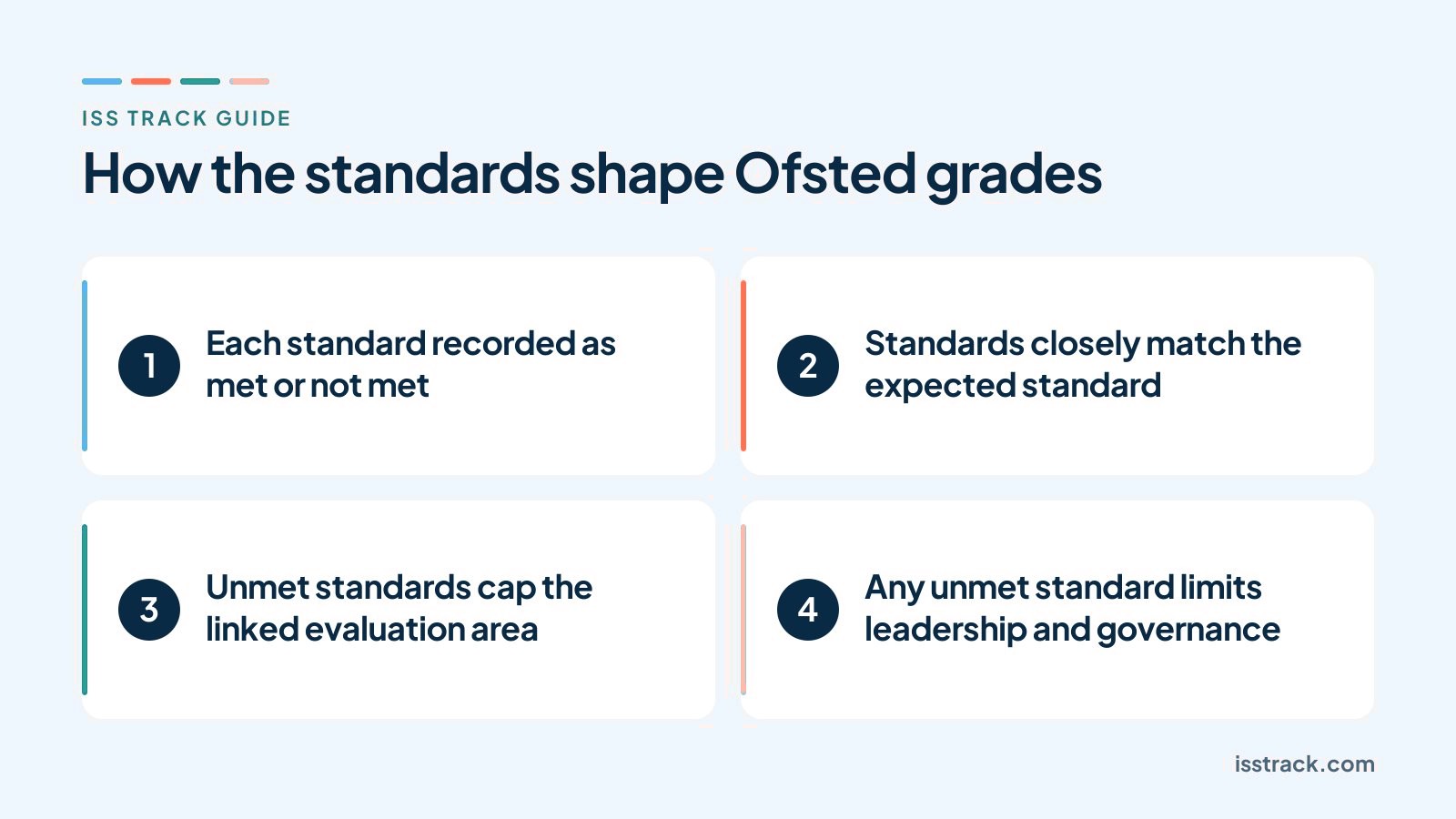
This is the most useful thing to understand. The standards closely match the “expected standard” in the toolkit. That means:
- If the standards linked to an evaluation area are not met, that area cannot be graded expected standard or above.
- If any standard is not met, leadership and governance cannot reach expected standard, because it is the proprietor’s job to make sure every standard is met.
- Leadership and governance is also where inspectors consider standards that other inspection activity does not naturally reach, such as premises, health and safety, provision of information and complaints.
In other words, the standards are the floor. Meeting them all is what makes the higher grades possible. Our guide to Part 8 and proprietor responsibilities explains why leadership and governance carries so much weight.
Common Misconception
“The standards are a separate tick list from the real inspection.” In Ofsted’s current approach, the two are closely joined. The compliance record and the graded evaluation areas inform each other. A precise detail missed in Part 6 or Part 7 can limit the leadership and governance grade, however strong the teaching is.
What is the compliance record in an Ofsted independent school inspection?
Alongside the graded evaluation areas, inspectors complete a compliance record. This records each relevant standard as met or not met.
From our experience, the compliance record is where small, easily fixed details matter most. A complaints procedure without a clear panel stage, a single central record without a completion date for one check, or a missing item of Part 6 information can each lead to a standard being recorded as not met. None of these says anything about how much a school cares for its pupils, but each one matters, because each standard protects something for children and families.
This is why so many schools find it helpful to work through an Independent School Standards checklist regularly, part by part, rather than relying on memory.
What do inspectors check on an independent school’s website before inspection?
Inspectors look at the school website before the inspection. They pay particular attention to the curriculum information, the safeguarding policy and the information required under Part 6 of the standards, such as contact details, the complaints procedure, behaviour and anti-bullying arrangements, and provision for pupils with EHC plans.
The website is often an inspector’s first impression of the school. We often see websites where practice in school is strong but the published information has drifted: an old safeguarding policy, a review date that has passed, a broken link, or a document still carrying wording from a template. Our guide to what an independent school must publish on its website has the full list, and a short termly check keeps it current.
Good Practice
Strong schools treat the website as part of their normal review cycle, not an inspection task. Someone owns it, published policies are checked against the current versions each term, and any change to a policy, such as the 2026 updates on restrictive interventions or mobile phones, is followed through to the published copy straight away.
How much notice does Ofsted give an independent school?
Very little. Ofsted contacts the school shortly before a standard inspection rather than weeks ahead, and an additional inspection can happen without notice when the DfE has concerns. The current operating guide sets out exactly how and when the school is told, so it is worth reading the latest version rather than relying on what happened last time.
Because the notice is short, the time to prepare is before the call comes. Our guide to preparing for an independent school inspection sets out what to keep in place all year and a calm plan for the first 48 hours after the call.
How long does an Ofsted inspection of an independent school take?
A standard inspection usually takes place over two or three days on site, depending on the size and complexity of the school, with the lead inspector speaking to leaders before it starts. Additional and progress monitoring inspections are often shorter, because they focus on particular standards. The operating guides give the detail for each type.
What happens during an Ofsted inspection of an independent school?
The operating guides describe the detail, and they change from time to time, so it is always worth reading the current versions. In broad terms, inspectors gather evidence through conversations with leaders, staff and pupils, visits to lessons, a look at records and documents, and discussion with the proprietor or those responsible for governance.
For the standards, inspectors want to see that each one is met in practice. A policy is the start, but they will look for the practice behind it: records that are complete, staff who can describe what they do, and pupils whose experience reflects what the school says. Our guide to Independent School Standards evidence explains the difference between evidence of policy and evidence of practice.
From Our Experience
Many leaders tell us they spent the days before inspection gathering documents that already existed somewhere. The schools that feel calmest are the ones that never had to gather anything, because their evidence was already current, organised and easy to find. Inspection then becomes a professional conversation about the school, rather than a search for paperwork.
What happens after an Ofsted inspection of an independent school?
At the end of the inspection, the lead inspector shares the provisional findings with leaders and the proprietor. The report follows once it has been through Ofsted’s quality assurance, and the DfE, as the registration authority, decides what happens next. Where every standard is met, the next step is to keep it that way.
Where any standard is not met, the DfE will usually ask the school for an action plan and a progress monitoring inspection may follow. Our guide to what happens if standards are not met explains each step calmly, and ISS Track turns each unmet standard into actions with an owner, a date and success criteria.
What other types of Ofsted inspection do independent schools have?
Alongside standard inspections, there are two other types that independent schools often meet.
What is an additional inspection of an independent school?
An additional inspection takes place outside the usual pattern of inspection. It is commonly linked to a request for a material change, such as a new age range, more pupils, different types of special educational needs, or new premises. It can also happen when the DfE has concerns about a school. Inspectors look at whether the school is likely to meet the relevant standards if the change goes ahead, or at the specific concern.
For schools planning to grow or change, it helps to check the standards most affected by the change, particularly premises, staffing and the curriculum, well before applying.
What is a progress monitoring inspection?
A progress monitoring inspection follows a finding that standards are not met. It checks whether the school has put right the unmet standards, usually through the action plan the DfE has asked for. Our guide to what happens if an independent school does not meet the standards explains this process calmly and in full.
An example: preparing for a material change
For example, a small independent special school for pupils aged 11 to 16 might decide to open a post-16 class. Because this changes the age range on its registration, the school needs the DfE’s approval before any older students start, and an additional inspection may follow the request.
Rather than waiting for that visit, the leadership team might work through the standards the change touches most, months before applying:
- Part 1: a written curriculum for the new age group that takes account of students’ EHC plans and includes careers guidance.
- Part 4: any new staff recruited and checked, with the single central record updated before they start.
- Part 5: the planned room, toilets and any changing facilities checked against the premises standards.
- Part 6: the website updated to describe the new provision accurately once it is approved.
Thinking this through early turns the additional inspection into a chance to show a well planned change. It also means the first post-16 students arrive to a provision that is ready for them, which is the real point of the exercise.
How can an independent school be ready for Ofsted without prepping for inspection?
The phrase “prepping for inspection” usually describes a burst of activity: updating policies, chasing evidence, fixing the website. It’s understandable, but it is tiring, it rarely shows the school at its best, and it means the picture only becomes accurate for a few weeks.
A better approach is to be a school that meets the standards all the time and knows it. In practice, that looks like:
- Every standard has an owner who knows what good looks like.
- An honest self-evaluation is kept current, with a rationale for each rating. See our guide to self-evaluating against the standards.
- Evidence is reviewed on a cycle, with evidence of practice as well as policies.
- Gaps become actions with a name, a date and a check that they worked.
- The website and policies are checked termly, including the 2026 changes covered in our guide to Independent School Standards changes in 2026.
- The proprietor sees the real picture, regularly and with evidence.
ISS Track was designed around exactly these habits, with 159 plain English requirements, an evidence library with review cycles, a website check against Part 6 and an optional inspection rehearsal. It holds the school’s own evaluation, and nothing is shared with any inspectorate.
How should an independent school prepare for an Ofsted inspection?
By being ready all year rather than preparing in a rush. Keep an honest, current self-evaluation of every standard, check the website and published policies each term, keep the single central record audited, and rehearse finding evidence so the team knows where everything is. When the call comes, follow a short plan rather than starting from scratch.
ISS Track’s inspection rehearsal and inspection call page were built for exactly this: five standards picked at random with a timer, and the first 48 hours turned into clear, tickable steps. You can watch the video walkthrough to see how it works, or download our free inspection preparation guide.
Questions for Leaders
- If an inspector looked at our website this afternoon, what would they find?
- Could we say, with evidence, whether every standard is met today?
- Which standards are most likely to be recorded as not met in our school, and why?
- Do our leaders understand how the compliance record connects to the leadership and governance grade?
- Is our evidence of practice as strong as our evidence of policy?
- If we planned a material change, which standards would we need to look at first?
Free download: Independent School Standards checklist
All 159 requirements in plain English, with space to record your rating, evidence and owner. A calm, practical way to see where you stand on every standard. Download the checklist (PDF)
Our Perspective
Inspection is never the destination. The strongest independent schools treat the standards as a description of a safe, well led school and keep them met all year because that is what their pupils deserve. When that is true, an Ofsted inspection becomes a chance to show the work already being done for children and young people. For the wider picture, return to our guide to the Independent School Standards.
Sources and further reading
- The Education (Independent School Standards) Regulations 2014
- Independent school inspection: toolkit, operating guide and information (Ofsted)
- Operating guide for standard inspections of non-association independent schools: for use from September 2026 (Ofsted)
- Operating guide for additional inspections of non-association independent schools: for use from September 2026 (Ofsted)
- Education and Skills Act 2008, section 114: Action plans
Look up the requirements, paragraph by paragraph
Continue exploring
- The single central record and Part 4, and the details inspectors check
- The independent school complaints procedure, short but very precise
- The policies an independent school needs, and how to keep them current
- Independent School Standards tracker: spreadsheet or software?
- Part 3: welfare, health and safety, including safeguarding and restrictive interventions
- Ofsted or ISI?: which inspectorate visits your school, and what stays the same
- The most commonly unmet standards: what the official data shows, and how to stay ahead of it
- Preparing for an independent school inspection: a calm, practical plan, including the first 48 hours
- How to review school policies so the published copies are current before inspectors read them
- Progress monitoring inspections: what Ofsted and ISI check against your action plan, and what happens next
- The Independent School Standards: a complete guide
- What happens if standards are not met?
- The 2026 changes to the standards
Elsewhere on ISS Track: see how the review calendar and inspection rehearsal helps with this, browse our free downloads, compare pricing, see ISS Track for groups or read every guide.
How can Jarvis Education help?
ISS Track is supported by Jarvis Education, an education consultancy led by a former HMI that supports independent schools, independent special schools and alternative provision. We help leaders and proprietors through independent reviews, ISS health checks, Quality Marks, CPD and leadership support.
If you would like an experienced, independent view of where your school stands on the standards, without the pressure of an inspection, an ISS health check gives leaders a clear, honest picture and a practical action plan. Our reviews are there to build confidence and strengthen practice, never to find fault. Get in touch and tell us a little about your school.
How can ISS Track help?
See how ISS Track helps you prepare calmly for the inspection call.
Rehearse finding evidence for standards picked at random, and follow a tickable plan for the first 48 hours with the inspection pack one click away.
Also useful:Watch the two minute tourView pricingBuy nowAll featuresFor groupsThe complete guide to the standards
ISS Track is supported by Jarvis Education
Support from Jarvis Education
Sometimes an experienced pair of eyes helps. These services and guides from the Jarvis Education team go further on this topic.