Independent school complaints procedure: what Part 7 requires


It’s understandable that complaints can feel difficult. Most leaders and staff care deeply about their pupils, so when a parent says something has gone wrong, it can feel personal. Many leaders tell us that a single, complex complaint can take up more time and emotional energy than almost anything else in a term.
From our experience, the schools that handle complaints well are not the ones that receive the fewest. They are the ones with a clear, fair procedure that everyone understands, and a culture that treats a complaint as information rather than an attack.
In short: Under Part 7 of the Independent School Standards, an independent school complaints procedure must be in writing and available to parents, set clear timescales, allow an informal stage, a formal written stage and a hearing before a panel of at least three people, one of them independent of the running of the school, and every formal complaint must be recorded.
This guide explains what Part 7 of the Independent School Standards requires, what a complaints procedure must include, and how to handle complaints in a way that strengthens relationships with families. Part 7 is one of the eight parts explained in our guide to what the Independent School Standards are.
Why does the complaints procedure matter?
A clear complaints procedure means parents’ concerns are heard fairly and in good time, which protects children, families, staff and the school.
For a parent, raising a complaint is often a last resort. They may have tried to resolve a worry informally and feel they have not been heard. For families of children with SEND, who may have had difficult experiences elsewhere, how the school responds can shape their trust for years.
A clear procedure protects everyone. Parents know their concern will be heard fairly and within a reasonable time. Staff know the process will be proper and balanced. The proprietor knows that problems are surfacing and being dealt with. Most importantly, children benefit when the adults around them resolve disagreements well.
What does Part 7 of the Independent School Standards require?
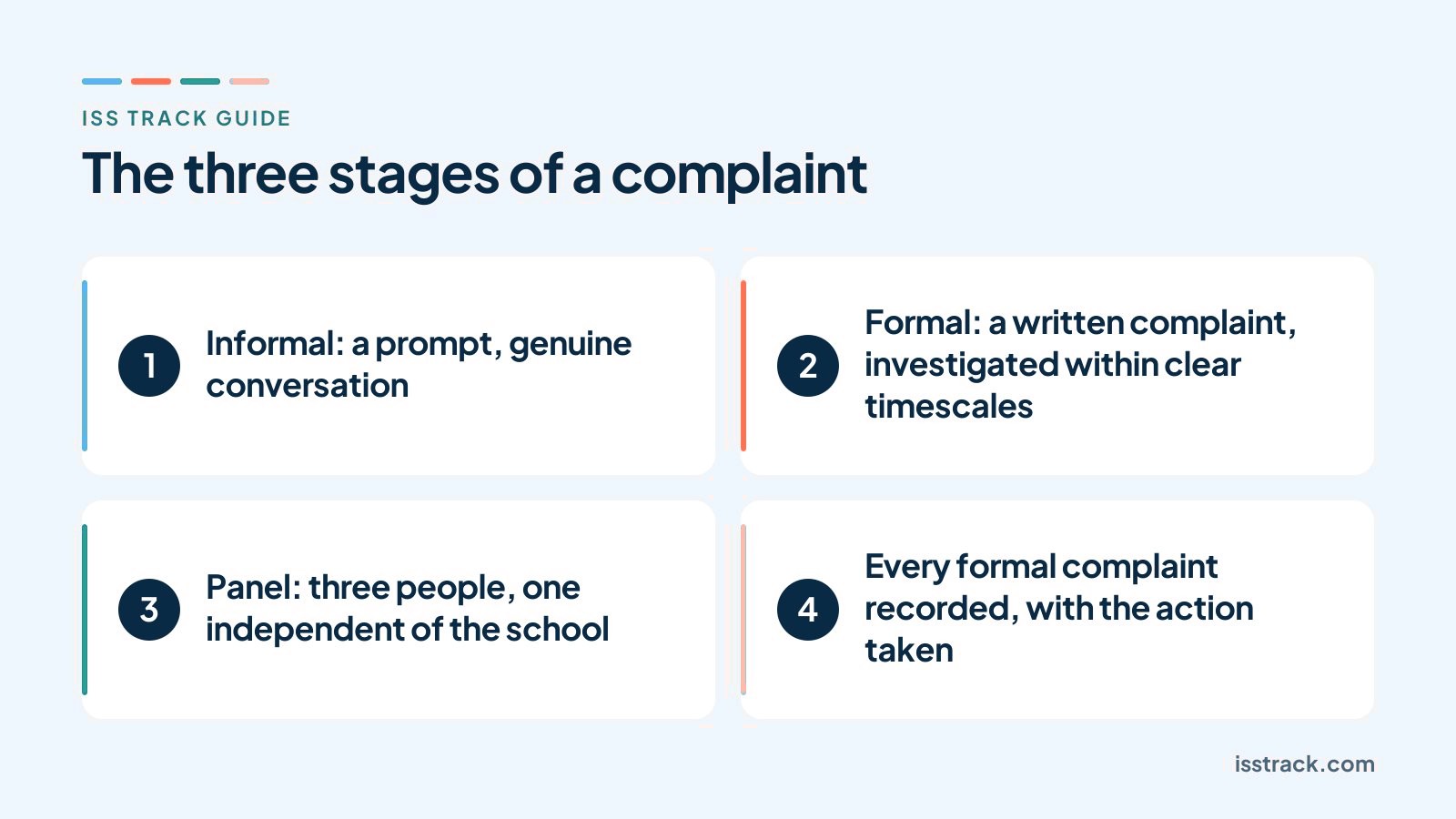
Part 7 requires a written complaints procedure, available to parents and followed in practice, with clear timescales, an informal stage, a formal written stage and a panel hearing that includes an independent member.
Part 7 is a single paragraph, paragraph 33, but it is very precise. It asks the proprietor to make sure a complaints procedure is drawn up and implemented effectively, and that the procedure meets each of the following elements.
| Element | What it means in practice |
|---|---|
| In writing | The procedure is a written document |
| Made available to parents | Parents of pupils can easily see and obtain it |
| Clear timescales | Each stage says how long it should take |
| Informal stage | A first stage where concerns can be resolved informally |
| Formal written stage | If not resolved, the complaint can be made in writing |
| Panel hearing | A hearing before a panel of at least three people not involved in the matter |
| Independent member | At least one panel member is independent of the management and running of the school |
| Parents may attend and be accompanied | Parents can attend the panel and bring someone with them |
| Findings and recommendations | Shared with the complainant and, where relevant, the person complained about |
| Written record | Formal complaints recorded, with the stage resolved and the action taken |
| Confidentiality | Correspondence and records kept confidential, except where the Secretary of State, or a body inspecting the school under section 109 of the Education and Skills Act 2008, requests access |
Every element matters. A procedure that covers ten of them but leaves out one, such as the right to be accompanied, does not meet the standard.
What must an independent school complaints procedure include?
It must include every element Part 7 lists, in plain language a parent can follow without help, with clear roles at each stage and timescales the school can realistically keep.
Beyond the list above, a good procedure is one that a parent can read and follow without help. That means plain language, clear names or roles at each stage, and realistic timescales the school can actually keep.
Clear timescales
The standards ask for clear timescales but do not set them. It is for the school to decide what is reasonable, and then to keep to it. One of the most common challenges is a procedure that sets very short timescales which the school cannot meet in practice, especially in holidays. It is better to set realistic timescales, explain how school holidays are handled, and keep the complainant informed if anything changes.
The informal stage
Most concerns are resolved here, often through a conversation with a class teacher, key worker or senior leader. The procedure should explain who to approach and how. Recording informal concerns is not required by Part 7, but many schools find it helpful for spotting patterns early.
The formal written stage
If the concern is not resolved informally, the parent can put it in writing. The procedure should say who to write to, how the complaint will be investigated, and how and when the parent will hear the outcome. Where the complaint is about the headteacher, it should explain who will deal with it instead.
From Our Experience
We often see complaints procedures that are well written but adapted from another school or a group template, with job titles, committees or contact details that no longer match. Many leaders only notice when a complaint reaches the formal stage and the procedure does not quite fit the school. Reading it through once a year, as a parent would, catches most of these issues before they matter.
Who must sit on an independent school complaints panel?
At least three people who were not directly involved in the matters complained about, and at least one of them must be independent of the management and running of the school.
The panel hearing is the final stage of the procedure. It must have at least three people who were not directly involved in the matters the complaint is about. At least one of them must be independent of the management and running of the school.
That independent member is there to give the parent confidence that the hearing is genuinely fair. They should not be a member of staff, a member of the proprietor body, or anyone otherwise involved in running the school. In a small school or a group of schools, finding someone truly independent can take thought. Some schools build a small pool of suitable people in advance, so a panel can be convened without delay. Others ask an outside organisation to provide an independent investigator or panel member when needed.
The panel should be properly prepared. Members need the papers in good time, a clear understanding of their role, and a chair who can run the hearing calmly and fairly.
Can parents bring someone to a complaints panel hearing?
Yes. Parents must be allowed to attend the panel hearing and to be accompanied if they wish. The procedure should say so clearly, and so should the letter inviting the parent to the hearing.
For many parents, especially those who find formal meetings daunting, being able to bring a friend, relative or advocate makes it possible to take part fully. Explaining this warmly, rather than as a technicality, helps the hearing start on the right footing.
What happens after the panel hearing?
The panel makes findings and, where appropriate, recommendations. These must be provided to the complainant and, where relevant, to the person complained about. It is good practice to set out in the procedure when this will happen and in what form, and for the proprietor to make sure recommendations are acted on.
Good Practice
Strong schools keep their complaints procedure short, plain and specific to the school. They set timescales they can meet, know in advance who could act as an independent panel member, brief panel members well, and write findings that are clear, respectful and focused on putting things right. The proprietor sees a regular summary of complaints and what changed as a result.
Do independent schools have to keep a record of complaints?
Yes. The school must keep a written record of all complaints made under the formal stage of the procedure. The record must show whether each complaint was resolved at the formal stage or proceeded to a panel hearing, and the action taken by the school as a result, whether or not the complaint was upheld.
Correspondence, statements and records relating to individual complaints must be kept confidential, except where the Secretary of State, or a body inspecting the school under section 109 of the Education and Skills Act 2008, requests access.
Does the school have to publish the number of complaints?
Yes. Under Part 6, the school must make available details of the complaints procedure and the number of complaints registered under the formal procedure during the preceding school year. If there were none, it is good practice to say so. Our guide to what an independent school must publish on its website explains how this fits with the rest of Part 6.
A good record makes this simple. It also lets leaders and the proprietor see patterns over time, which is where the real value lies.
Common Misconception
“Publishing our number of complaints will make us look bad.” Parents and inspectors understand that every school receives complaints. A clear figure, handled through a fair procedure with a written record of what changed, shows a school that listens. A missing figure, or a procedure that is hard to find, raises far more questions than an honest number.
How do data protection complaints fit with the school complaints procedure?
From June 2026, organisations must facilitate complaints about the way they use personal information. In practice, that means providing a clear way for people to complain (for example, an electronic form), acknowledging the complaint within 30 days, investigating it, and telling the person the outcome without undue delay.
The DfE’s April 2026 guidance on the standards explains that this can sit alongside the parental complaints procedure required by Part 7, but it must not get in the way of it. A parent whose concern involves data, such as a disclosure or a records request, must still be able to use the Part 7 procedure.
Many schools add a short section to their complaints procedure explaining how data protection complaints are handled, and link it to their data protection policy and privacy notices. Our guide to the 2026 changes to the standards covers this alongside the other updates.
How can schools handle complaints well?
Listen early, keep to the timescales, support staff through the process and write outcome letters that are clear and kind.
Part 7 sets the floor. Handling complaints well goes further, and it is where relationships with families are strengthened or strained.
Schools that handle complaints well usually:
- Listen early. Most complaints start as a worry. A prompt, genuine conversation often resolves it before it becomes formal.
- Separate the person from the problem. Staff are supported through the process, and the focus stays on what happened and what would help the child.
- Keep to the timescales. And tell the parent promptly if something changes.
- Write clearly and kindly. Outcome letters explain what was found, what will change and what the parent can do next.
- Learn from patterns. Leaders and the proprietor look at complaints over time and ask what they say about the school.
This last point is the heart of it. A complaints record is one of the most honest sources of insight a school has. When complaints shape improvements to communication, transition, SEND provision or behaviour support, children benefit directly. Our guide to self-evaluating against the standards shows how this kind of insight can feed into the bigger picture.
Example: a complaint that arrives at the end of term
For example, a small independent special school might receive a written complaint in the last week of the summer term. A parent is unhappy with how their child’s move to a new class was planned, and an informal conversation has not resolved it.
The headteacher acknowledges the letter within the timescale in the procedure and explains, as the procedure already sets out, how the summer holiday affects the next steps. The parent is told who will investigate and when, and the investigation begins in the first week of the new term.
It finds that the transition plan itself was sound, but it was not shared with the family in time. The outcome letter says so plainly and explains what will change. The parent remains unhappy and asks for a panel hearing. Because the school already knows who it could approach as an independent member, the panel meets within the published timescale, and the parent brings a friend for support.
The panel partly upholds the complaint and recommends sharing transition plans with families earlier. The proprietor makes sure that happens, the written record shows the stage reached and the action taken, and the following year every family sees their child’s plan before the summer break. One complaint, handled well, improves transition for every pupil.
How does Part 7 connect to leadership and management?
A complaints procedure that is not followed suggests leadership systems are not secure, so a gap in Part 7 usually affects how Part 8 is judged too.
Part 8 asks leaders to fulfil their responsibilities so that the standards are met consistently. A complaints procedure that exists on paper but is not followed, or a panel that cannot be convened, suggests the systems around it are not secure. Our guide to proprietor responsibilities under Part 8 explains why.
Leaders also sometimes ask about evidence for Part 7. The procedure itself, the written record, panel papers and outcome letters, and the proprietor’s minutes showing oversight together tell a clear story. Our guide to Independent School Standards evidence has more on this, and the Independent School Standards checklist breaks Part 7 into each of its separate requirements.
Questions for Leaders
- Does our complaints procedure include every element paragraph 33 requires, including the right to be accompanied?
- Are our timescales realistic, including during school holidays?
- If a complaint reached a panel next week, who would be our independent member?
- Does our written record show the stage each formal complaint reached and the action taken?
- Have we published the number of formal complaints for last year?
- Have we set out how data protection complaints are handled, without getting in the way of Part 7?
Free download: Independent School Standards checklist
Every requirement in all eight parts in plain English, including each element of the Part 7 complaints procedure, with space for your rating, evidence and owner. Download the checklist (PDF)
Our Perspective
A complaint is a parent telling you something matters to them and their child. When the procedure is clear, fair and genuinely followed, families feel heard even when they do not get the outcome they hoped for, and the school learns something it may not otherwise have seen. That is what Part 7, and the Independent School Standards as a whole, are really asking for: a school that listens, and improves for its children and young people.
Sources and further reading
- Education (Independent School Standards) Regulations 2014, Schedule, Part 7: Manner in which complaints are handled
- Education (Independent School Standards) Regulations 2014, Schedule, Part 6: Provision of information
- How to deal with data protection complaints (Information Commissioner’s Office)
- Regulating independent schools: Independent school standards guidance (DfE, updated 2 April 2026)
Look up the requirements, paragraph by paragraph
Continue exploring
- What policies does an independent school need?, grouped clearly
- What must an independent school publish on its website?, including the complaints figure
- The single central record and Part 4, another part where precise detail matters
- How Ofsted inspects independent schools against the standards
- Independent School Standards tracker: keeping every part current all year
- Information for local authorities: the annual account and annual review information Part 6 asks for
- The most commonly unmet standards: what the official data shows, and how to stay ahead of it
- The Independent School Standards: a complete guide
- Part 1: Quality of education
- Part 1: EHC plans in independent special schools
- Part 2: SMSC and British values
- Part 3: Welfare, health and safety
- Part 3: KCSIE in independent schools
- Part 3: Restrictive interventions (16A and 32A)
- Part 5: Premises and accommodation
- The accessibility plan
- Part 8: Leadership and proprietors
Elsewhere on ISS Track: see how the policy register and website review helps with this, browse our free downloads, compare pricing, see ISS Track for groups or read every guide.
How can Jarvis Education help?
ISS Track is supported by Jarvis Education, an education consultancy led by a former HMI that supports independent schools, independent special schools and alternative provision. We can review your complaints procedure against Part 7, and where a school needs it, provide an independent complaint investigator or an independent panel member, so families can be confident the process is fair.
Our work is there to build confidence and strengthen relationships with families, never to find fault. Get in touch and tell us a little about your school.
How can ISS Track help?
See how ISS Track keeps your complaints procedure and records in order.
Your procedure is read and checked for the Part 7 essentials, compared with your website, and kept on a review cycle.
Also useful:Watch the two minute tourView pricingBuy nowAll featuresFor groupsThe complete guide to the standards
ISS Track is supported by Jarvis Education
Support from Jarvis Education
Sometimes an experienced pair of eyes helps. These services and guides from the Jarvis Education team go further on this topic.