Part 3 of the Independent School Standards: welfare, health and safety explained


Part 3, welfare, health and safety, is the largest part of the Independent School Standards, and the one closest to every child’s day. It’s understandable that leaders can feel stretched by it. It asks about safeguarding and fire doors, sanctions and first aid, registers and restraint, often held by a small team who are also teaching, meeting families and responding to whatever the day brings.
From our experience, schools rarely fall short on Part 3 because staff do not care. They fall short because small things drift: a register code, a sanctions record, a risk assessment that was right last year.
In short: Part 3 of the Independent School Standards covers welfare, health and safety. It includes safeguarding, behaviour and anti-bullying, health and safety, fire safety, first aid, supervision, the admission and attendance registers, risk assessment and, since April 2026, the use of restrictive interventions under paragraph 16A.
This guide takes paragraphs 7 to 16A in turn, briefly and practically. For an overview of all eight parts, start with our complete guide to the Independent School Standards.
What does Part 3 of the Independent School Standards cover?
Part 3 covers safeguarding, boarding welfare, behaviour, anti-bullying, health and safety, fire safety, first aid, supervision, admission and attendance registers, risk assessment and, from April 2026, recording restrictive interventions.
| Paragraph | What it covers |
|---|---|
| 7 | Safeguarding |
| 8 | Boarding and residential welfare |
| 9 | Behaviour policy, sanctions and serious sanctions record |
| 10 | Anti-bullying strategy |
| 11 | Health and safety |
| 12 | Fire safety |
| 13 | First aid |
| 14 | Supervision |
| 15 | Admission and attendance registers |
| 16 | Risk assessment |
| 16A | Recording use of force, seclusion and restraint |
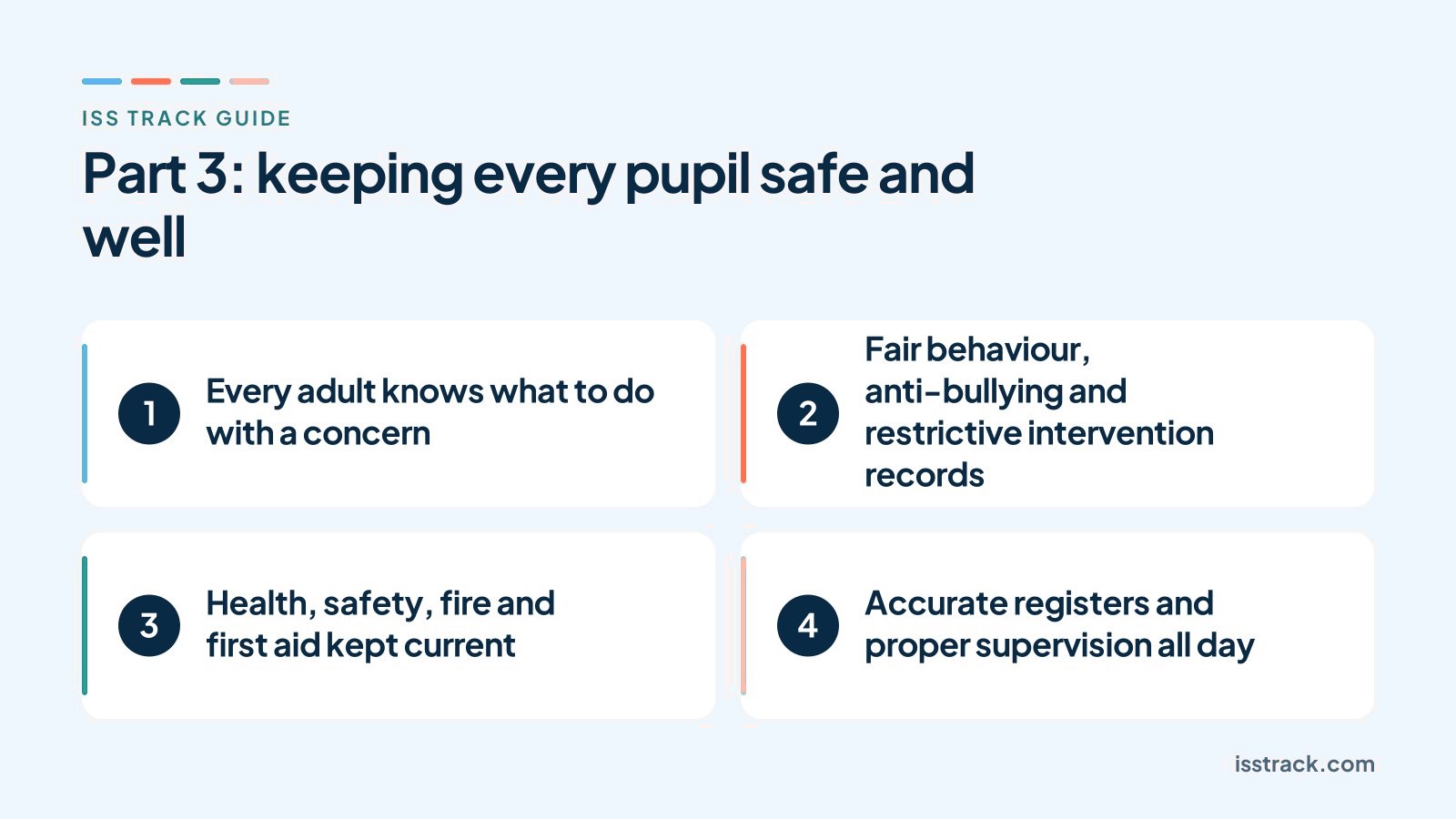
Part 3 exists so that every pupil is safe, well and cared for while they learn. For many pupils in special schools and AP, feeling safe is the condition for everything else. Safeguarding is also judged separately at Ofsted inspection, as met or not met.
What does standard 7 require for safeguarding?
Standard 7 asks the proprietor to make and carry out arrangements that safeguard and promote pupils’ welfare, having regard to the current edition of Keeping Children Safe in Education (KCSIE). That guidance is long, but in practice the standard rests on a few things working together:
- a school specific safeguarding policy, reviewed and approved by the proprietor, reflecting the current KCSIE and your local safeguarding partners’ procedures, and published on the website
- a designated safeguarding lead (DSL) with the time, training and authority to do the role, plus deputies
- staff who are trained and know what to do, including about child-on-child abuse, online safety and the additional vulnerability of pupils with SEND
- careful records of concerns, referrals and follow up
- clear arrangements for allegations against staff and low-level concerns
- filtering and monitoring that is reviewed and understood
- attention to children absent from education and pupils in off-site or alternative provision
- a culture where pupils feel safe, are listened to and know who to tell
Safeguarding also depends on safer recruitment, which sits in Part 4. Our guide to the single central record and Part 4 covers the checks.
From Our Experience
The strongest safeguarding cultures we see are not the ones with the thickest policies. They are the ones where any member of staff, asked about a pupil who worries them, knows exactly what they would do and who they would tell, and where the DSL can show how concerns were followed through. Many leaders tell us that regular, short case discussions with staff did more for their culture than any single training session.
Does paragraph 8 apply to every school?
No. Paragraph 8 applies only where a school provides boarding or residential accommodation. It asks the school to safeguard and promote boarders’ welfare with regard to the relevant National Minimum Standards. For a day school, record it as not applicable.
What must be in an independent school behaviour policy?
Paragraph 9 asks for a written behaviour policy that sets out the sanctions to be used, is implemented effectively, and is supported by a record of the sanctions imposed for serious misbehaviour.
For special schools, the policy should reflect how behaviour is understood as communication, with reasonable adjustments, individual behaviour support plans and a clear approach to suspensions and exclusions. Implemented effectively means staff apply it consistently and pupils experience it as fair.
The record of serious sanctions is one of the most commonly overlooked details. It should show what happened, the sanction and the date, and leaders should look at it for patterns. One of the most common challenges is that serious incidents are recorded in several systems but never brought together.
What do the standards expect about mobile phones?
The DfE’s April 2026 guidance on the standards expects schools to be mobile phone-free environments by default, considered through behaviour, safeguarding and wellbeing. Expectations should cover the whole school day: lessons, transitions, breaks and lunch. Your behaviour policy should say how this works and how any exceptions, for example for medical needs, are managed. Our summary of the Independent School Standards changes in 2026 explains this alongside the other updates.
What does paragraph 10 require for anti-bullying?
Paragraph 10 asks for an effective anti-bullying strategy, drawn up and implemented. Effective is the key word. A good strategy covers prevention, cyber-bullying and prejudice-based bullying, records incidents, and uses the records to spot patterns and respond. It connects closely to respect for people with protected characteristics in Part 2 and SMSC.
What do paragraphs 11 and 12 require for health and safety and fire?
Paragraph 11 asks for a written health and safety policy that is implemented effectively. That usually means clear responsibilities, arrangements for contractors, hazardous substances, legionella and asbestos where relevant, off-site activity, and accident reporting.
Paragraph 12 asks the school to comply with the Regulatory Reform (Fire Safety) Order 2005. In practice: a current fire risk assessment by a competent person, with actions completed; regular drills; alarm and emergency lighting tests; and personal emergency evacuation plans for pupils who need them.
These overlap closely with the condition of the building in Part 5: premises and accommodation. A fire door wedged open is both a Part 3 and a Part 5 concern.
What does paragraph 13 require for first aid?
Paragraph 13 asks for a written first aid policy, implemented effectively. That means enough trained first aiders (including paediatric first aid where you have younger pupils), cover for off-site activities, a record of treatment and a clear approach to informing parents.
In special schools, first aid sits alongside supporting pupils with medical conditions: individual healthcare plans, safe storage and administration of medicines, and staff trained in rescue medication or specialist procedures. The first aid policy must also be available to parents, and our guide to what an independent school must publish on its website explains where it goes.
What does paragraph 14 mean by proper supervision?
Paragraph 14 asks that pupils are properly supervised through the appropriate deployment of staff. The times to think about are often the unstructured ones: arrival and departure, breaks, lunch, transitions between rooms, and off-site visits. For pupils who need close support, deployment should reflect their individual risk assessments.
What are the admission and attendance register requirements for independent schools?
Paragraph 15 asks schools to keep an admission register and an attendance register in line with the pupil registration regulations. In practice that means:
- registers are accurate and kept on time, with the correct codes
- the local authority is notified when pupils join or leave in the circumstances the regulations set out
- attendance is managed in line with the DfE’s Working Together to Improve School Attendance guidance, with early support where attendance falls
The April 2026 guidance highlights the safeguarding side of persistent or unexplained absence. A pupil who is not in school is less visible, which is why part-time timetables should be short term, agreed and recorded accurately. Our guide to Part 1 and the quality of education explains why the standards expect full-time education.
Common Misconception
“Attendance is an admin task.” Registers are a legal record, and absence is often the first sign that something is wrong for a child. Schools that recover well usually bring the attendance lead and the DSL together regularly, so patterns are noticed and acted on early.
Does an independent school need a risk assessment policy?
Yes. Paragraph 16 asks for a written risk assessment policy, implemented effectively, and for appropriate action to reduce any risks identified. The policy should cover the site, activities, educational visits and, for many pupils in special schools, individual risk assessments.
The second half matters most. A risk assessment that identifies a risk but does not lead to action, or is never revisited, does not meet the standard. Review dates and a named owner make the difference.
What is paragraph 16A of the Independent School Standards?
Paragraph 16A, in force from 1 April 2026, requires a procedure for recording every significant use of force and a separate procedure for recording seclusion, restraint and immobilisation, with records made in writing as soon as practicable.
Paragraph 16A came into force on 1 April 2026. It asks every school to have:
- a procedure for recording every significant use of force incident
- a separate procedure for recording seclusion, restraint or immobilisation incidents
- reasonable steps to make sure both procedures are followed
Records must be made in writing as soon as practicable. Staff includes supply staff and volunteers. Alongside it, paragraph 32A asks schools to tell each parent about each incident as soon as practicable, with limited exceptions where telling a parent would be likely to result in significant harm to the pupil.
From our experience, the schools handling this well see it as more than recording. They debrief after incidents, look at patterns, and use what they learn to reduce the need for restrictive interventions over time.
Good Practice
Strong schools treat restrictive interventions as exceptional. Every incident is recorded promptly, parents are told, the pupil is supported afterwards, and leaders review the records regularly with the proprietor, asking what could prevent the next one. Training, policy and practice all point in the same direction: fewer incidents and safer, calmer pupils.
How can we keep Part 3 current all year?
Give each paragraph an owner, review it on a regular rhythm and keep evidence of practice as well as policies, because Part 3 changes more often than any other part.
Part 3 changes more often than any other part. KCSIE is updated, staff leave, risk assessments age, and registers need daily care. That is why it suits a regular review rhythm, with owners for each paragraph and evidence of practice, not just policies. Our guide to Independent School Standards evidence explains what good evidence looks like, and our list of the policies an independent school needs covers each Part 3 policy.
ISS Track breaks Part 3 into separate, checkable requirements, so the DSL, business manager and senior leaders can each rate the paragraphs they lead, and its policy register checks which edition of KCSIE each policy follows.
Questions for Leaders
- Could every member of staff tell us what they would do with a safeguarding concern today?
- When did we last look at our record of serious sanctions for patterns?
- Are our mobile phone expectations clear across the whole school day?
- Is our fire risk assessment current, and have its actions been completed?
- Do the attendance lead and DSL look at absence together?
- Are we recording every significant use of force, seclusion and restraint, and learning from the records?
Free download: Independent School Standards checklist
Every requirement in all eight parts, including each paragraph of Part 3, in plain English with space to record your rating, evidence and owner. Download the checklist (PDF)
Our Perspective
Part 3 is where the standards come closest to each child’s experience of school: feeling safe, being cared for when they are unwell, being treated fairly when things go wrong. When leaders keep these arrangements current and honest, pupils are safer and staff are more confident. That is the purpose behind every part of the Independent School Standards.
A termly 30-minute look at your incident records
Part 3 produces several records that are most useful when read together, yet many schools keep them in different places, so patterns stay hidden. A short termly routine, ideally with the headteacher, the DSL and whoever leads on behaviour around one table, might look like this:
- Gather the records (5 minutes). The record of serious sanctions, the bullying log, the use of force and restrictive intervention records, and attendance for the term.
- Look for names that appear more than once (10 minutes). A pupil who appears in two or three records may be telling you something no single record shows.
- Look for times and places (5 minutes). Do incidents cluster at transitions, at lunch, on a particular day or in a particular room? That often points to supervision or routine rather than the pupil.
- Check the follow up (5 minutes). Were parents told about each restrictive intervention? Did each pupil have a chance to talk it through afterwards?
- Agree two or three actions (5 minutes). Give each one a name and a date, and send the proprietor a short note of what you found.
The aim is not another report. It is a clearer understanding of what pupils’ behaviour is telling you, so that incidents reduce over time and pupils feel safer.
Sources and further reading
- Education (Independent School Standards) Regulations 2014, Schedule, Part 3: Welfare, health and safety of pupils
- Keeping children safe in education 2026 (DfE)
- Regulating independent schools: Independent school standards guidance (DfE, updated 2 April 2026)
- The Regulatory Reform (Fire Safety) Order 2005
- The School Attendance (Pupil Registration) (England) Regulations 2024
- Working together to improve school attendance (DfE)
- The Schools (Recording and Reporting of Seclusion and Restraint) (No. 2) (England) Regulations 2025
- Use of reasonable force in schools, including Restrictive interventions, including the use of reasonable force, in schools (DfE, from 1 April 2026)
- Boarding schools: national minimum standards (DfE)
- Residential special schools: national minimum standards (DfE)
- Operating guide for standard inspections of non-association independent schools, for use from September 2026 (Ofsted)
Look up the requirements, paragraph by paragraph
Continue exploring
- Part 5: premises and accommodation, where health and safety meets the building
- The 2026 changes to the standards, including 16A and 32A
- Part 8 and proprietor responsibilities for welfare and safety
- What happens if a school does not meet the standards, and how schools recover well
- An Independent School Standards tracker to keep Part 3 current all year
- Restrictive interventions in independent schools: recording restraint and seclusion, and telling parents (paragraphs 16A and 32A)
- KCSIE in independent schools: how Keeping children safe in education connects to the standards
- The most commonly unmet standards: what the official data shows, and how to stay ahead of it
- The Independent School Standards: a complete guide
- Part 1: Quality of education
- Part 1: EHC plans in independent special schools
- Part 2: SMSC and British values
- Part 4: The single central record (SCR)
- Part 6: What to publish on your website
- Part 6: Information for local authorities
- The accessibility plan
- Part 7: The complaints procedure
Elsewhere on ISS Track: see how the standards tracker helps with this, browse our free downloads, compare pricing, see ISS Track for groups or read every guide.
How can Jarvis Education help?
ISS Track is supported by Jarvis Education, an education consultancy led by a former HMI that supports independent schools, independent special schools and alternative provision. Our consultants include experienced safeguarding and SEND leaders who understand the realities of keeping pupils with complex needs safe.
If you would like an independent view of safeguarding, behaviour, attendance or restrictive interventions, through a focused review, a full ISS health check, CPD or leadership support, we would be glad to help. Our reviews are designed to build confidence, never to find fault. Get in touch and tell us about your school.
How can ISS Track help?
See how area leads rate the parts they look after.
Your DSL, site manager and other area leads rate their own requirements, with review dates that keep policies and logs current.
Also useful:Watch the two minute tourView pricingBuy nowAll featuresFor groupsThe complete guide to the standards
ISS Track is supported by Jarvis Education
Support from Jarvis Education
Sometimes an experienced pair of eyes helps. These services and guides from the Jarvis Education team go further on this topic.