Which Independent School Standards are most commonly not met?


Many leaders tell us they would love to know where other schools tend to fall short, so they can check their own school before anything becomes a problem. It’s an understandable question. When you are running a busy school, with pupils who need a great deal from you every day, it helps to know where to look first.
The good news is that there is official data on this. Ofsted and the Independent Schools Inspectorate (ISI) both publish figures on how often the Independent School Standards are not met, and which parts come up most. This guide sets out what that data actually says, explains why those areas slip, and gives you a quick, practical check for each one.
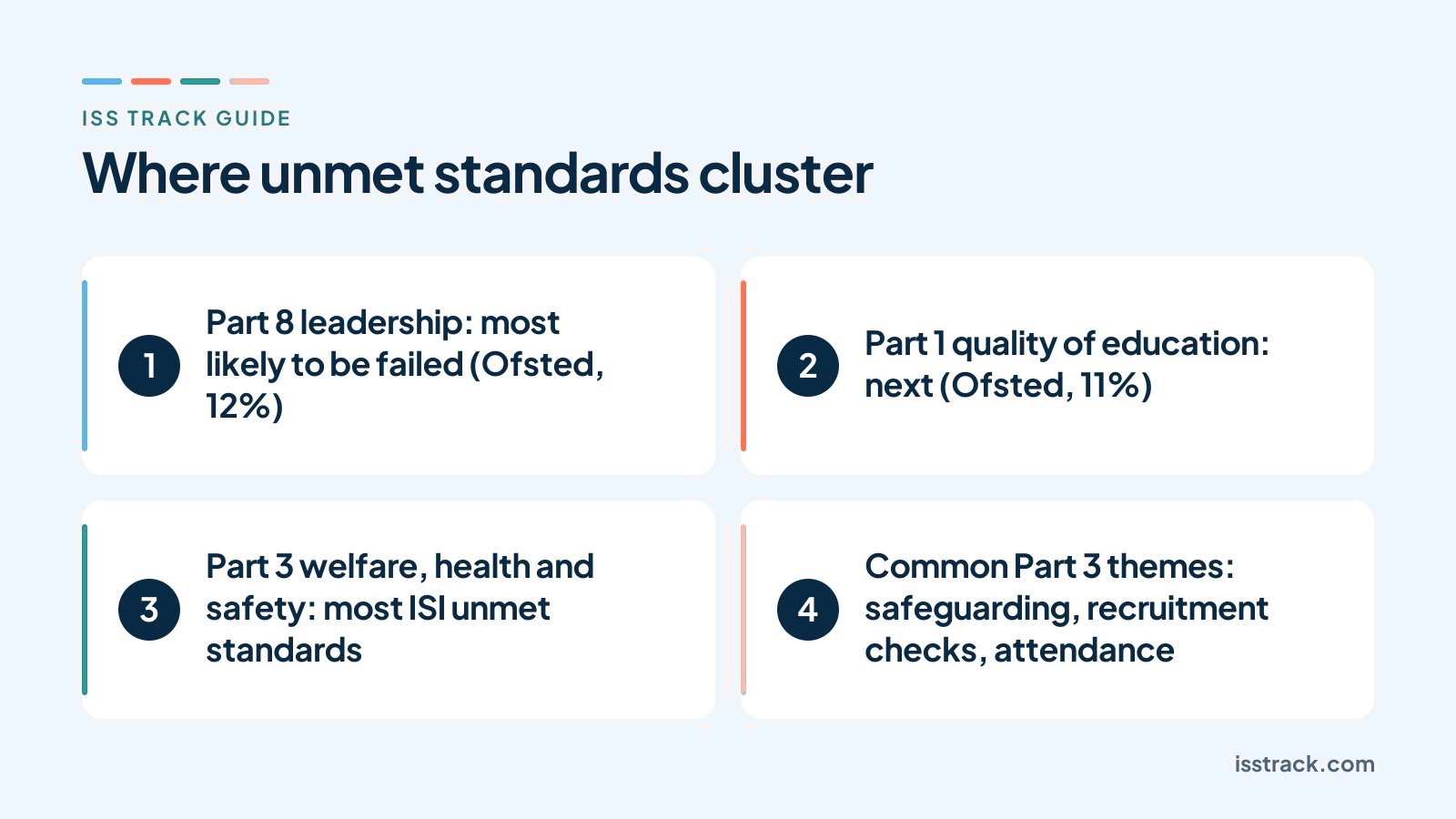
In short: The most commonly unmet Independent School Standards, according to Ofsted’s official statistics, are Part 8 (leadership and management) and Part 1 (quality of education). ISI reports that most unmet standards in its 2024-25 inspections related to Part 3 (welfare, health and safety), especially safeguarding, recruitment checks and attendance.
If you would like a refresher on the eight parts first, our guide to the Independent School Standards explains each one in plain English.
Which Independent School Standards are most commonly not met?
Part 8, leadership and management, is the most commonly unmet part, followed by Part 1, the quality of education, according to Ofsted’s latest official statistics for non-association independent schools.
Ofsted inspects non-association independent schools, which includes most independent special schools. Each November it publishes official statistics on those inspections. The latest release, Non-association independent schools inspections and outcomes in England: August 2025, covers inspections from 1 September 2024 to 31 August 2025. It reports that:
- At their most recent inspection, 12% of non-association independent schools did not meet all the standards, a slight improvement from 13% a year earlier.
- The Part 8 standards (leadership and management) are the most likely to be failed, at 12%.
- The Part 1 standards (quality of education) come next, at 11%.
- Part 7 (complaints) was met by all independent special schools and other independent schools, and by 98% of faith schools.
The previous year’s release, as at 31 August 2024, showed the same order and added a third: Part 8 at 13%, Part 1 at 11% and Part 3 (welfare, health and safety) at 6%.
ISI inspects association independent schools. Its annual review of inspections 2024-25 reports that 84.4% of schools met all of the standards, and that the majority of unmet standards related to the welfare, health and safety of pupils, which is Part 3.
One honest caveat. Ofsted’s published findings report compliance by part, not by individual paragraph. Its data files do record each standard as met or not met for each inspection, but Ofsted does not publish a ranked list of the most commonly unmet paragraphs. So if you see a confident “top ten” of individual standards, it is worth asking where it came from.
Why is Part 8 the most commonly failed standard?
Because if any standard in Parts 1 to 7 is not met, Part 8 is normally not met either, as it is the proprietor’s job to make sure every standard is met consistently.
Part 8 asks whether the proprietor makes sure that leaders have the skills and knowledge for their roles, fulfil their responsibilities effectively so that the standards are met consistently, and actively promote pupils’ wellbeing. Ofsted explains that if a school fails any standard in Parts 1 to 7, it will normally not meet Part 8 as well.
That is why Part 8 sits at the top of the list. It is rarely where the problem starts, but it is where the problem is owned. A gap in fire risk assessment or in recruitment checks is, in the end, a question about oversight: who knew, who checked, and why it was not picked up sooner.
Our guide to proprietor responsibilities looks at what good oversight looks like in practice.
Common Misconception
“If Part 8 is the most failed, we should focus on leadership paperwork.” Not quite. Because Part 8 usually follows a gap elsewhere, the most useful work is making sure leaders and the proprietor genuinely know whether every other standard is met, with evidence. Strong oversight of Parts 1 to 7 is what protects Part 8.
Are independent special schools more likely to meet the standards?
Ofsted’s figures show that independent special schools are generally more likely to meet the standards than independent faith schools and other independent schools. At their most recent inspection, as at 31 August 2025, the Part 1 standards were met by 95% of independent special schools inspected, compared with 87% of other independent schools and 74% of independent faith schools. The Part 8 standards were met by 94% of independent special schools, compared with 85% and 73%.
That is encouraging for the sector, and it reflects the care and commitment we see in so many special schools. It is not a reason to relax. A national percentage tells you nothing about your own school, and the areas that do slip in special settings, such as safeguarding records, risk assessment and recording, can matter enormously for pupils who are often among the most vulnerable.
What are the most common weaknesses in Part 3?
Safeguarding arrangements that do not follow statutory guidance, safer recruitment checks not completed or recorded properly, attendance, and fire and health and safety work not carried out rigorously enough.
ISI’s 2024-25 review gives the clearest official picture of what sits underneath unmet Part 3 standards. It points to:
- safeguarding arrangements that did not follow relevant statutory guidance;
- leaders not always making sure the designated safeguarding lead has the status and authority to fulfil the role;
- a limited understanding of the requirements for safer recruitment checks, and checks not always completed or recorded accurately and in good time;
- leaders not having due regard to statutory guidance on managing and improving attendance;
- fire assessments that needed to be more rigorous, and health and safety works not always carried out in a timely way.
ISI also notes that policies were sometimes not made available to parents as required, which links to Part 6. These findings come from association schools, but from our experience the same themes are just as relevant in non-association and independent special schools. Our guides to Part 3: welfare, health and safety, KCSIE in independent schools and the single central record go into each area in more depth.
Why do these standards slip, and how can you check them?
They usually slip because oversight relies on reassurance rather than evidence, and each can be checked quickly by looking at the evidence behind it, as the table below shows.
The table below brings the official findings together with what we see in practice. The “why it slips” column is our experience, not official data. The quick check is something a leader or proprietor can do this week.
| Area | Official source | Why it often slips | Quick check |
|---|---|---|---|
| Part 8: leadership and proprietor oversight | Ofsted: most likely part to be failed | Oversight relies on reassurance rather than evidence | Can the proprietor show, with evidence, that every part was checked this term? |
| Part 1: quality of education | Ofsted: second most likely part to be failed | Curriculum on paper does not match what pupils actually receive | Pick three pupils. Does their timetable and work reflect the written curriculum and their plans? |
| Part 3: safeguarding | ISI: majority of unmet standards were in Part 3 | Policy is updated but practice and DSL capacity are not | Does the DSL have the time, status and authority the role needs, and do staff know how to raise a concern? |
| Recruitment checks | ISI: limited understanding of checks; checks late or poorly recorded | Pressure to fill posts quickly; knowledge sits with one person | Sample five recent starters. Was every check completed and dated before they started? |
| Attendance | ISI: not having due regard to attendance guidance | Registers kept, but patterns not analysed or acted on | Who reviews attendance patterns, how often, and what changed as a result? |
| Health, safety and fire | ISI: fire assessments needed to be more rigorous; works not timely | Actions from assessments are not tracked to completion | Are the actions from your last fire risk assessment closed, with dates? |
| Information for parents | ISI: policies sometimes not made available as required | Website updates fall between roles | Is every required policy on the website, current and the version staff use? |
For a full view of every requirement, our Independent School Standards checklist covers all 159 in plain English.
What does good look like in Part 1, the quality of education?
Good Part 1 practice means the curriculum pupils actually receive matches the written curriculum, takes account of each pupil’s needs and EHC plan, and helps every pupil make progress.
Part 1 is the second most commonly unmet part in Ofsted’s figures, and it is the part most closely tied to what pupils experience every day. It covers the written curriculum, teaching, assessment and a curriculum that takes account of the needs of all pupils, including those with an EHC plan.
One of the most common challenges is the gap between the curriculum as written and the curriculum as received. For example, a small independent special school might have a broad curriculum policy, but a pupil on a reduced timetable might in practice miss whole areas of learning without anyone planning how to cover them. Our guide to Part 1: quality of education and our guide to EHC plans in independent special schools explore this further.
Good Practice
In the schools we see doing this well, leaders regularly test the standards against real pupils rather than documents. They follow a handful of pupils through a week, check records against what actually happened, and bring what they find to the proprietor. Gaps are spotted early, owned by a named person and closed with evidence, so nothing waits for an inspection to be noticed.
How can schools avoid the most common unmet standards?
Give every standard an owner, keep an honest and dated self-evaluation, look for evidence of practice, give the proprietor a regular evidenced picture and invite an independent view from time to time.
The pattern in the official data is helpful because it tells you where to start, not because it predicts what will happen in your school. Schools that stay strong usually:
- give every standard a named owner, not only the ones that feel risky;
- keep an honest, dated self-evaluation against the standards, reviewed through the year;
- look for evidence of practice, not just policy;
- give the proprietor a regular, evidenced picture so Part 8 oversight is real;
- ask someone independent to look with fresh eyes from time to time.
From Our Experience
We often see unmet standards in schools where the care for pupils is obvious. The gap is rarely a lack of commitment. More often a check was done but not recorded, a risk assessment was written but its actions never tracked, or one person held knowledge that nobody else could see. When a standard is found not met, the most helpful question is not “who missed this?” but “how would we have known?” Our guide to what happens when standards are not met explains the next steps if you are already there.
Questions for Leaders
- If we were inspected tomorrow, which of these areas would we feel least sure about, and why?
- Does our proprietor see evidence for every part, or mainly reassurance?
- Does the curriculum our pupils receive match the curriculum we have written?
- Would a sample of recent recruitment files show every check completed and recorded on time?
- Are actions from our fire and health and safety assessments tracked to completion?
- Who analyses attendance, and what has changed for pupils as a result?
Free download: Independent School Standards checklist
All 159 requirements in plain English, with space to record your rating, evidence and owner. Start with the areas in the table above, then work through the rest. Download the checklist (PDF)
Our Perspective
A list of the most commonly unmet standards is useful, but only as a starting point for honest reflection. The national figures show that most schools meet the standards, and that the gaps which do appear tend to cluster around oversight, the quality of education and keeping pupils safe and well. Those are exactly the areas that matter most to children and young people. Look at them with curiosity rather than anxiety, and your school will be stronger for it.
Sources and further reading
Look up the requirements, paragraph by paragraph
Continue exploring
- What happens if standards are not met? Action plans and progress monitoring inspections
- Proprietor responsibilities and what Part 8 asks of them
- Part 3: welfare, health and safety, paragraph by paragraph
- Part 5: premises and accommodation and how it links to health and safety
- What an independent school must publish on its website under Part 6
- Ofsted or ISI: who inspects your school?
- Independent school compliance, all year: a calm routine for keeping every standard met
- What is ISS Track?: a friendly introduction to the Independent School Standards tracker
- Preparing for an independent school inspection: what to check, what evidence to have ready and the first 48 hours
- Progress monitoring inspections: what Ofsted and ISI check against your action plan, and what happens next
- The Independent School Standards: a complete guide
- How Ofsted inspects independent schools
- The 2026 changes to the standards
Elsewhere on ISS Track: see how the standards tracker helps with this, browse our free downloads, compare pricing, see ISS Track for groups or read every guide.
How can Jarvis Education help?
ISS Track is supported by Jarvis Education, an education consultancy led by a former HMI that supports independent schools, independent special schools and alternative provision. We work alongside leaders and proprietors through independent reviews, ISS health checks, Quality Marks, CPD and leadership support, including interim leadership when capacity is stretched.
If you would like an honest, supportive check of the areas that most often slip, we can review them with you, help you see what is working, and agree clear next steps that make a difference for pupils. Get in touch and tell us a little about your school.
How can ISS Track help?
See how ISS Track gives the standards that most often slip a named owner, a rating and evidence all year.
Rate every standard honestly, attach evidence and give your proprietor a clear picture of where you stand.
Also useful:Watch the two minute tourView pricingBuy nowAll featuresFor groupsThe complete guide to the standards
ISS Track is supported by Jarvis Education
Support from Jarvis Education
Sometimes an experienced pair of eyes helps. These services and guides from the Jarvis Education team go further on this topic.