What policies does an independent school need?


It’s understandable that policies can feel like the least rewarding part of leading a school. There are a great many of them, they all need reviewing, and it is not always clear which ones are genuinely required and which have simply accumulated over the years. Many leaders tell us they are never quite sure whether their list is complete.
From our experience, the schools that feel most confident about policies are not the ones with the thickest folder. They are the ones whose policies describe, accurately and simply, what actually happens for their pupils.
In short: The core independent school policies the Independent School Standards expect in writing cover the curriculum, relationships and sex education, safeguarding, behaviour, anti-bullying, health and safety, first aid, risk assessment and complaints. Statutory guidance such as Keeping Children Safe in Education adds others, and several must be published on the school website or made available to parents.
This guide sorts the policies an independent school needs into clear groups, explains why each group exists, and shares practical advice on keeping policies current and specific to your school. Our guide to what the Independent School Standards are sets out the wider framework.
What policies does an independent school need?
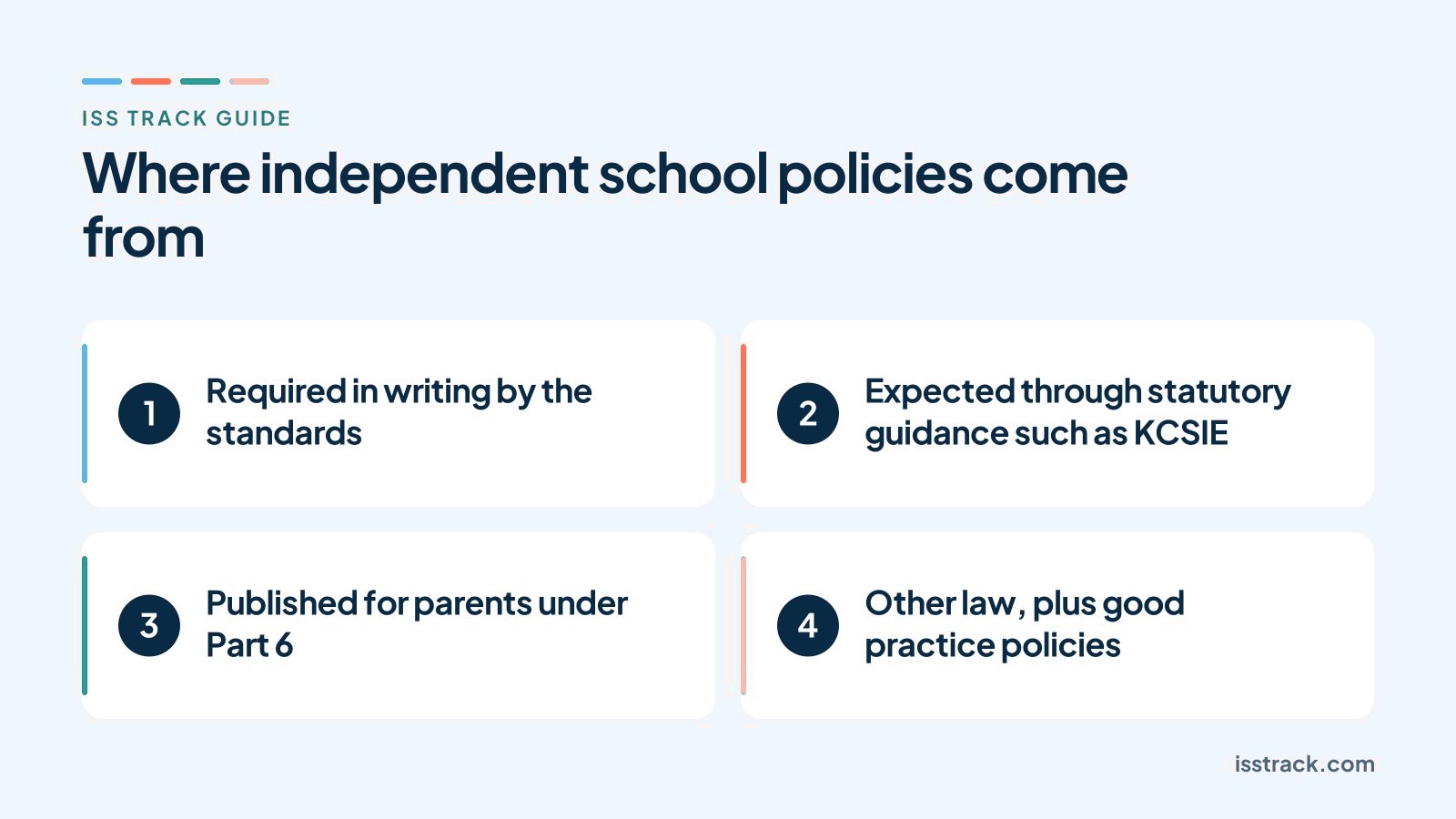
The answer depends a little on your school. A day school with no early years pupils needs fewer policies than a residential special school with a nursery class. But for most schools, the policies fall into five groups:
- Policies the Independent School Standards require in writing. The standards name these directly.
- Policies expected through statutory guidance. The standards require schools to have regard to guidance such as Keeping Children Safe in Education (KCSIE), and that guidance expects certain policies.
- Policies and details you must publish. Part 6 asks schools to make particulars of certain arrangements available to parents, mostly on the website.
- Policies required by other law. Fire safety, data protection, equality and, where relevant, early years and boarding.
- Good practice policies. Not named as a written requirement, but they help a school show that a standard is met in practice.
ISS Track’s policy register works from a list of 37 policies drawn from these groups. You may not need all of them, and you may hold some within a larger document. What matters is that each requirement is covered somewhere, clearly.
Is there a checklist of the policies an independent school must have?
Yes. The quickest way to check your list is to work through the policies in this guide group by group, then tick off each one against the standard it supports. Our free Independent School Standards checklist lists every requirement in all eight parts, including each written policy the standards expect, with space for your rating, evidence and owner.
If you would rather keep the list live, ISS Track’s policy register starts with 37 policies drawn from these groups. You mark the ones that apply to your school, upload each approved version or link to where it is kept, and the register shows what is missing, what is overdue and what still carries template wording.
Which policies do the Independent School Standards require in writing?
These are the policies the standards name directly. If one is missing, the related standard cannot be met.
| Policy | Where it comes from |
|---|---|
| Curriculum policy, with plans and schemes of work | Paragraph 2 |
| Relationships education or RSE policy | Paragraph 2A |
| Behaviour policy, setting out sanctions | Paragraph 9 |
| Anti-bullying strategy | Paragraph 10 |
| Health and safety policy | Paragraph 11 |
| First aid policy | Paragraph 13 |
| Risk assessment policy | Paragraph 16 |
| Procedures for recording use of force, seclusion and restraint | Paragraph 16A |
| A way of informing parents about each restrictive intervention | Paragraph 32A |
| Complaints procedure | Paragraph 33 |
Each of these exists for a reason that goes beyond paperwork. A curriculum policy makes sure every pupil receives a full-time, broad education that takes account of their needs, including those with an EHC plan. A behaviour policy makes sanctions fair and predictable. A risk assessment policy means risks are thought about before something goes wrong, not after. Our guides to Part 1 and the quality of education and Part 3: welfare, health and safety explain these standards in more depth.
Do independent schools need a separate RSE policy?
Yes. Paragraph 2A asks for a separate written statement of the school’s policy on relationships education (for primary pupils) or relationships and sex education (for secondary pupils). It must be kept up to date, written with regard to the statutory RSHE guidance, developed after consulting parents, published on a website and provided free of charge to anyone who asks.
It should also explain the right to be excused from sex education. In special schools, the policy is much stronger when it explains how content is adapted for the pupils you actually teach.
What changed for policies in April 2026?
From 1 April 2026, paragraph 16A requires a procedure for recording every significant use of force and a separate procedure for recording seclusion, restraint or immobilisation, with records made in writing as soon as practicable. Paragraph 32A asks for a way of telling each parent about each incident, with limited exceptions. Many schools build this into a positive handling or restrictive interventions policy, which then links to the behaviour policy.
The April 2026 guidance also expects the behaviour policy to address mobile phones across the whole school day, with schools mobile phone-free by default. Our summary of the 2026 changes to the standards covers both in detail.
Which policies are required through statutory guidance such as KCSIE?
Paragraph 7 asks schools to have arrangements that safeguard and promote pupils’ welfare, with regard to the Secretary of State’s guidance, which means KCSIE. That guidance expects a set of policies and procedures, and inspectors will look for them when they evaluate safeguarding.
- Safeguarding and child protection policy, school specific and reflecting the current edition of KCSIE
- Staff code of conduct, including online conduct and physical contact
- Whistleblowing policy with clear internal and external routes
- Managing allegations against staff, and low-level concerns
- Online safety, including filtering and monitoring
- Safer recruitment policy, including how the single central record is kept
- Staff induction and safeguarding training arrangements
- Lettings and use of premises by other organisations, where relevant
Attendance sits alongside this group. The DfE’s Working Together to Improve School Attendance guidance expects a clear attendance policy, and paragraph 15 asks for accurate admission and attendance registers.
From Our Experience
We often see safeguarding policies that are thorough and well written but still refer to last year’s edition of KCSIE, name a DSL who has since left, or describe local safeguarding arrangements from a different area. None of these reflect poor practice on the ground. They simply show that the policy has not kept pace with the school, and that can undermine confidence in everything else.
Which policies must an independent school publish on its website?
The safeguarding policy must be published on the website (or provided on request if the school has no website). Part 6 also asks schools to publish or provide particulars of:
- the curriculum policy
- admissions, misbehaviour and exclusions
- provision for pupils with EHC plans and pupils with English as an additional language
- arrangements for behaviour, anti-bullying, health and safety and first aid
- the complaints procedure, and the number of formal complaints in the preceding school year
The RSE policy must be published on a website too. Parents must also be told where this information can be found and that it can be inspected at the school, and, if something is not on the website, that they can ask for a copy free of charge. Our guide to what an independent school must publish on its website goes through every Part 6 item, including the ones that are most often missing.
One of the most common challenges is that the published copy and the version leaders are working from drift apart. A policy is updated, the new version is approved, and the old one stays on the website. It is worth checking that what parents can see is what the school actually does.
Which other policies are required by law?
Some policies come from legislation outside the standards, but they still matter to how the standards are judged.
- Fire risk assessment and fire procedures, under the Regulatory Reform (Fire Safety) Order 2005, which links to paragraph 12
- Data protection policy and privacy notices, under UK GDPR and the Data Protection Act 2018, including a route for data protection complaints from June 2026
- Accessibility plan, under the Equality Act 2010, covering the curriculum, the physical environment and information
- Early years policies, only where the school has pupils in the early years foundation stage
- Boarding or residential policies, only where the school has residential provision, in line with the National Minimum Standards
Which policies are good practice?
These are not named as written requirements, but a clear policy often makes it much easier to show how a standard is met consistently.
- PSHE policy or programme
- Careers guidance policy or programme
- Assessment and reporting policy
- Supporting pupils with medical conditions and administering medicines
- Intimate and personal care, which matters greatly in many special schools
- Supervision and staff deployment
- Educational visits and off-site activities
- Visiting speakers
- SMSC and fundamental British values statement
Every school’s circumstances are different. A small alternative provision might combine several of these into one well organised document, and that is fine, as long as each requirement is clearly covered.
Common Misconception
“If we have a policy for everything, we are compliant.” A policy shows what a school intends. A standard is met when that intention is what actually happens, every day, and the school can show it. Several standards ask for a policy that is “implemented effectively”, which is why evidence of practice matters as much as the document itself.
Can independent schools use template policies?
Templates can save a great deal of time, and many schools sensibly start from one provided by a group, an association or a trusted supplier. The risk is not the template. It is the wording that never gets adapted.
The most common issues we see are:
- another school’s name, or a group name, left in the text
- an age range, SEN type or number of pupils that does not match your registration
- references to roles, committees or procedures the school does not have
- an out of date edition of KCSIE or other guidance
- review dates that have passed, or no date at all
Each of these tells a reader, whether a parent, a placing authority or an inspector, that the policy may not describe the school. That matters most in safeguarding, where staff need to know exactly what to do and who to tell.
Good Practice
Strong schools give every policy an owner and a review date, and ask the owner to read it as a parent would. They check it against what really happens, update the names and contacts, remove anything that does not apply, and record who approved it and when. The published copy is replaced the same day.
Template wording compared with a policy that describes your school
A quick way to test an adapted template is to read a few sections side by side with what really happens. This table shows the kind of difference we look for.
| Section | Unadapted template | Adapted to your school |
|---|---|---|
| Who to tell | “Report concerns to the DSL” | Names the DSL and deputies, with how to reach them on site and during trips |
| Pupils | “All pupils” | Explains how the policy works for the pupils you teach, including those who communicate without speech |
| Local arrangements | Generic reference to local partners | Your local safeguarding partnership and LADO contact details |
| Roles | Refers to a governing body or committee | Refers to your actual proprietor body and who chairs it |
| Review | No date, or a date that has passed | Approval date, approver and next review date |
| Guidance | An earlier edition of KCSIE | The current edition, checked when it changes |
If most rows sit in the middle column, the template has done its job as a starting point. The next step is to make it yours, so staff and families can rely on it.
How often should independent school policies be reviewed?
The standards do not set a single review cycle for every policy. Most schools review their key policies annually, and the safeguarding policy each year once the new edition of KCSIE is published. Some, such as the curriculum policy, may sensibly sit on a longer cycle if nothing has changed.
What matters more than the cycle is the trigger. A policy should be looked at again when the law or guidance changes, when the school changes (a new age range, new SEN types, new premises), when a key person leaves, or when something happens that shows the policy did not work as intended. Schools that recover well after difficulties usually build this habit in afterwards.
A simple policy calendar, spread across the year rather than bunched into one term, keeps the work manageable. It also means policies are reviewed with care rather than signed off in a hurry. ISS Track’s policy register checks each policy for the school name, review dates, KCSIE edition and leftover template wording, and compares the published copy with the website, which takes some of the strain out of this. Our guide to the Independent School Standards tracker looks at the wider options honestly.
How do you carry out a policy review in an independent school?
A good policy review checks three things: that the policy still meets the law and current guidance, that it describes what really happens in your school, and that the published copy matches the approved one. In practice, most schools follow the same short routine:
- Read the policy against the current standard and guidance, such as the latest edition of KCSIE.
- Check every name, role, contact, age range and procedure against how the school works today.
- Ask the people who use the policy whether it matches what they do.
- Remove anything that does not apply, and record what changed.
- Send it to the proprietor for approval, with the date and the next review date.
- Replace the published copy and tell staff what changed.
Our step by step guide to reviewing school policies goes through each stage, with a review schedule and a worked example.
What do inspectors look for in school policies?
Inspectors look for policies that are current, specific to the school and followed in practice. They usually read the published policies, especially safeguarding, behaviour and complaints, before they arrive, and then test them against what they see and hear: whether staff can describe the procedure, whether records match it and whether pupils’ experience reflects it.
A policy that names the wrong DSL or still refers to last year’s guidance will not on its own decide an inspection, but it does raise a question about whether the school’s arrangements are kept under review. Our guide to how Ofsted inspects independent schools explains how this links to the compliance record, and our guide to preparing for an independent school inspection shows how to check policies calmly as part of being ready all year.
Who should approve independent school policies?
The proprietor is responsible for making sure the standards are met, so key policies should be approved by the proprietor or the proprietor body, with the date recorded. Part 8 asks that leaders have the skills and knowledge to meet the standards consistently, and proprietor oversight of policies is one of the clearest ways to show it. Our guide to proprietor responsibilities under Part 8 explains this further.
Questions for Leaders
- Do we have every policy the standards require in writing, and does each one name our school, our age range and our pupils?
- Does our safeguarding policy reflect the current edition of KCSIE and name the right people?
- Have we updated our behaviour and positive handling policies for the April 2026 changes?
- Does the version on our website match the version staff are working from?
- Who owns each policy, and when is it next due for review?
- If a parent read our policies tonight, would they recognise our school?
Free download: Independent School Standards checklist
Every requirement in all eight parts in plain English, including each written policy the standards expect, with space for your rating, evidence and owner. Download the checklist (PDF)
Our Perspective
Policies are not paperwork for its own sake. Each one is a promise about what will happen for a child: how they will be taught, kept safe, supported when things go wrong and listened to when they or their family raise a concern. When policies are accurate, current and genuinely lived, staff act with confidence and pupils feel the difference. That is what the Independent School Standards are really asking for.
Sources and further reading
- The Education (Independent School Standards) Regulations 2014, Schedule Part 1: Quality of education provided
- The Schools (Recording and Reporting of Seclusion and Restraint) (No. 2) (England) Regulations 2025, regulation 7
- Regulating independent schools (DfE), including Independent school standards guidance, April 2026
- Keeping children safe in education 2026
- The Education (Independent School Standards) Regulations 2014, Schedule Part 6: Provision of information
- Equality Act 2010, Schedule 10: Accessibility for disabled pupils
- The Education (Independent School Standards) Regulations 2014, Schedule Part 3: Welfare, health and safety of pupils
- Working together to improve school attendance
- How to deal with data protection complaints (ICO)
Look up the requirements, paragraph by paragraph
Continue exploring
- Independent School Standards checklist: what to check in every part
- What evidence do you need for the standards?, beyond the policy itself
- The single central record and Part 4, and how safer recruitment policy becomes practice
- Independent school complaints procedure: every element Part 7 asks for
- How to self-evaluate against the standards honestly and consistently
- The independent school accessibility plan: what the Equality Act asks of you, and how to keep the plan alive
- KCSIE in independent schools: how Keeping children safe in education connects to the standards
- Restrictive interventions in independent schools: recording restraint and seclusion, and telling parents (paragraphs 16A and 32A)
- How to review school policies: a step by step policy review, with a schedule and a worked example
- Preparing for an independent school inspection: what to check, what evidence to have ready and the first 48 hours
- The Independent School Standards: a complete guide
- Independent school compliance, all year
- Choosing an Independent School Standards tracker
Elsewhere on ISS Track: see how the policy register and website review helps with this, browse our free downloads, compare pricing, see ISS Track for groups or read every guide.
How can Jarvis Education help?
ISS Track is supported by Jarvis Education, an education consultancy led by a former HMI that supports independent schools, independent special schools and alternative provision. Our experienced consultants can review your policies alongside your practice, through an ISS health check or a focused policy review, and help you make them clear, current and specific to your school.
Our reviews are there to build confidence and strengthen leadership, never to find fault. Get in touch and tell us a little about your school.
How can ISS Track help?
See how ISS Track reads your policies and keeps them in date.
Upload each approved policy, or link to it where it is already kept, and ISS Track reads it where it can: your school's name, review dates, the KCSIE edition and any template wording left in.
Also useful:Watch the two minute tourView pricingBuy nowAll featuresFor groupsThe complete guide to the standards
ISS Track is supported by Jarvis Education
Support from Jarvis Education
Sometimes an experienced pair of eyes helps. These services and guides from the Jarvis Education team go further on this topic.