Part 1 of the Independent School Standards: quality of education explained


It’s understandable that Part 1 quality of education can feel like the most demanding part of the Independent School Standards. It asks about the thing leaders care about most, the education children receive every day, and it asks you to show it in writing as well as in the classroom.
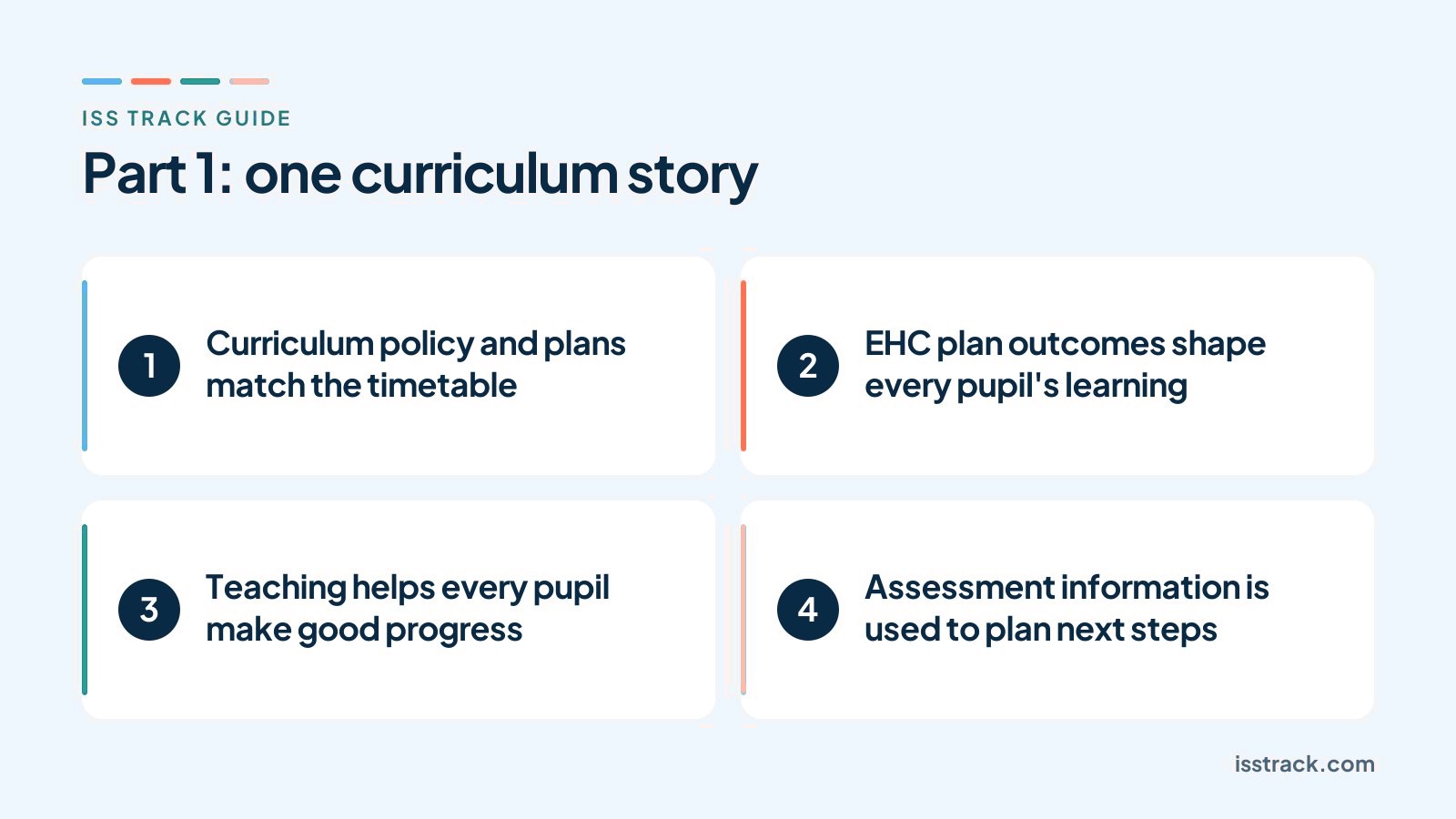
From our experience, the schools that feel most settled about Part 1 are not the ones with the longest curriculum documents. They are the ones where the policy, the timetable, the plans and what happens in lessons all tell the same story, and where each pupil’s needs shape that story.
In short: Part 1 of the Independent School Standards covers the quality of education. A school needs a written curriculum policy backed by plans and schemes of work, a curriculum that covers the required areas of experience and reflects each pupil’s needs and EHC plan, relationships education, teaching that helps pupils make good progress, and a framework for assessing their performance.
This guide explains paragraphs 2, 2A, 3 and 4 in plain English, with practical insight for special schools and AP. If you are new to the standards, our complete guide to the Independent School Standards sets out all eight parts.
What does Part 1 of the Independent School Standards require?
Part 1 requires a written curriculum that gives every pupil a full-time education suited to their needs, relationships and sex education, teaching that helps pupils make good progress, and a framework for assessing how pupils are doing.
Part 1 is about the quality of education. It has four main paragraphs:
- Paragraph 2: the curriculum. A written policy, supported by plans and schemes of work, that gives every pupil full-time education suited to their ages, aptitudes and needs.
- Paragraph 2A: relationships and sex education. Relationships education for primary pupils and RSE for secondary pupils, with a separate policy, parental consultation and the right to be excused from sex education.
- Paragraph 3: teaching. Teaching that helps pupils learn and make good progress.
- Paragraph 4: assessment. A framework for evaluating how well pupils are doing.
Part 1 exists because every child deserves a planned, ambitious education, and parents and placing local authorities need confidence that it is happening. For many pupils in special schools and AP, school is where they rebuild their trust in learning.
At inspection, Part 1 sits closely alongside the curriculum and teaching and achievement areas. Our guide to how Ofsted inspects independent schools against the standards explains how the compliance record and the evaluation areas fit together.
What should an independent school curriculum policy include?
Paragraph 2 asks for a written curriculum policy, supported by appropriate plans and schemes of work, and implemented effectively. That last part matters: a policy describing a curriculum pupils do not actually receive will not meet the standard.
A helpful curriculum policy usually explains:
- what the school wants pupils to know, do and become, and why
- how the seven areas of experience are covered for every pupil
- the pathways for different groups, including early years or post-16 where relevant
- how EHC plan outcomes shape what each pupil learns
- how PSHE, careers guidance and RSE fit in
- how literacy, numeracy, speaking and listening are developed across the day
- how the curriculum prepares pupils for life in British society and does not undermine fundamental British values
The particulars of the curriculum policy must also be available to parents, usually on the school website. Our guide to what an independent school must publish on its website covers this, and our list of the policies an independent school needs shows where the curriculum policy sits alongside the others.
Plans and schemes of work
Plans and schemes of work show what is taught, in what order, and how it builds over time. In a special school, they also show how teachers adapt content for pupils working at very different stages.
We often see strong teaching alongside schemes of work that have not kept up. A short annual check of the policy, schemes and timetable side by side catches most of this.
What are the areas of experience in the Independent School Standards?
Paragraph 2 asks for full-time supervised education for pupils of compulsory school age that gives pupils experience in seven areas:
| Area of experience | What it might include |
|---|---|
| Linguistic | Communication, reading, writing, languages |
| Mathematical | Number, measures, money, problem solving |
| Scientific | Investigation, the natural world |
| Technological | Computing, design and technology, food |
| Human and social | History, geography, citizenship, life skills |
| Physical | PE, movement, sport, outdoor learning |
| Aesthetic and creative | Art, music, drama, sensory and creative work |
These are areas of experience, not compulsory subjects. A thematic, sensory or vocational curriculum can cover them, provided every pupil genuinely receives all seven.
Paragraph 2 also asks that all pupils have the opportunity to learn and make progress, and that the curriculum prepares them for the opportunities, responsibilities and experiences of life in British society. That links closely to Part 2 and the fundamental British values.
Common Misconception
“Our pupils have complex needs, so some areas of experience don’t apply.” Every pupil is entitled to experience in all seven areas. What changes is how that experience is offered. Scientific experience for one pupil might be a sensory exploration of materials. For another it is a GCSE. Both count, when they are planned and meaningful.
How should EHC plans shape the curriculum?
Paragraph 2 asks that the curriculum takes account of pupils’ ages, aptitudes and needs, including those with an EHC plan. In an independent special school, this is the heart of Part 1.
Many leaders describe it as a golden thread. The outcomes in a pupil’s EHC plan should be visible in their curriculum pathway, in teachers’ planning, in what happens in lessons and therapy sessions, in how progress is assessed, and in what the school reports at the annual review. When that thread is unbroken, everyone can see how the school is helping the child move towards the outcomes that matter most.
The thread often breaks in quiet places: outcomes that never reach planning, therapy running separately from teaching, or progress assessed against a scheme that does not reflect the plan. None of this means the provision is poor, but it makes it hard to show how well it is working.
From Our Experience
Schools that do this well usually keep it simple. Each pupil has a short profile that turns their EHC plan outcomes into a few clear targets, staff know those targets, and progress against them is reviewed regularly. When we ask a teaching assistant what a pupil is working on, they can tell us, and their answer matches the plan.
What do the standards expect for PSHE and careers guidance?
Paragraph 2 asks for personal, social, health and economic education that reflects the school’s aims and ethos and encourages respect for other people, paying particular regard to the protected characteristics in the Equality Act 2010.
For pupils receiving secondary education, it also asks for accurate, up-to-date careers guidance, presented impartially, that helps pupils make informed choices about a broad range of options and encourages them to fulfil their potential. In special schools and AP, this often sits within preparation for adulthood, and impartial guidance means opening doors pupils or families may not have considered.
What does standard 2A require for relationships and sex education?
Standard 2A asks schools to provide relationships education for primary pupils and relationships and sex education for secondary pupils, with regard to the statutory RSHE guidance. The school must also:
- have a separate, written RSE policy statement that is kept up to date
- consult parents on that policy
- publish it on a website and provide a copy free of charge to anyone who asks
The DfE’s updated guidance on the standards, published in April 2026, says more about consultation, publication and withdrawal. Our summary of the Independent School Standards changes in 2026 covers what changed.
For pupils with SEND, RSE often needs careful adaptation, with repetition, concrete examples and close work with families. It is also central to keeping young people safe, which is why it connects so closely to safeguarding in Part 3.
Can parents withdraw their child from sex education in an independent school?
Yes. Parents can ask for their child to be excused from sex education, but not from relationships education. The headteacher should agree to the request except in exceptional circumstances. From three terms before their 16th birthday, a young person can choose to receive sex education even if their parents have asked for them to be excused.
The RSE policy should explain how parents make a request, how the school will talk it through with them, and what the pupil will do instead. Many families feel reassured once they have seen the resources.
What does good teaching look like under paragraph 3?
Paragraph 3 describes teaching that:
- helps pupils acquire new knowledge and make good progress
- encourages them to apply effort, think for themselves and work independently
- is well planned, with effective use of lesson time
- takes account of pupils’ needs and prior attainment
- shows good understanding of the subject
- uses good quality resources well
- uses assessment information to plan
- manages behaviour effectively
- does not undermine fundamental British values or discriminate against pupils
This describes everyday good practice, not a checklist for one observed lesson. Inspectors build a picture from lessons, pupils’ work and conversations with pupils and staff.
Good Practice
In strong schools, leaders spend regular, low-stakes time in classrooms and talk with pupils about their learning. Feedback to staff is developmental, focused on a few things that will make the biggest difference for pupils, and followed up. Teachers can explain why they are teaching what they are teaching, and how it builds on what came before.
What does paragraph 4 say about assessing pupil performance?
Paragraph 4 asks for a framework to evaluate how well pupils are doing, by reference to the school’s own aims, national norms, or both. Paragraph 3 then asks that assessment information is used to plan teaching so pupils can progress.
In special schools and AP, national norms may not tell you much. What matters is that the framework is meaningful for your pupils: small, real steps in communication, independence, regulation and learning, often linked to EHC plan outcomes. One of the most common challenges is collecting a great deal of assessment data that is never used. A simpler system that teachers actually use to plan is far more valuable.
Can an independent school use part-time timetables?
Only as a short-term exception that is in the pupil’s best interests, agreed with parents and the placing local authority, time limited and recorded accurately, because Part 1 asks for full-time education.
Paragraph 2 asks for full-time supervised education for pupils of compulsory school age. A part-time timetable should therefore be a short-term exception, not an arrangement that quietly becomes permanent.
Where a part-time timetable is genuinely right for a pupil, for example during a phased return or for health reasons, it should be:
- in the pupil’s best interests, not a way of managing behaviour
- agreed with parents and the placing local authority
- time limited, with a clear plan back to full-time education
- reviewed regularly, with the pupil’s views heard
- accurately recorded in the attendance register
Part-time arrangements also carry safeguarding risk, because a pupil out of school is less visible, so they connect closely to attendance registers in Part 3 and to the DfE’s Working Together to Improve School Attendance guidance.
Example: a phased return that stays on track
For example, a small independent special school might admit a pupil who has been out of education for several months and finds a full school day overwhelming. Rather than an open-ended reduced timetable, leaders could agree a six-week plan with the parents and the placing local authority:
- Weeks 1 and 2: mornings in school, with a key adult and a quiet base to return to.
- Weeks 3 and 4: mornings and lunch, plus one afternoon session the pupil has chosen.
- Weeks 5 and 6: full days, building from three days a week to five.
Each week, the key adult asks the pupil how it is going, using whatever way of communicating works best for them, and the plan is reviewed with the family. The attendance register shows exactly when the pupil is in school, and the DSL knows the arrangements for the hours they are not.
If the pupil is not ready to move on at a review point, the plan is adjusted and a new end date agreed, so the arrangement never quietly continues. What makes this work is not the exact timings. It is that everyone, including the pupil, can see where they are heading, and full-time education stays the goal from the very first day.
How can we show we meet Part 1?
Part 1 is met through practice, so the best evidence shows practice: lesson visits, pupils’ work, curriculum maps that match the timetable, pupil profiles and progress reviews. Our guide to Independent School Standards evidence explains what good evidence looks like, and our guide to self-evaluating against the standards shows how to rate each requirement honestly.
ISS Track breaks Part 1 into separate, checkable requirements, each with what a reviewer would look for and typical evidence, so leaders can see quickly where the curriculum story is strong and where it needs a little attention.
Questions for Leaders
- If we laid our curriculum policy next to our timetable, would they match?
- Can we follow the golden thread from a pupil’s EHC plan to their lessons, their assessment and their annual review?
- Does every pupil receive experience in all seven areas, and could we show it?
- Is our RSE policy separate, current, published and shaped by parental consultation?
- Are any pupils on part-time timetables, and does each one have an end date and a plan?
- Do teachers use our assessment information to plan, or does it mainly sit in a system?
Free download: Independent School Standards checklist
Every requirement in all eight parts, including each element of Part 1, in plain English with space for your rating, evidence and owner. Download the checklist (PDF)
Our Perspective
Part 1 is not about producing documents for inspection. It is about making sure every child receives a full, ambitious education that fits who they are and where they are heading. When the curriculum, teaching and assessment all tell the same story, pupils feel it, and that is what the standards were written to protect. For the wider picture, return to our guide to all eight parts of the Independent School Standards.
Sources and further reading
- Education (Independent School Standards) Regulations 2014, Schedule, Part 1: Quality of education provided
- Equality Act 2010, section 4: The protected characteristics
- Relationships and sex education (RSE) and health education: statutory guidance (DfE)
- Regulating independent schools: Independent school standards guidance (DfE, updated 2 April 2026)
- Working together to improve school attendance (DfE)
Look up the requirements, paragraph by paragraph
Continue exploring
- Part 2: SMSC and fundamental British values, and how to promote them actively
- Part 3: welfare, health and safety, from safeguarding to attendance registers
- An Independent School Standards checklist covering every part
- What policies an independent school needs, including curriculum and RSE
- Part 8 and proprietor responsibilities for quality of education
- How to track the standards all year without a last-minute scramble
- EHC plans in independent special schools: making each plan shape teaching, review and reporting
- The independent school accessibility plan: what the Equality Act asks of you, and how to keep the plan alive
- The Independent School Standards: a complete guide
- Part 3: KCSIE in independent schools
- Part 3: Restrictive interventions (16A and 32A)
- Part 4: The single central record (SCR)
- Part 5: Premises and accommodation
- Part 6: What to publish on your website
- Part 6: Information for local authorities
- Part 7: The complaints procedure
Elsewhere on ISS Track: see how the standards tracker helps with this, browse our free downloads, compare pricing, see ISS Track for groups or read every guide.
How can Jarvis Education help?
ISS Track is supported by Jarvis Education, an education consultancy led by a former HMI that supports independent schools, independent special schools and alternative provision. Our consultants have led and reviewed curriculum in settings like yours, and understand how different good education can look for pupils with complex needs.
If you would like an independent view of your curriculum, teaching and assessment, through a focused Part 1 review, a full ISS health check, CPD for staff or support for leaders, we would be glad to help. Our reviews are designed to build confidence and strengthen practice, never to find fault. Get in touch and tell us about your school.
How can ISS Track help?
See how ISS Track breaks Part 1 into clear, checkable requirements.
Rate each curriculum and teaching requirement, link the documents that show it, and see at a glance where work is needed.
Also useful:Watch the two minute tourView pricingBuy nowAll featuresFor groupsThe complete guide to the standards
ISS Track is supported by Jarvis Education
Support from Jarvis Education
Sometimes an experienced pair of eyes helps. These services and guides from the Jarvis Education team go further on this topic.