What happens if an independent school does not meet the standards?


Receiving a finding that some of the Independent School Standards are not met can be one of the hardest moments in a leader’s career. It’s understandable to feel disappointed, worried about what comes next, and protective of a staff team who work incredibly hard for their pupils. Many leaders tell us the uncertainty is the worst part.
So it helps to say clearly at the start: when independent school standards are not met, the process that follows is designed to secure improvement. Many schools recover from unmet standards, and often come out of the experience stronger, with clearer systems and a more confident leadership team.
In short: When Independent School Standards are not met, the DfE usually asks the school for an action plan setting out how and when each unmet standard will be put right. Ofsted then checks progress at a progress monitoring inspection. Most schools recover well, but standards that stay unmet can lead to enforcement action.
This guide explains what happens after standards are found not met, what a good action plan looks like, what a progress monitoring inspection checks, and why some schools find the same standards unmet twice. If you need a refresher on the standards themselves, our complete guide to the Independent School Standards covers all eight parts.
What happens if an independent school does not meet the standards?
The inspectorate reports the unmet standards to the DfE, which usually asks the school for an action plan and later commissions a progress monitoring inspection to check the standards have been put right.
Every registered independent school must meet the standards all the time. When an inspection finds that one or more standards are not met, the inspectorate reports this to the Department for Education (DfE), which is the registration authority. The DfE, not the inspectorate, decides what happens next.
Most commonly, the DfE asks the school for an action plan setting out how and when each unmet standard will be put right. Later, a progress monitoring inspection checks whether it has been. For many schools, that is the whole story: the standards are put right and the school moves on.
It is worth knowing how unmet standards appear in Ofsted’s current approach. Inspectors record each relevant standard as met or not met in a compliance record. If any standard is not met, the leadership and governance evaluation area cannot reach expected standard, because it is the proprietor’s job to make sure every standard is met. Our guide to how Ofsted inspects independent schools explains the toolkit in more detail.
Why does an unmet standard matter so much?
Because each standard protects something real for children, so when one is not met, that protection is not fully in place.
It can feel as though a single gap, such as a missing date on the single central record or a complaints procedure without an independent panel member, is being treated very seriously. That reaction is understandable.
The reason is that each standard protects something real for children. A missing check might mean an adult has not been fully vetted. An unclear complaints procedure might mean a parent’s concern about their child is not heard fairly. The standards are a minimum, so when one is not met, the protection it offers is not fully in place. Seen that way, putting it right is simply part of keeping children safe and well educated.
What should leaders do first?
Read the findings carefully, tell staff honestly, fix anything urgent for safety straight away and involve the proprietor early.
The first few days set the tone. Schools that recover well usually:
- Pause before reacting. Read the findings carefully, and make sure everyone understands exactly which standards are not met and why.
- Tell the team honestly and kindly. Staff need to know what was found, that leaders have a plan, and that the focus is on pupils, not blame.
- Fix the urgent things now. Anything that affects safeguarding or immediate safety should be addressed straight away, not saved for the action plan.
- Involve the proprietor early. Under Part 8, the proprietor carries responsibility for the standards being met. Our guide to proprietor responsibilities explains what that means in practice.
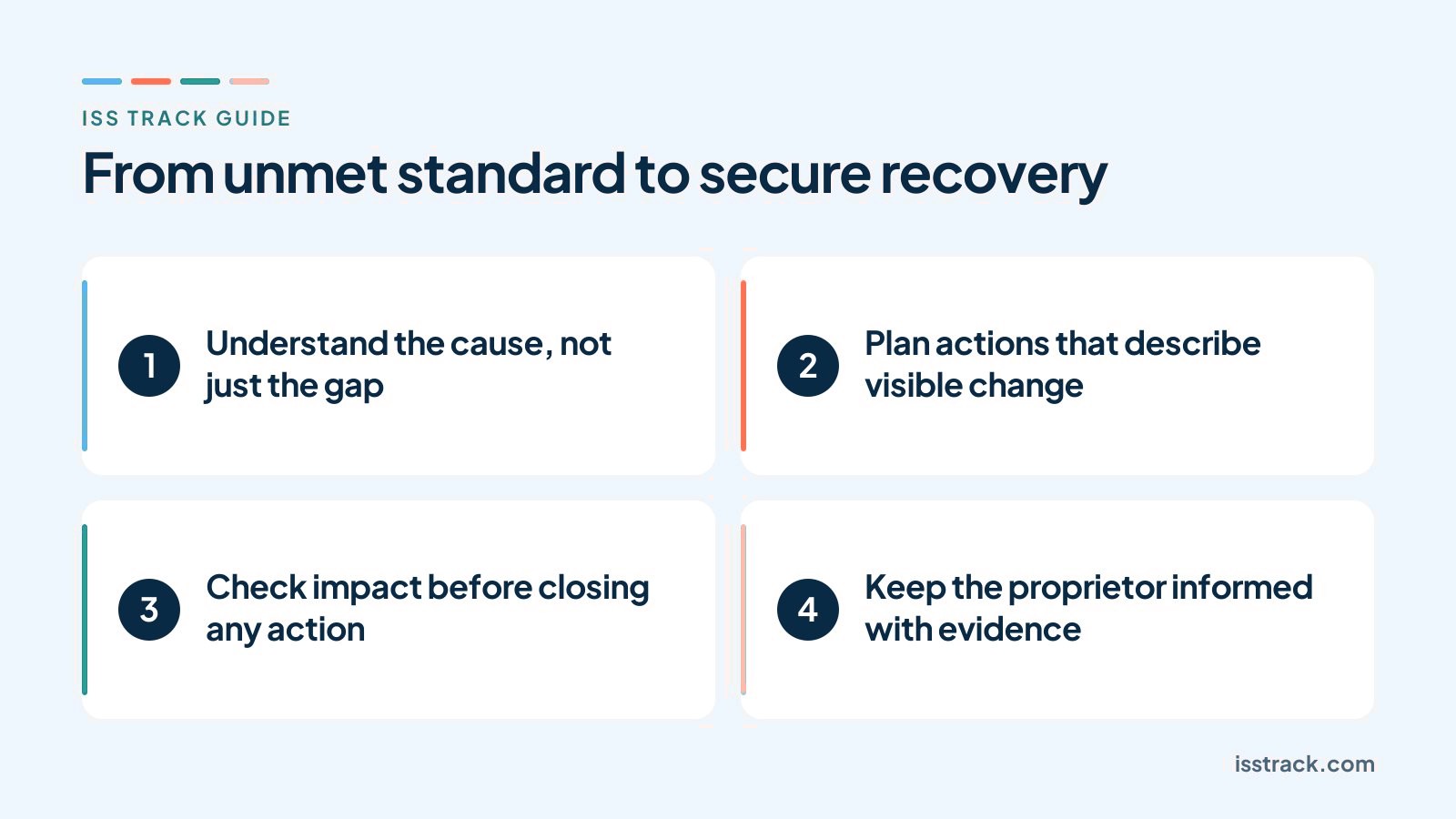
- Look for the cause. Ask why each standard was not met, not only what is missing.
Common Misconception
“An unmet standard means the inspectors thought we were a bad school.” Not at all. Many schools with warm, caring practice have unmet standards because a precise detail was missed, a document drifted out of date, or evidence did not show what was really happening. An unmet standard is a specific finding about a specific requirement. It is something to put right, not a verdict on the whole school.
Sample wording for telling your staff team
Many leaders tell us that finding the right words for staff is one of the hardest parts of the first few days. Here is an outline you can adapt for a briefing or a short written message. Every school’s circumstances are different, so change anything that does not fit.
“Thank you, first of all, for everything you did during the inspection and every day before it. The report found that some of the Independent School Standards are not met. These are specific requirements, and they are listed below, along with what was found.
This is not a judgement on how much you care about our pupils. We know how hard you work for them. It does mean there are things we need to put right, and we will do that together.
Over the next week, the senior team will agree a plan with our proprietor. Each action will have a named owner and a date, and we will share it with you. If any of the findings relate to your area, I will speak with you personally before then.
If you have questions or worries, please come and talk to me. Our focus stays where it has always been: on our children and young people.”
What should an action plan for unmet standards include?
For each unmet standard: what was found and why, the actions with a named person and a date, success criteria describing what will be true in practice, and how progress will be checked and evidenced.
A good action plan is clear, specific and honest. For each unmet standard, it usually sets out:
- The standard, in plain English, and what was found.
- The cause, as leaders understand it.
- The actions, each with a named person and a realistic date.
- Success criteria: what will be true, in practice, when the standard is met.
- How progress will be checked, by whom and how often.
- The evidence that will show the change has happened.
One of the most common challenges is writing actions that describe activity rather than change. “Review the safeguarding policy” is an activity. “The safeguarding policy reflects current KCSIE, staff can describe how to raise a concern, and the DSL has checked this through a sample of conversations” describes a change you can see.
It also helps to think beyond the specific finding. If a gap appeared in Part 4, is there a wider question about how recruitment is overseen? If information was missing from the website, are other Part 6 items current? Our Independent School Standards checklist is a useful way to check related requirements while you are working on the unmet ones.
Good Practice
Strong action plans read like improvement plans. Each action has an owner and a date, the success criteria describe what pupils, parents or staff will experience differently, and leaders check progress regularly rather than waiting for the deadline. When an action is marked done, someone asks whether it has made a difference, and only then is it treated as complete.
What is a progress monitoring inspection?
A progress monitoring inspection checks whether a school has put right the standards that were previously not met. Inspectors look at the action plan and, more importantly, at whether each of those standards is now met in practice.
The focus is on the previously unmet standards, so it is not a full inspection. But because the standards connect to each other, inspectors will want to see that the change is real and secure. A new policy alone is rarely enough. They will want to see that it is understood and followed, and that records, staff knowledge and pupils’ experience reflect it.
That is why evidence of practice matters so much at this stage. Records, observations, staff and pupil voice, and dated checks show that change has happened, not just that a document has been rewritten.
How do schools prepare well for a progress monitoring inspection?
The best preparation is simply doing the action plan properly. Schools that feel confident at progress monitoring usually:
- Keep the action plan live, updating it as actions are completed and checked.
- Gather evidence as they go, rather than all at once near the end.
- Ask someone independent to test whether each standard is now met.
- Make sure the website and published policies reflect any changes.
- Keep the proprietor informed with honest progress reports.
In ISS Track, an action plan for unmet standards can be built from the ratings, with named owners, dates and success criteria, and each action is closed only when someone confirms what changed and the rating is looked at again.
What happens if an independent school fails the Independent School Standards a second time?
If a progress monitoring inspection finds that standards are still not met, the DfE will consider what to do. It can take enforcement action. Depending on the circumstances, this can include restricting admissions or other relevant restrictions and, in the most serious cases, removing the school from the register.
It is important to keep this in proportion. These steps follow a process, and the most serious measures are reserved for the most serious cases. Every school’s circumstances are different. What makes the biggest difference is that leaders and the proprietor act promptly, are open about progress, and make sure change is real.
If you find yourself in this position, the most helpful thing is to look honestly at why the first plan did not fully work, and to get support if leadership capacity is stretched.
Why do schools fail the same standards twice?
From our experience, it is rarely because leaders did not care or did not try. The reasons are usually more practical.
- The fix was on paper, not in practice. A policy was rewritten but staff were not trained, or a procedure was written but not followed.
- The cause was not understood. The symptom was treated, but the underlying reason, such as unclear ownership or a stretched office team, remained.
- Improvement was not sustained. Things were put right, then slipped once attention moved elsewhere.
- Nobody checked. Actions were marked complete without anyone testing whether the standard was now met.
- Capacity was too thin. A small leadership team tried to carry the action plan on top of everything else.
From Our Experience
We often see schools where the action plan is completed on time, every box ticked, yet the same standard is found not met again. When we look closer, the change happened in the documents but not in the daily life of the school. The schools that recover well usually test each action by asking a simple question: if someone walked in tomorrow, would they see this working?
How do independent schools recover well from unmet standards?
Schools that recover well usually share a few habits. They treat the finding as useful information. They put clear ownership in place for every standard, not only the unmet ones. They keep an honest self-evaluation against the standards so that drift is spotted early. And they make sure the proprietor sees the real picture, with evidence.
Above all, they keep pupils at the centre. The question is not “how do we pass the next inspection?” but “what needs to be true for our children to be safe, happy and learning well, every day?” When leaders work from that question, the standards tend to follow.
Many schools also find that keeping the standards live all year, using a shared Independent School Standards tracker, makes it far less likely that the same gap reappears.
Questions for Leaders
- Do we understand the cause of each unmet standard, not just what was missing?
- Does each action describe a change we could see in practice, with a named owner and a date?
- Who checks that a completed action has actually made a difference?
- How are we making sure the improvement lasts beyond the next inspection?
- Does our proprietor body see honest, evidenced progress reports?
- Do we have enough leadership capacity, or would independent support help?
Free download: Independent School Standards checklist
All 159 requirements in plain English, with space to record your rating, evidence and owner. A practical way to check related standards while you work on your action plan. Download the checklist (PDF)
Our Perspective
An unmet standard is a moment, not a definition. The schools we see recover well treat it as a chance to strengthen systems, sharpen leadership and make sure every child is protected by every standard, every day. When the change is real, inspection simply confirms what pupils and families are already experiencing. For the wider context, our guide to the Independent School Standards is a good place to return to.
Sources and further reading
- Regulating independent schools (DfE), including Independent school standards guidance, April 2026
- Education and Skills Act 2008, section 114: Action plans
- Operating guide for standard inspections of non-association independent schools: for use from September 2026 (Ofsted)
- Operating guide for additional inspections of non-association independent schools: for use from September 2026 (Ofsted)
- Education and Skills Act 2008, section 115: Power of Secretary of State to take enforcement action
Look up the requirements, paragraph by paragraph
Continue exploring
- The 2026 changes to the standards, including restrictive intervention recording
- What evidence do you need for the standards? and how to show practice, not just policy
- The single central record and Part 4, one of the most common areas for gaps
- What an independent school must publish on its website under Part 6
- The independent school complaints procedure and what Part 7 requires
- The most commonly unmet standards: what the official data shows, and how to stay ahead of it
- Ofsted or ISI?: which inspectorate visits your school, and what stays the same
- Preparing for an independent school inspection: what to check, what evidence to have ready and the first 48 hours
- Progress monitoring inspections: what Ofsted and ISI check against your action plan, and what happens next
- The Independent School Standards: a complete guide
- How Ofsted inspects independent schools
Elsewhere on ISS Track: see how actions and improvement planning helps with this, browse our free downloads, compare pricing, see ISS Track for groups or read every guide.
How can Jarvis Education help?
ISS Track is supported by Jarvis Education, an education consultancy led by a former HMI that supports independent schools, independent special schools and alternative provision. We work alongside leaders and proprietors through independent reviews, ISS health checks, Quality Marks, CPD and leadership support, including interim leadership when capacity is stretched.
If your school has unmet standards, or wants an honest check before a progress monitoring inspection, we can help you understand the causes, build an action plan that leads to real change, and test whether it is working. Our approach is supportive and confidence-building, never fault-finding. Get in touch and tell us a little about your situation.
How can ISS Track help?
See how ISS Track assigns, tracks and reviews actions.
Turn every unmet standard into actions with an owner, a date and success criteria, with reminders and a clear record of what has changed.
Also useful:Watch the two minute tourView pricingBuy nowAll featuresFor groupsThe complete guide to the standards
ISS Track is supported by Jarvis Education
Support from Jarvis Education
Sometimes an experienced pair of eyes helps. These services and guides from the Jarvis Education team go further on this topic.