Part 5: premises and accommodation standards for independent schools


It’s understandable that premises can feel like the least educational part of the Independent School Standards. Leaders are rarely building surveyors, and many independent special schools and AP settings work in buildings that were never designed as schools. Converted houses, offices and shared sites all bring their own challenges.
Yet the building shapes every pupil’s day. It affects their dignity when they need personal care, their comfort when they are unwell, their safety moving around the site, and how well they can hear, see and learn. Many leaders tell us that once they started walking the site through a pupil’s eyes, Part 5 felt very different.
In short: Independent school premises requirements are set out in Part 5 of the Independent School Standards. They cover toilets and changing facilities, space for medical care, maintenance, acoustics and lighting, drinking water and hot water, outdoor space for play and PE, and boarding accommodation, so that pupils are safe, comfortable and able to learn.
This guide explains paragraphs 23 to 30 in plain English. For an overview of all eight parts, see our complete guide to the Independent School Standards.
What does Part 5 of the Independent School Standards require?
Part 5 requires suitable toilets and washing facilities, medical accommodation, well maintained premises, suitable acoustics and lighting, safe water, outdoor space for PE and play, and suitable boarding accommodation where relevant.
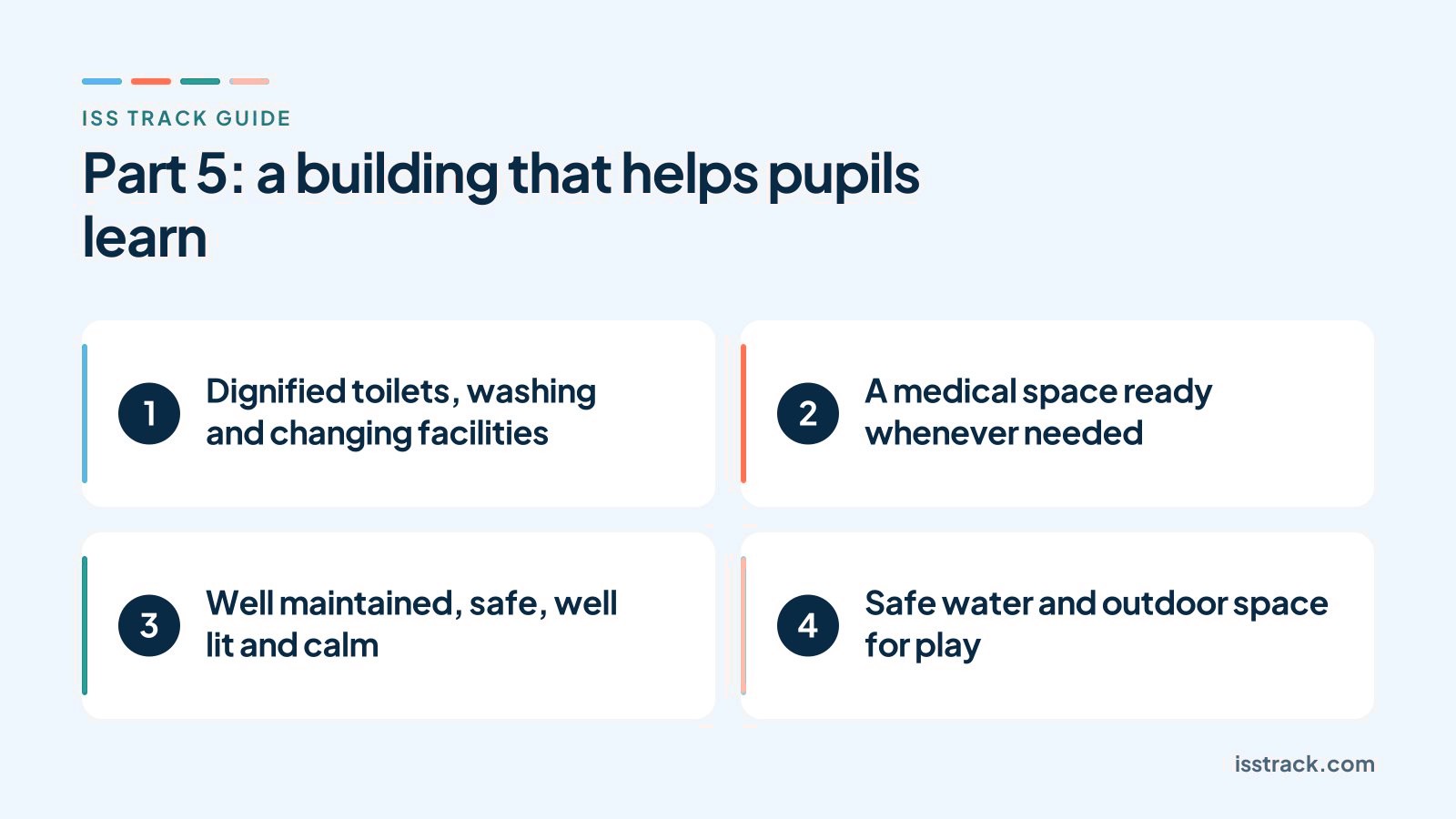
| Paragraph | What it covers |
|---|---|
| 23 | Toilets, washing, changing and showers |
| 24 | Medical accommodation and care of sick pupils |
| 25 | Maintenance, so health, safety and welfare are ensured |
| 26 | Acoustics and sound insulation |
| 27 | Internal and external lighting |
| 28 | Drinking water, hot and cold water, scalding risk |
| 29 | Outdoor space for PE and play |
| 30 | Boarding accommodation |
Part 5 exists because children cannot learn well, or stay safe, in an environment that does not meet their needs. For pupils with SEND, the environment can make the difference between a calm, regulated day and a distressing one.
At Ofsted inspection, premises are usually considered under leadership and governance, because they are the proprietor’s responsibility. Our guide to how Ofsted inspects independent schools explains how this works, and our guide to Part 8 and proprietor responsibilities explains why unmet premises standards also affect leadership.
Do independent schools need separate toilets for boys and girls?
Yes, for pupils aged 8 and over, unless a toilet is in a room for one person at a time that can be secured from the inside.
Paragraph 23 asks for suitable toilet and washing facilities for the sole use of pupils. For pupils aged 8 and over, there must be separate toilets for boys and girls, except where a toilet is in a room intended for one person at a time that can be secured from the inside.
Suitable means suitable for your pupils. In a special school that might mean accessible toilets, changing benches, hoists and space for a member of staff to support with dignity. An intimate and personal care policy sits naturally alongside this, so that privacy, consent and safeguarding are all considered.
What about changing rooms and showers?
Paragraph 23 also asks for suitable changing accommodation and showers for pupils aged 11 and over at the start of the school year who receive physical education. Where pupils need support, think about privacy, supervision and how pupils who may find shared spaces difficult are accommodated.
Does an independent school need a medical room?
Yes. It needs suitable accommodation for medical examination and treatment and for the short-term care of sick or injured pupils, though the space does not have to be used only for medical purposes as long as it is readily available.
Paragraph 24 asks for suitable accommodation for:
- the medical examination and treatment of pupils
- the short-term care of sick and injured pupils, including a washing facility and access to a toilet
- where a school caters for pupils with complex needs, additional medical accommodation that meets those needs
The space does not always have to be used only for medical purposes, but it must be readily available whenever it is needed. A room that doubles as a busy office or meeting space can be hard to justify if a pupil who is unwell has nowhere quiet to go.
For schools supporting pupils with complex medical or physical needs, this is where Part 5 matters most. Pupils may need space for therapies, specialist equipment, tube feeding or medication administered in privacy. This connects closely to first aid and supporting pupils with medical conditions in Part 3: welfare, health and safety.
From Our Experience
We often see medical rooms that met the standard when the school opened but have gradually become storage. A wheelchair is parked there, then boxes, then a printer. Nothing dramatic happened, the room simply drifted. Schools that keep this right usually include the medical room in a regular site walk and ask one simple question: if a pupil were unwell right now, would this space work?
What does paragraph 25 mean by maintenance?
Paragraph 25 asks that the premises and accommodation are maintained to a standard that, so far as is reasonably practicable, ensures pupils’ health, safety and welfare.
This is where Part 5 overlaps most with Part 3. Health and safety (paragraph 11) and fire safety (paragraph 12) are about policies, procedures and risk assessment. Paragraph 25 is about the condition of the building itself. In practice, that means:
- a planned maintenance schedule, and a way for staff to report problems
- statutory checks completed and recorded, such as electrical, gas, legionella and asbestos management where relevant
- repairs prioritised by risk to pupils
- security of the site, including gates, doors and boundaries
- regular site walks by someone with the authority to act
Many of these checks also sit in your health and safety policy. Our list of the policies an independent school needs shows how they fit together.
Common Misconception
“The landlord is responsible for the building, so maintenance isn’t our problem.” Whatever the lease says about who pays, the proprietor is responsible for making sure the premises meet the standards for pupils. Schools in leased buildings usually do best when they agree clear responsibilities with the landlord and keep their own record of checks and repairs.
Why do acoustics and lighting matter?
Because echoing rooms or poor lighting can make learning genuinely hard, and distressing, for many pupils, including those with hearing impairments, sensory processing difficulties or autism.
Paragraph 26 asks that the acoustics and sound insulation of each room are suitable for the activities that take place there. Paragraph 27 asks for suitable lighting inside, and appropriate external lighting so people can move around safely.
These can sound technical, but they matter enormously for many pupils. A pupil with a hearing impairment, a sensory processing difficulty or autism may find an echoing room or flickering light genuinely distressing. Soft furnishings, acoustic panels, blinds and calm lighting are often simple, affordable changes that make a real difference to regulation and learning.
What are the water requirements in Part 5?
Paragraph 28 asks for:
- suitable drinking water that pupils can easily access
- drinking water facilities that are clearly marked as such
- adequate supplies of hot and cold water
- hot water at a temperature that does not pose a scalding risk to pupils
The clear marking is one of the details that is easily missed, especially where a sink provides both drinking and washing water. The scalding risk matters particularly for pupils who may not recognise danger or who have reduced sensation, so thermostatic mixing valves and regular temperature checks are worth including in your maintenance routine.
Does an independent school need outdoor space?
Paragraph 29 asks for suitable outdoor space so that pupils can take part in physical education in line with the curriculum and play outside.
The space does not always have to be on your own site. Many schools use nearby parks, sports centres or shared facilities. What matters is that the arrangement is genuine, regular and safe, with risk assessments, supervision and travel planned, and that pupils really do get to play outside every day. Physical education is one of the seven areas of experience in Part 1: quality of education, so outdoor space and the curriculum need to match.
What does paragraph 30 require for boarding?
Paragraph 30 applies only where a school provides boarding or residential accommodation. It asks that the accommodation is suitable, having regard to the relevant National Minimum Standards. For a day school, record it as not applicable.
Do we need DfE approval to change or add school premises?
Usually, yes. An independent school must apply to the DfE for approval before making a material change to its registration. Moving to new premises, or bringing additional premises into use, is generally a material change, as are changes such as the age range, the maximum number of pupils or the types of SEN the school caters for.
The DfE may arrange an additional inspection to check that the new or changed premises meet the standards, including Part 5. Every school’s circumstances are different, so check the DfE’s current material change guidance and allow plenty of time. Starting to use premises before approval can lead to the standards being found not met. Our guide to what happens if a school does not meet the standards explains the process calmly.
Good Practice
Strong schools walk their site regularly with fresh eyes, often with a checklist and a camera, and turn what they find into actions with a name and a date. They involve pupils too, asking where they feel comfortable, where it is too noisy, and where they would go if they felt unwell. Premises then become part of the school’s improvement work, not something only considered when an inspection is due.
How can we evidence Part 5?
Part 5 is one of the few parts where photographs are genuinely useful evidence, alongside maintenance logs, statutory check certificates, water temperature records and the notes from site walks. Our guide to Independent School Standards evidence explains how to keep evidence current, and an Independent School Standards checklist helps make sure nothing is missed. Bursars and estates leads can also draw on the operational guidance of the Independent Schools’ Bursars Association (ISBA) and, for non-association schools, NAISA.
ISS Track lets staff add phone photos straight to the evidence for each premises requirement, with a review date, so the picture stays current between site walks.
Questions for Leaders
- When did someone last walk our whole site through a pupil’s eyes?
- If a pupil were unwell right now, would our medical accommodation work for them?
- Are our drinking water points clearly marked, and is hot water checked for scalding risk?
- Do our acoustics and lighting support pupils with sensory needs?
- Is our outdoor space, on or off site, used regularly and safely?
- Are we planning any premises changes that need a material change application?
Free download: Independent School Standards checklist
Every requirement in all eight parts, including each element of Part 5, in plain English with space to record your rating, evidence and owner. Ideal to take on a site walk. Download the checklist (PDF)
Our Perspective
Part 5 is not about having a perfect building. It is about making sure the space pupils spend their days in is safe, dignified and helps them learn. Small, thoughtful changes to a room often make more difference to a child than any policy. Seen that way, premises belong at the heart of improvement, alongside every other part of the Independent School Standards.
What good looks like, space by space
It can help to picture each space from a pupil’s point of view. This table is not a full list of requirements, but it shows the difference between a space that technically exists and one that genuinely works for pupils.
| Space | Technically there | Genuinely working for pupils |
|---|---|---|
| Medical room | A room labelled “medical” that also holds equipment and boxes | Clear, clean and free whenever a pupil needs it, with washing facilities and a toilet close by |
| Toilets and changing | The right number of toilets | Accessible facilities with space for dignified support, and privacy for pupils who find shared spaces hard |
| Drinking water | A tap in the kitchen area | Clearly marked points that pupils can reach and use independently through the day |
| Hot water | Hot water available | Temperatures checked and recorded, with controls wherever pupils could be at risk of scalding |
| Classrooms | Lights and windows in every room | Calm lighting, blinds that work and acoustics that let every pupil hear and settle |
| Outdoor space | A nearby park mentioned in the prospectus | A timetabled, risk assessed arrangement that pupils can count on |
Every school’s circumstances are different. Where a space sits in the middle column, the fix is often small, and pupils are usually the first to notice the difference.
Sources and further reading
- Education (Independent School Standards) Regulations 2014, Schedule, Part 5: Premises of and accommodation at schools
- Operating guide for standard inspections of non-association independent schools, for use from September 2026 (Ofsted)
- Residential special schools: national minimum standards (DfE)
- Boarding schools: national minimum standards (DfE)
- Independent schools: making a material change (DfE)
Look up the requirements, paragraph by paragraph
Continue exploring
- Part 3: welfare, health and safety, including health and safety and fire
- Part 2: SMSC and fundamental British values, and how pupils experience respect
- How to self-evaluate against the standards honestly and consistently
- An Independent School Standards tracker to keep premises checks current
- The 2026 changes to the standards and what they mean in practice
- The independent school accessibility plan: what the Equality Act asks of you, and how to keep the plan alive
- The most commonly unmet standards: what the official data shows, and how to stay ahead of it
- The Independent School Standards: a complete guide
- Part 1: Quality of education
- Part 1: EHC plans in independent special schools
- Part 3: KCSIE in independent schools
- Part 3: Restrictive interventions (16A and 32A)
- Part 4: The single central record (SCR)
- Part 6: What to publish on your website
- Part 6: Information for local authorities
- Part 7: The complaints procedure
- Part 8: Leadership and proprietors
Elsewhere on ISS Track: see how premises and standards updates helps with this, browse our free downloads, compare pricing, see ISS Track for groups or read every guide.
How can Jarvis Education help?
ISS Track is supported by Jarvis Education, an education consultancy led by a former HMI that supports independent schools, independent special schools and alternative provision. We understand the realities of running a school in a building that was not designed as one, and the difference the environment makes for pupils with complex needs.
If you would like an independent view of your premises, through a site walk as part of an ISS health check, support preparing for a material change, or a review of the wider standards, we would be glad to help. Our work is about building confidence and strengthening provision, never finding fault. Get in touch and tell us about your school.
How can ISS Track help?
See how ISS Track rates premises building by building.
Rate premises for each site or building, add photos on a walk round and give repairs to the site team with a date.
Also useful:Watch the two minute tourView pricingBuy nowAll featuresFor groupsThe complete guide to the standards
ISS Track is supported by Jarvis Education
Support from Jarvis Education
Sometimes an experienced pair of eyes helps. These services and guides from the Jarvis Education team go further on this topic.