Part 2: SMSC and fundamental British values in independent schools


Many leaders tell us that Part 2 is the part of the Independent School Standards they find hardest to pin down. It is not about a document or a certificate. It is about who pupils become, and that can feel difficult to show, especially in a special school where pupils communicate and learn in very different ways.
It’s understandable, too, that fundamental British values in independent schools can sound abstract or even uncomfortable. In practice, it describes things good schools already care about: fairness, being heard, keeping rules that protect everyone, making real choices and treating others with respect.
In short: Part 2 of the Independent School Standards requires independent schools to actively promote pupils’ spiritual, moral, social and cultural (SMSC) development and the fundamental British values of democracy, the rule of law, individual liberty, and mutual respect and tolerance of those with different faiths and beliefs, while keeping the teaching of political issues balanced.
This guide explains paragraph 5 in plain English, what active promotion looks like, how to adapt it for pupils with SEND, and how to handle political issues and visiting speakers. For the bigger picture, our guide to the Independent School Standards explains all eight parts.
What does Part 2 of the Independent School Standards require?
Part 2 is a single paragraph, paragraph 5, about pupils’ spiritual, moral, social and cultural (SMSC) development. In plain English, it asks the school to:
- actively promote the fundamental British values
- help pupils develop self-knowledge, self-esteem and self-confidence
- help pupils distinguish right from wrong and respect the civil and criminal law of England
- encourage pupils to take responsibility, show initiative and contribute to the school and wider community
- give pupils a broad general knowledge of, and respect for, public institutions and services in England
- help pupils appreciate their own and other cultures, promoting tolerance and harmony
- encourage respect for other people, paying particular regard to the protected characteristics in the Equality Act 2010
- encourage respect for democracy and support for participation in democratic processes
- prevent the promotion of partisan political views, and offer a balanced presentation of opposing views on political issues
Part 2 exists because school is where children learn how to live alongside others. For many pupils in special schools and AP, it is where they first experience being listened to, having a say and being treated fairly. Those experiences shape their confidence, their safety and their place in the community long after they leave.
What are the fundamental British values?
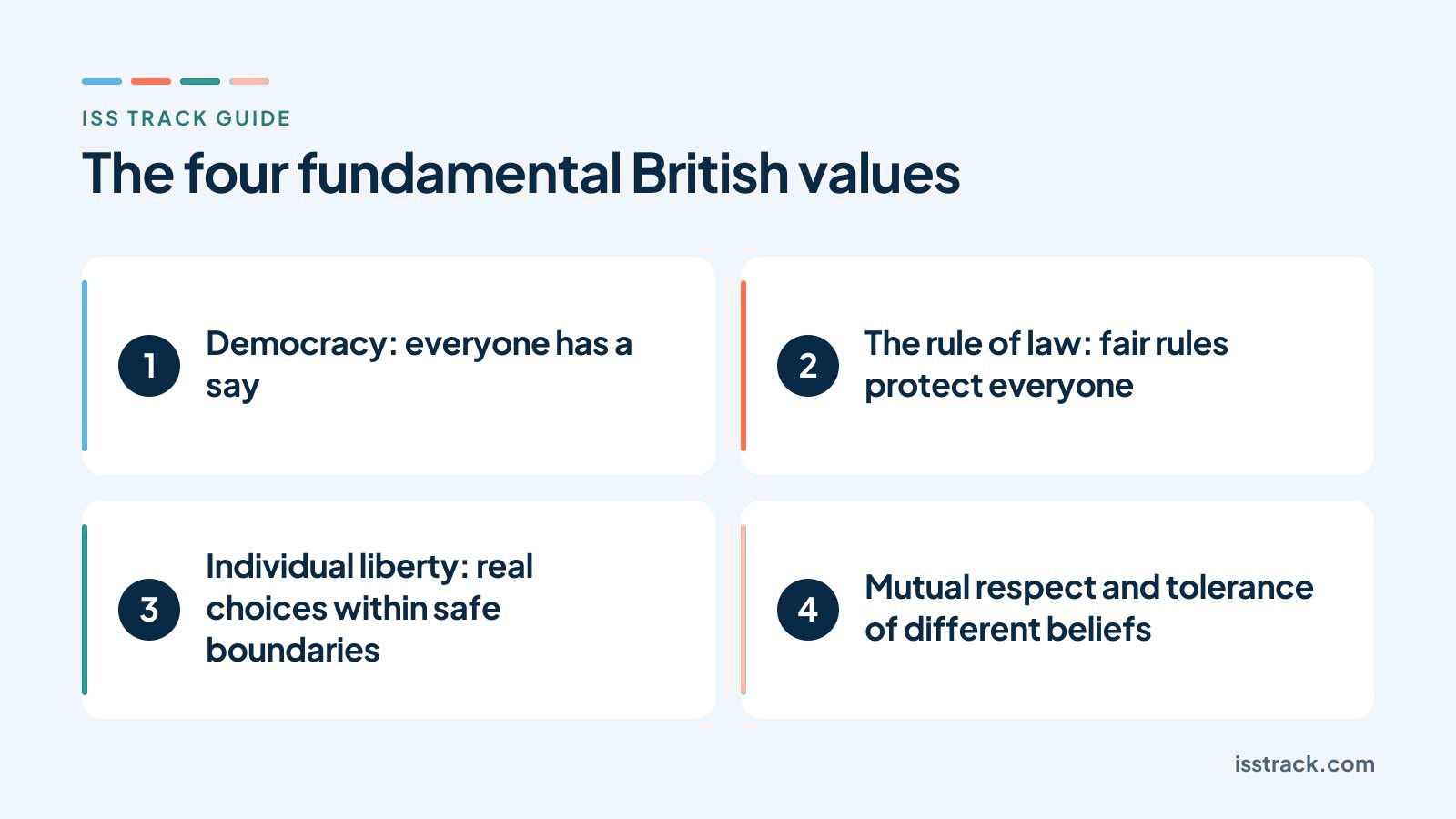
The fundamental British values are:
- Democracy: everyone can have a say, and decisions are made fairly.
- The rule of law: rules and laws protect us, apply to everyone and are applied fairly.
- Individual liberty: we can make choices and express ourselves, within safe boundaries.
- Mutual respect and tolerance of those with different faiths and beliefs, and of those without faith.
The word “British” can distract from the point. These are the shared values that allow people of different backgrounds to live well together. Promoting them does not mean asking pupils to give up their own identity, faith or culture.
What is the difference between actively promoting and not undermining British values?
Not undermining British values, in Part 1, means nothing pupils are taught works against them, while actively promoting them, in Part 2, means deliberately planning for pupils to understand and experience them.
The standards use both phrases, and the difference matters.
Part 1 asks that the curriculum and teaching do not undermine the fundamental British values. That is the floor: nothing pupils are taught should work against them. Our guide to Part 1 and the quality of education covers this.
Part 2 goes further. It asks the school to actively promote them. That means deliberately planning opportunities for pupils to understand and experience the values, across the curriculum and the wider life of the school, and being willing to challenge views that run contrary to them, whoever expresses them.
Common Misconception
“We’ve got a British values display and a PSHE unit, so Part 2 is covered.” Displays and lessons can help, but active promotion is about what pupils experience every day. Inspectors are more likely to be persuaded by a pupil explaining how the school council changed something than by a poster. The values should be visible in how the school works.
What does active promotion of British values look like in practice?
Every school’s circumstances are different, but active promotion usually shows up in several places at once:
- The curriculum: history, citizenship, RE and PSHE that explore democracy, law, rights and different beliefs, at a level that suits pupils.
- Pupil voice: a school council, class votes or regular ways for pupils to influence decisions, with visible results.
- Behaviour and relationships: rules that are clear and fair, and restorative conversations that help pupils understand why rules matter.
- Choice: real opportunities to make decisions about learning, activities and how pupils present themselves.
- The wider world: visits to public services, local councils, places of worship and community organisations.
- How adults model it: staff who listen, explain decisions and treat every pupil and family with respect.
The DfE’s updated guidance on the standards, published in April 2026, includes more examples of what promoting fundamental British values can look like in practice. Our summary of the Independent School Standards changes in 2026 explains what else was updated.
Good Practice
In strong schools, leaders can map where each element of paragraph 5 is promoted across the curriculum, pastoral work and enrichment. More importantly, pupils can talk about it in their own way. They can describe a time they had a say, a rule that keeps them safe and why, or something they learned about a culture or belief different from their own.
How do you teach British values to pupils with SEND?
For pupils with SEND, the values are often best understood through experience rather than explanation. The DfE’s guidance recognises that the approach should be adapted to pupils’ needs. Some examples:
- Democracy: choosing between two activities using symbols, objects of reference or eye gaze, and seeing that the choice made happens.
- The rule of law: consistent routines and boundaries, with simple explanations of why they keep everyone safe.
- Individual liberty: real choices built into the day, from food and clothing to how a task is approached.
- Mutual respect: learning about different celebrations through sensory experiences, and talking about difference with kindness.
For older pupils and those in AP, the values often connect closely to preparation for adulthood: understanding consent and the law, voting, rights at work, and how to get help from public services.
From Our Experience
We often see special schools doing excellent work here without recognising it as Part 2. Choice boards, regulation routines, community visits and restorative conversations are all active promotion. Schools that show this well usually name it: staff know which values they are developing, and leaders capture a few examples each term.
How does Part 2 connect to protected characteristics and respect?
Paragraph 5 asks schools to encourage respect for other people, paying particular regard to the protected characteristics in the Equality Act 2010. These include age, disability, gender reassignment, marriage and civil partnership, pregnancy and maternity, race, religion or belief, sex and sexual orientation.
This links closely to PSHE in Part 1, and to anti-bullying in Part 3. When prejudice-based language or bullying is challenged consistently, recorded and learned from, pupils see respect in action. Our guide to Part 3: welfare, health and safety covers the anti-bullying strategy.
Can independent schools discuss political issues with pupils?
Yes, and they should. Pupils need to understand the issues that shape their lives and their communities. Part 2 sets two clear expectations:
- No promotion of partisan political views in the teaching of any subject.
- A balanced presentation of opposing views whenever political issues are brought to pupils’ attention, whether in lessons, extracurricular activities or the promotion of those activities.
In practice, that means staff can discuss contested topics, but present different viewpoints fairly and avoid steering pupils towards a party or position. It’s understandable that staff sometimes worry about getting this wrong. A short staff briefing and a few agreed principles usually give people the confidence to have these conversations well.
How should independent schools manage visiting speakers?
Check who the speaker is and what they will say before confirming, consider safeguarding and Prevent, make sure a member of staff is always present and balance any political views.
Visiting speakers can bring learning to life, from local councillors and emergency services to charities and faith leaders. A simple, proportionate procedure helps keep the experience positive and safe:
- Find out who the speaker is and what they plan to say, before confirming.
- Consider any safeguarding or Prevent concerns, and check online if needed.
- Make sure a member of staff is present throughout.
- If political issues are involved, ensure opposing views are balanced, either in the session or alongside it.
- Talk with pupils afterwards, so they can reflect and ask questions.
The visiting speakers procedure often sits alongside the safeguarding policy. Our list of the policies an independent school needs shows where it fits.
How can we evidence Part 2?
Part 2 is met through what pupils experience, so the strongest evidence is pupil voice, observation and examples of impact, alongside curriculum maps and a short SMSC statement. Our guide to Independent School Standards evidence explains how to balance policies with evidence of practice.
At inspection, this connects closely to the personal development and well-being evaluation area. Our guide to how Ofsted inspects independent schools explains how evaluation areas and the compliance record fit together.
ISS Track breaks paragraph 5 into its separate requirements, with what a reviewer would look for and typical evidence for each, so leaders can see which elements are well evidenced and which rest on a policy alone.
Questions for Leaders
- Could our pupils describe, in their own way, a time they had a say in school?
- Where is each element of paragraph 5 promoted, and how do we know it is working?
- How have we adapted our approach to British values for the way our pupils learn and communicate?
- Do staff feel confident handling political topics and offering balanced views?
- Is our visiting speakers procedure simple, followed and known by staff?
- Do we challenge prejudice consistently, and do we learn from what we record?
Free download: Independent School Standards checklist
Every requirement in all eight parts, including each element of paragraph 5, in plain English with space to record your rating, evidence and owner. Download the checklist (PDF)
Our Perspective
Part 2 is not a box to tick at inspection. It is how pupils learn that their voice matters, that rules are fair and that difference is something to respect. For many young people in special schools and AP, those experiences change how they see themselves and their future. When leaders plan for them deliberately, every part of the Independent School Standards becomes stronger.
Sample wording: a short SMSC and British values statement
Many leaders ask what a short SMSC statement might sound like. Here is an example you could adapt for your website or staff handbook. It works best when every example in it is true of your school, so replace the words in square brackets with your own.
“At [school name], we help pupils grow in confidence, understand right from wrong and learn to live well alongside others. We actively promote the fundamental British values of democracy, the rule of law, individual liberty, and mutual respect and tolerance of those with different faiths and beliefs and those without faith.”
“Pupils experience these values every day. They have a real say through [our pupil council, class votes or choice boards], learn why our rules keep everyone safe, make meaningful choices about their learning, and explore cultures and beliefs different from their own through [visits, celebrations and lessons]. We adapt how we do this to the way each pupil learns and communicates.”
“When political issues come up, staff present different views fairly and do not promote any party or position. We challenge prejudice whenever we see it, and we learn from what we record.”
A statement like this is only as strong as the practice behind it. A good test is whether a pupil, a parent and a member of staff would all recognise the school it describes.
Sources and further reading
- Education (Independent School Standards) Regulations 2014, Schedule, Part 2: Spiritual, moral, social and cultural development of pupils
- Promoting fundamental British values through SMSC (DfE)
- Equality Act 2010, section 4: The protected characteristics
- Regulating independent schools: Independent school standards guidance (DfE, updated 2 April 2026)
- Prevent duty guidance: England and Wales (Home Office)
- Independent school inspection: toolkit, operating guide and information (Ofsted)
Look up the requirements, paragraph by paragraph
Continue exploring
- Part 1: quality of education, including PSHE and RSE
- Part 5: premises and accommodation, and why the environment matters for dignity
- How to self-evaluate against the standards honestly and consistently
- An Independent School Standards checklist covering every part
- Part 8 and proprietor responsibilities, including promoting wellbeing
- The most commonly unmet standards: what the official data shows, and how to stay ahead of it
- Independent school compliance, all year: a calm routine for keeping every standard met
- The Independent School Standards: a complete guide
- Part 1: EHC plans in independent special schools
- Part 3: Welfare, health and safety
- Part 3: KCSIE in independent schools
- Part 3: Restrictive interventions (16A and 32A)
- Part 4: The single central record (SCR)
- Part 6: What to publish on your website
- Part 6: Information for local authorities
- The accessibility plan
- Part 7: The complaints procedure
Elsewhere on ISS Track: see how evidence from learning walks helps with this, browse our free downloads, compare pricing, see ISS Track for groups or read every guide.
How can Jarvis Education help?
ISS Track is supported by Jarvis Education, an education consultancy led by a former HMI that supports independent schools, independent special schools and alternative provision. We understand how differently SMSC and British values can look for pupils with complex needs, and how much good work often goes unrecognised.
If you would like an independent view of your personal development offer, through a focused review, a full ISS health check, staff CPD or leadership support, we would be glad to help. Our work is about building confidence and strengthening practice, never finding fault. Get in touch and tell us about your school.
How can ISS Track help?
See how ISS Track helps you show SMSC across the whole school.
Gather evidence of SMSC and British values from across your team, including observations from learning walks, linked to each requirement.
Also useful:Watch the two minute tourView pricingBuy nowAll featuresFor groupsThe complete guide to the standards
ISS Track is supported by Jarvis Education
Support from Jarvis Education
Sometimes an experienced pair of eyes helps. These services and guides from the Jarvis Education team go further on this topic.