Restrictive interventions in independent schools: recording restraint and telling parents


For many leaders in independent special schools and alternative provision, the hardest moments of the week are the ones where a child is so distressed that staff have to step in physically. It’s understandable that these moments weigh heavily. Afterwards there is a record to write and a parent to call, often at the end of a long day.
Since 1 April 2026, the Independent School Standards say more about those moments than ever before. From our experience, the new duties are less about paperwork and more about something good schools already value: being open with families, learning from every incident, and steadily reducing the need to restrict any child at all.
In short: Restrictive interventions in independent schools are now covered by two standards. Paragraph 16A requires procedures for recording each significant use of force and every seclusion, restraint or immobilisation, in writing as soon as practicable, and paragraph 32A requires schools to tell each parent about each incident as soon as practicable, with limited exceptions.
This guide explains what the standards ask for, what a good record looks like, how to tell parents well, and how to use what you learn to keep children safer. If you want the wider picture first, our guide to Part 3: welfare, health and safety shows where 16A sits among the other welfare standards.
What are restrictive interventions in independent schools?
The DfE’s guidance, Restrictive interventions, including the use of reasonable force, in schools, which took effect on 1 April 2026 and applies to independent schools as well as state schools, describes a restrictive intervention as a means to prevent, restrict or subdue movement of the body. In practice, the standards cover three kinds of incident:
- Use of force: physical contact to control or restrain a pupil, using no more force than is necessary for the least amount of time.
- Restraint or immobilisation: restricting a pupil’s movement, other than as a disciplinary penalty. This includes holding part of their body, securing them to a fixed or heavy object, or taking away an aid they normally use to move, such as a walking frame.
- Seclusion: keeping a pupil in a place apart from everyone else, other than as a disciplinary penalty. It still counts as seclusion if a member of staff blocks the exit, secures the room, or leads the pupil to believe they will be punished if they leave.
That last point matters. We often see calm rooms and sensory spaces that are used well most of the time. But if a child is prevented from leaving, it is seclusion, whatever the room is called. A useful exercise is to walk round your site and ask of each space, “Could a child ever be kept in here?”
What does paragraph 16A require independent schools to record?
Every use of force incident, and every incident in which a member of staff secludes, restrains or immobilises a pupil, recorded in writing as soon as practicable.
Paragraph 16A of the Independent School Standards was inserted from 1 April 2026 by the Schools (Recording and Reporting of Seclusion and Restraint) (No. 2) (England) Regulations 2025. It asks the proprietor to make sure that:
- there is a procedure for recording each use of force incident
- there is a procedure for recording each incident in which a member of staff secludes, restrains or immobilises a pupil, with the record made in writing as soon as practicable
- all reasonable steps are taken to make sure both procedures are followed
An incident that is both a use of force and a restraint only needs recording once, under the use of force procedure. “Staff” includes supply staff and volunteers, so induction for temporary colleagues needs to cover how and where to record.
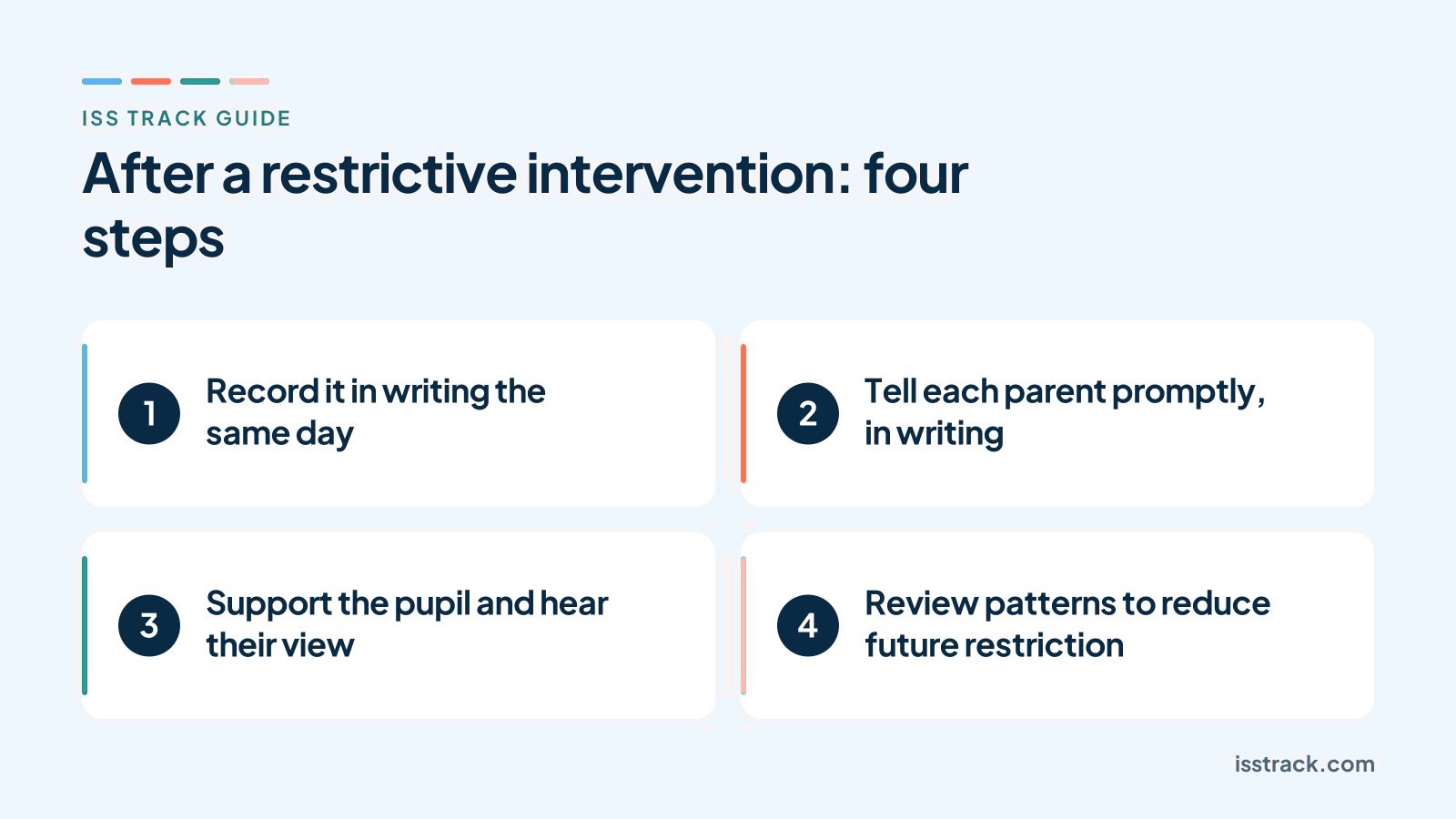
The DfE guidance adds helpful detail on timing: records should be made as soon as practicable and, where possible, no later than the same day. Many leaders tell us a short, protected slot before staff go home makes all the difference.
What should a restraint or seclusion record include?
The DfE guidance sets out minimum content for use of force records, and says seclusion and other restraint records need similar details. The template below brings those minimums together with a few good practice fields we recommend. It is a starting point to adapt, not an official form.
| Field | What to write | Source |
|---|---|---|
| Pupil | Name, year group and any relevant needs, including SEN status and whether they have an EHC plan | DfE minimum |
| Staff involved | Names and roles of staff directly involved, noting any supply staff or volunteers | DfE minimum |
| When and where | Date, time, location and approximate duration | DfE minimum |
| Type of intervention | Use of force, restraint, immobilisation or seclusion, and the hold or method used | DfE minimum |
| What happened | A brief, factual account: the lead-up, likely triggers and the de-escalation strategies tried first | DfE minimum |
| Why it was necessary | The risk staff judged they were preventing, and why less restrictive options were not enough | DfE minimum |
| Injuries | Any injury to the pupil or staff, first aid given and medical advice sought | DfE minimum |
| Support afterwards | How the pupil, staff and any witnesses were supported | DfE minimum |
| Pupil’s view | What the pupil said about the incident when they were calm, in their own words where possible | Good practice |
| Parent informed | Who told which parent, how and when, or the reason recorded for using an exception | Good practice (evidence for 32A) |
| Leader review | Name of the leader who checked the record, date, and any actions such as a plan review | Good practice |
Keep the language plain and factual. “Sam pushed chairs over and moved towards a younger pupil” tells a reader far more than “Sam became aggressive.” Describe what happened without labelling the child.
From Our Experience
One of the most common challenges is that incidents are recorded in several places: a behaviour log, a safeguarding system, an accident book. Each may be accurate, but nobody sees the whole picture. Schools that handle this well usually choose one place where restrictive interventions live, and link out from it to safeguarding or injury records where needed.
When must schools tell parents about restraint?
Paragraph 32A, in Part 6, requires the recording procedures to include giving information about each incident to each parent of the pupil, as soon as practicable afterwards. The DfE guidance says this should be in writing, for example by email or an online messaging system, and ideally on the same day.
There are limited exceptions, and they need careful handling:
- The duty does not apply where the pupil is aged 20 or over.
- Information must not be given to a parent if the person deciding judges it would be likely to result in significant harm to the pupil. If no parent can be told safely, the information goes to the local authority where the pupil ordinarily lives.
- “Parent” includes a local authority that is accommodating the child under section 20 of the Children Act 1989, which matters for schools with looked after pupils.
Decisions about the significant harm exception should involve the designated safeguarding lead and be recorded, with the reasons. Every school’s circumstances are different, but it helps to agree in advance who makes that call. Our guide to KCSIE in independent schools covers the wider safeguarding arrangements this sits within.
Common Misconception
“If a hold is agreed in the pupil’s behaviour support plan, we don’t need to record it or tell parents each time.” The DfE guidance is clear that the recording and reporting duties still apply where a plan has agreed the intervention. A plan explains what staff may do. The record and the message home show what actually happened, each time.
What should a letter to parents about restraint say?
The guidance expects the written report to include the time, date, location and duration, why the intervention was necessary, the type and degree of force used, and any injuries. A good message is honest, calm and warm, and never reads like a complaint about the child.
Here is a short, illustrative example of how a school might write to a parent.
Dear Ms Patel, I’m writing to let you know that staff needed to hold Leo safely today. At about 11:20, during the move from science to lunch, Leo became very distressed in the corridor and started hitting his head against the wall. Staff first gave him space and offered his ear defenders. Because he was at risk of hurting himself, two members of staff, Mr Okafor and Mrs Lewis, guided him using a two-person standing hold, as set out in his support plan, for about three minutes, until he was calm enough to walk to the quiet room with an adult. Leo has a small red mark on his forehead, which our first aider checked. He ate his lunch and joined his afternoon class. We will talk with Leo tomorrow about what made the corridor hard, and I would welcome a call with you this week about lunchtime transitions. Kind regards, Ms Ahmed, Deputy Headteacher
Example only: names and details are fictional
The example names what came before the hold, shows that gentler options were tried first, mentions the injury honestly and invites the parent into the next step. Many leaders tell us messages like this build trust, even on difficult days.
How can schools reduce the need for restrictive interventions?
By putting prevention and de-escalation first: individual plans built with the pupil and family, calmer environments, trained staff and a review after every significant incident.
Recording and reporting are the minimum. The real purpose is that fewer children are restricted over time. The DfE guidance puts prevention and de-escalation first, and is clear that force must never be used as a punishment and that restraint must not restrict a child’s airway, breathing or circulation. In schools where this works well, we often see:
- Individual plans built with the pupil and family, describing early signs of distress, what helps, and what staff should try first. The guidance expects plans to be reviewed periodically and after any significant incident.
- Environments that lower pressure: predictable routines, quieter transitions and spaces a child can choose to use.
- Training that goes beyond holds, covering communication, sensory needs and de-escalation.
- A conversation after every incident, ideally led by someone not involved, that hears separately from the pupil and the staff about what happened and what might help next time.
Checking in with pupils who saw an incident, and with staff, is part of keeping everyone’s dignity intact. For pupils with an EHC plan, make sure the EHC plan and the behaviour support plan tell the same story. Our guide to EHC plans in independent special schools explains how.
Good Practice
In strong schools, restrictive interventions are rare, planned for and openly discussed. Staff notice distress early. Every incident is recorded the same day, parents hear promptly and kindly, the child is supported afterwards, and each record prompts one question: what could we do so this does not need to happen again?
How should leaders and proprietors review restraint records?
The proprietor must take all reasonable steps to make sure the procedures are followed. The DfE guidance also expects governing bodies and proprietors to look at the data regularly: to improve policy and practice, spot training needs, notice repeated patterns and triggers, and check for any disproportionate use with pupils who have SEND, protected characteristics or other vulnerabilities.
For example, a small independent special school might give its proprietor a half-termly summary of incidents by pupil, time of day and location, with a short narrative on what has changed and what the school will try next. The guidance warns against over-reading small numbers, so the narrative matters as much as the figures. Our guide to proprietor responsibilities explains how this fits with Part 8.
Policies need to keep pace too. A restrictive interventions or positive handling policy should link to the behaviour policy and explain how parents will be told. Our list of the policies an independent school needs shows where it fits, and the DfE’s Independent School Standards guidance, updated in April 2026, is worth reading alongside it.
Questions for Leaders
- Could a supply teacher or volunteer explain how to record a restrictive intervention here?
- Are any of our rooms or practices seclusion in law, even if we call them something else?
- How quickly are parents told, and could we show it for the last ten incidents?
- Who decides when the significant harm exception applies, and is each decision recorded?
- Do we hear the child’s view after every incident?
- What have our records taught us this term, and what have we changed as a result?
Free download: Independent School Standards checklist
Every requirement in all eight parts, including paragraphs 16A and 32A, in plain English with space to record your rating, evidence and owner. Download the checklist (PDF)
Our Perspective
The new standards ask schools to write down some of the most significant moments in a child’s school life, tell families honestly, and learn from them. Schools that approach this with curiosity rather than fear usually find that incidents fall, staff feel more confident, and children feel safer. That is the measure that matters, far more than any inspection.
Sources and further reading
- Restrictive interventions, including the use of reasonable force, in schools (DfE)
- The Education (Independent School Standards) Regulations 2014, Schedule Part 3: Welfare, health and safety of pupils
- The Schools (Recording and Reporting of Seclusion and Restraint) (No. 2) (England) Regulations 2025
- The Education (Independent School Standards) Regulations 2014, Schedule Part 6: Provision of information
- Regulating independent schools (DfE), including Independent school standards guidance, April 2026
Look up the requirements, paragraph by paragraph
Continue exploring
- The Independent School Standards changes in 2026, including 16A and 32A alongside the other updates
- What are the Independent School Standards? A plain English guide to all eight parts
- What evidence do you need for the standards? and how to show practice, not just policy
- What an independent school must publish, including how 32A affects your published policies
- Self-evaluation against the standards: knowing honestly where you stand
- KCSIE in independent schools: how Keeping children safe in education connects to the standards
- The most commonly unmet standards: what the official data shows, and how to stay ahead of it
- Independent school compliance, all year: a calm routine for keeping every standard met
- Part 1: Quality of education
- Part 1: EHC plans in independent special schools
- Part 2: SMSC and British values
- Part 3: Welfare, health and safety
- Part 4: The single central record (SCR)
- Part 5: Premises and accommodation
- Part 6: Information for local authorities
- The accessibility plan
- Part 7: The complaints procedure
- Part 8: Leadership and proprietors
Elsewhere on ISS Track: see how the standards tracker helps with this, browse our free downloads, compare pricing, see ISS Track for groups or read every guide.
How can Jarvis Education help?
ISS Track is supported by Jarvis Education, an education consultancy led by a former HMI and former headteacher in specialist settings and alternative provision. Our consultants include experienced safeguarding, SEND and AP leaders.
If you would like an independent look at your restrictive interventions policy, a sample of your records and parent messages, or how your proprietor reviews the data, we would be glad to help through a focused review, a full ISS health check or staff CPD. Our reviews are designed to build confidence and reduce restriction over time, never to find fault. Get in touch and tell us a little about your school.
How can ISS Track help?
See how ISS Track keeps paragraphs 16A and 32A in your regular review, with actions, owners and evidence in one place.
ISS Track includes paragraphs 16A and 32A, so you can rate each one, attach sample records and parent letters, and set actions with owners.
Also useful:Watch the two minute tourView pricingBuy nowAll featuresFor groupsThe complete guide to the standards
ISS Track is supported by Jarvis Education
Support from Jarvis Education
Sometimes an experienced pair of eyes helps. These services and guides from the Jarvis Education team go further on this topic.