Ofsted or ISI: who inspects independent schools?


It sounds like a simple question, but many leaders tell us they were not completely sure of the answer when they first took on an independent school. Is our school inspected by Ofsted or ISI? Does it make a difference? And could it change? It’s understandable to feel unsure. New proprietors, heads moving across from the state sector and trustees joining a board all meet this question early, often while juggling everything else that comes with leading a school.
The reassuring part is that the answer is clear once you know where to look, and the expectations underneath it are the same whichever inspectorate visits. This guide explains who inspects independent schools, how the two inspectorates compare, how to check which one is yours, and why the most useful focus is always the standards themselves.
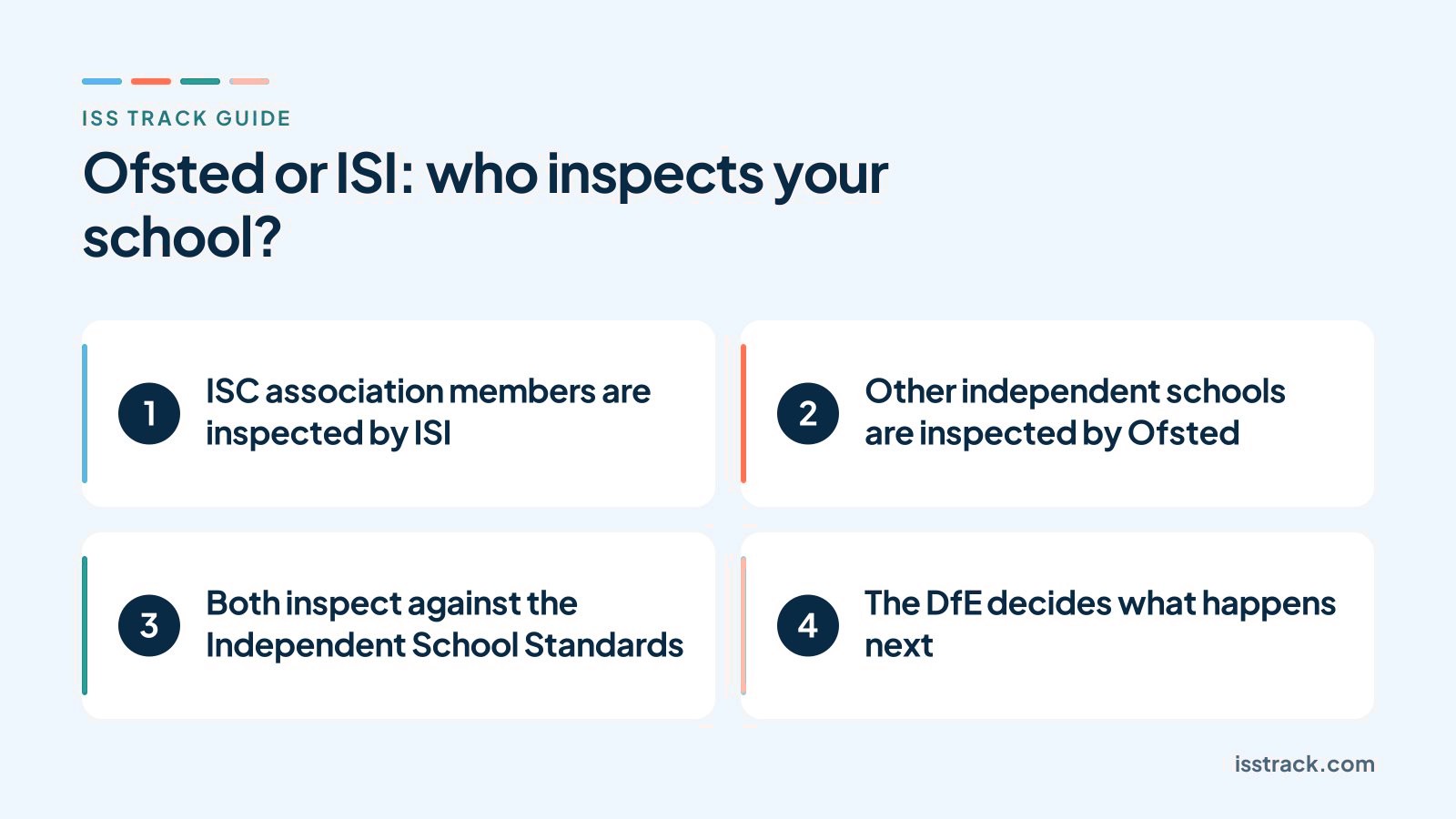
In short: Whether a school is inspected by Ofsted or ISI depends on association membership. Schools in associations affiliated to the Independent Schools Council are inspected by the Independent Schools Inspectorate (ISI); all other registered independent schools, including most independent special schools, are inspected by Ofsted. Both inspect against the same Independent School Standards, and the Department for Education decides what happens next.
Who inspects independent schools in England?
Ofsted inspects non-association independent schools, including most independent special schools, and ISI inspects schools that belong to an association affiliated to the Independent Schools Council.
Every registered independent school in England must meet the Education (Independent School Standards) Regulations 2014, and every one is inspected against them. Two bodies carry out that work.
- Ofsted inspects non-association independent schools. This group includes most independent special schools, many smaller independent schools, and alternative provision that is registered as an independent school.
- The Independent Schools Inspectorate (ISI) inspects schools that are members of associations affiliated to the Independent Schools Council, such as the Independent Schools Association (ISA), the Independent Association of Prep Schools (IAPS) and the Girls’ Schools Association (GSA).
Non-association schools now have a network of their own too. The Non-association Independent Schools Alliance (NAISA) brings them together for support, representation and practical guidance on compliance and inspection readiness.
The arrangement exists because the law allows the Secretary of State to approve an independent inspectorate for a described group of schools, including a group defined by membership of a particular body. That power is in section 106 of the Education and Skills Act 2008. ISI is the approved inspectorate for association schools, and Ofsted inspects the rest.
If you are new to the language around all this, our short guide to what ISS means in schools explains the acronyms you will hear.
Ofsted vs ISI: what is the difference?
They use different frameworks and report in different ways, but both inspect against the same Independent School Standards, and the DfE decides what happens next in both cases.
The two inspectorates have different frameworks, different ways of writing up what they find and different histories. What they share matters more: the same legal standards, and the same body deciding what happens afterwards. Here is a side by side view.
| Ofsted | ISI | |
|---|---|---|
| Which schools | Non-association independent schools, including most independent special schools and registered alternative provision | Schools in associations affiliated to the Independent Schools Council |
| Standards used | The Independent School Standards, plus boarding or residential standards and early years requirements where relevant | The Independent School Standards, plus the boarding National Minimum Standards and early years requirements where relevant |
| Framework document | Ofsted’s independent school inspection toolkit and operating guides, with new versions in use from September 2026 | ISI’s framework for the inspection of association independent schools, introduced in September 2023, and its inspection handbook |
| How findings are reported | Evaluation areas graded on a five-point scale, with each standard recorded as met or not met in a compliance record | No overall grades; standards are reported as met or unmet, and inspectors may identify significant strengths |
| Who acts on findings | The Department for Education, as the registration authority | The Department for Education, as the registration authority |
The last row is the one we would ask every leader to remember. Neither inspectorate registers schools or takes regulatory action. Inspection reports inform the DfE, and the DfE decides what follows, from asking for an action plan to more formal steps.
Common Misconception
“ISI is the easier inspection” or “Ofsted is tougher on independent schools.” We hear both, and neither is a helpful way to think about it. Both inspectorates check the same standards, and an unmet standard is an unmet standard whoever records it. The style of the report differs; the expectations on the school do not.
Is my school inspected by Ofsted or ISI?
The quickest way to check is to ask one question: is the school a member of an association affiliated to the Independent Schools Council? If yes, it is inspected by ISI. If not, it is inspected by Ofsted.
To confirm it with evidence, there are three simple places to look:
- Your school’s record on Get Information about Schools, the DfE’s service holding information on state-funded schools, independent schools and other education providers. Check that the details are accurate while you are there.
- Your most recent inspection report, which will show which inspectorate carried it out.
- Your registration correspondence with the DfE, which the proprietor should hold.
For most independent special schools and registered alternative provision, the answer will be Ofsted. Our guide to how Ofsted inspects independent schools explains that process in detail.
Do Ofsted and ISI use the same standards?
Yes. Both inspect against the Independent School Standards, all eight parts, from the quality of education to leadership and management. A strong safeguarding culture, an accurate single central record, a complaints procedure with a proper panel stage and a well kept website matter in exactly the same way whichever inspectorate visits.
This is why we always encourage leaders to look past the inspectorate to the standards themselves. Our complete guide to the Independent School Standards sets out what each part asks of a school, and why each one protects something important for children and families.
From Our Experience
We often meet leaders who have read a great deal about one inspectorate’s framework and much less about the standards underneath it. The schools that feel most settled are usually the other way round. They know every standard well, they keep their evidence current, and the framework simply describes how someone else will look at work they already understand.
What framework does Ofsted use for independent schools?
Ofsted inspects non-association independent schools using its independent school inspection toolkit, operating guides and inspection information. These replaced the old independent schools inspection handbook and additional inspection handbook from January 2026. New versions were published in June 2026 and came into force in September 2026. A summary of the changes was added to the page in August 2026.
Under the toolkit, evaluation areas are graded on a five-point scale, and inspectors record each standard as met, not met or not applicable in a compliance record. The standards closely match the “expected standard” in the toolkit, so an unmet standard limits the grades a school can receive. Because the documents are updated from time to time, it is always worth reading the current versions rather than relying on a copy saved last year.
What framework does ISI use?
ISI inspects association schools under its framework for the inspection of association independent schools, which has applied since September 2023, alongside an inspection handbook. The handbook explains that inspectors check the Independent School Standards, the National Minimum Standards for boarding schools where they apply, and early years requirements. Rather than awarding grades, ISI reports whether the standards are met and may identify significant strengths.
ISI updates its framework and handbook from time to time, so association schools should always check isi.net for the current versions.
Who decides what happens after an Ofsted or ISI inspection?
The Department for Education. It registers independent schools, it commissions some inspections, and it is the body that takes regulatory action when standards are not met. Inspectors find and record; the DfE decides.
In practice, when standards are not met, the first step is usually a request for an action plan, followed by a progress monitoring inspection to check that things have been put right. Our guide to what happens if an independent school does not meet the standards walks through the process calmly. Schools that recover well usually treat it as a clear, time limited improvement task, owned by the proprietor and shared honestly with staff.
What happens if a school joins or leaves an association?
A school that joins an association affiliated to the Independent Schools Council normally moves to ISI inspection, and one that leaves normally moves to Ofsted.
Because ISI’s approval covers schools in membership of associations affiliated to the Independent Schools Council, a change in membership can change which inspectorate is responsible. A school that joins such an association would normally move to ISI inspection. A school that leaves would normally move to Ofsted.
Every school’s circumstances are different, and the timing of the next inspection after a change is not something to assume. If membership is changing, the proprietor should talk to the DfE early, keep the school’s details on Get Information about Schools accurate, and make sure leaders understand the framework they will meet next. Ofsted’s operating guide also allows for the DfE to commission Ofsted to inspect a school that would normally be inspected by ISI, so it is wise not to assume the inspectorate can never vary.
Good Practice
Strong schools that are changing association membership, or growing through a material change, treat it as a good moment for an honest look at every standard. They check their evidence against the standards rather than against one framework, so the picture holds up whoever inspects and whenever they arrive.
Who inspects boarding in independent schools?
ISI inspects boarding in association schools, and Ofsted inspects boarding and residential provision in non-association schools, against the relevant national minimum standards.
Schools with boarding must also meet the National Minimum Standards for boarding schools, and residential special schools have their own national minimum standards. These sit alongside the Independent School Standards and focus on the welfare of children who live at school.
For association schools, ISI checks the boarding standards as part of its inspection. For non-association schools, Ofsted inspects boarding and residential provision, and its guidance explains that, where both are due, the education and boarding or residential inspections are normally carried out together, with one report. For a residential setting, it helps to keep the two sets of standards in one shared view, because the same children experience both the school day and the evening.
Questions for Leaders
- Can everyone on our leadership team and board say which inspectorate is responsible for our school, and why?
- Is our record on Get Information about Schools accurate and up to date?
- Have we read the current version of our inspectorate’s framework, not last year’s?
- Do we evaluate ourselves against the standards themselves, or only against one framework?
- If we have boarding or residential provision, do we review the national minimum standards alongside the Independent School Standards?
Free download: Independent School Standards checklist
Whichever inspectorate visits your school, the standards are the same. Our checklist sets out every requirement in plain English, with space for your rating, evidence and owner. Download the checklist (PDF)
Our Perspective
Knowing whether you are inspected by Ofsted or ISI is useful, but it is not where a school’s strength comes from. The standards describe a school that is safe, well led and giving every child a good education. Keep them met, keep the evidence current and keep asking how the school can be better for its pupils, and the question of who inspects becomes far less important. Inspection is never the destination; continuous improvement is.
Sources and further reading
- The Education (Independent School Standards) Regulations 2014
- Education and Skills Act 2008, section 106: independent inspectorates
- Get Information about Schools (DfE)
- Independent school inspection: toolkit, operating guide and information (Ofsted)
- Inspection handbook: introduction (ISI)
- Boarding schools: national minimum standards (DfE)
Look up the requirements, paragraph by paragraph
Continue exploring
- How Ofsted inspects independent schools: the toolkit, the compliance record and the website check
- What are the Independent School Standards? The complete plain English guide
- What happens if standards are not met, explained calmly and step by step
- What does ISS mean in schools? The acronyms leaders hear, explained
- Self-evaluating against the standards, honestly and all year
- The most commonly unmet standards: what the official data shows, and how to stay ahead of it
- Independent school compliance, all year: a calm routine for keeping every standard met
- Preparing for an independent school inspection: what to check, what evidence to have ready and the first 48 hours
- Progress monitoring inspections: what Ofsted and ISI check against your action plan, and what happens next
- The 2026 changes to the standards
Elsewhere on ISS Track: see how the standards tracker helps with this, browse our free downloads, compare pricing, see ISS Track for groups or read every guide.
How can Jarvis Education help?
ISS Track is supported by Jarvis Education, an education consultancy led by a former HMI and Lead Ofsted Inspector, supporting independent schools, independent special schools and alternative provision across England. We help leaders and proprietors through independent reviews, ISS health checks, Quality Marks, CPD and leadership support.
Whether your school is inspected by Ofsted or ISI, an ISS health check gives leaders an experienced, independent view of where they stand on every standard, with a clear report and a practical action plan. It is there to build confidence and strengthen practice, never to find fault. Get in touch and tell us a little about your school.
How can ISS Track help?
See how ISS Track keeps your evidence against every Independent School Standard current, whichever inspectorate visits.
Every standard, its evidence and its owner kept current all year, so the picture is accurate whoever inspects.
Also useful:Watch the two minute tourView pricingBuy nowAll featuresFor groupsThe complete guide to the standards
ISS Track is supported by Jarvis Education
Support from Jarvis Education
Sometimes an experienced pair of eyes helps. These services and guides from the Jarvis Education team go further on this topic.