Does an independent school need an accessibility plan?


It’s understandable that the accessibility plan rarely feels like a priority. It is not one of the Independent School Standards, it often arrives as a template, and once signed it can sit in a folder for years. Many leaders tell us they are not sure what it should contain or how often it should change.
Yet for a disabled pupil, it is one of the most practical documents a school holds: a short, honest plan for making more of the curriculum, the building and everyday information open to them.
In short: Every independent school accessibility plan is required by Schedule 10 to the Equality Act 2010, not by the Independent School Standards. The proprietor must prepare a written plan, covering a three-year period, to improve disabled pupils’ access to the curriculum, the physical environment and information, then implement it, keep it under review and make a copy available on request.
This guide explains what the law asks, how the plan connects to the standards, and how to make it a plan that genuinely changes things for children and young people.
Do independent schools need an accessibility plan?
Yes. Schedule 10 to the Equality Act 2010 requires the responsible body of every school in England to prepare an accessibility plan. For an independent school, the responsible body is the proprietor. That includes independent special schools and independent alternative provision, regardless of size.
The plan must be in writing. The proprietor must keep it under review, revise it where necessary and implement it, having regard to the need for adequate resources. The law expects a plan that is funded and acted on, not just written.
The duty is about disabled pupils, which in the Equality Act means pupils with a physical or mental impairment that has a substantial and long-term adverse effect on their ability to carry out normal day-to-day activities (section 6 of the Act). It also includes disabled children who may be admitted, so plan for pupils you might welcome, not only those on roll.
What must a school accessibility plan cover?
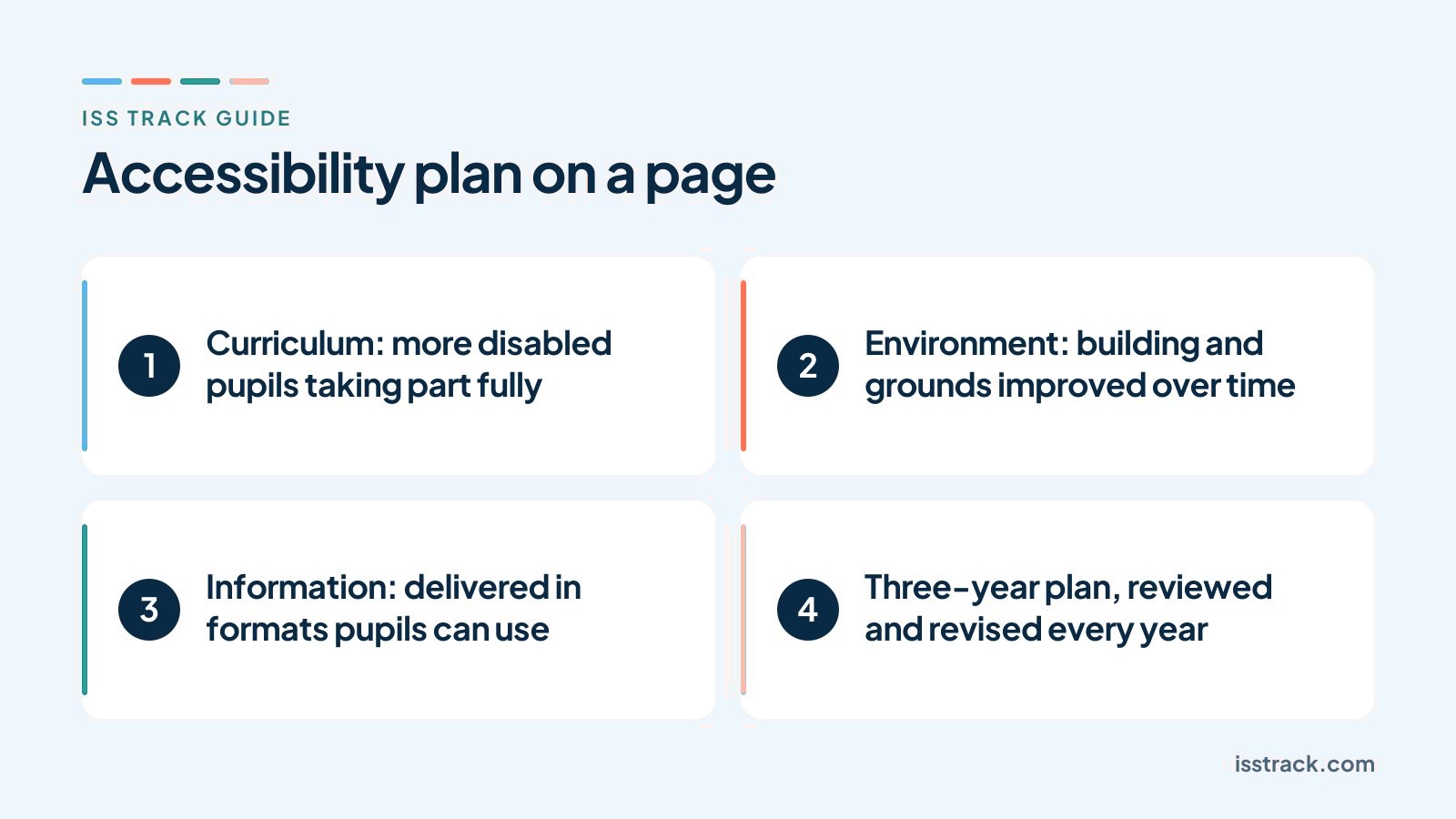
Schedule 10 sets out three areas, and a good plan has clear actions in each.
- Increasing access to the curriculum. Increasing the extent to which disabled pupils can participate in the school’s curriculum, including lessons, trips, clubs and other activities.
- Improving the physical environment. Improving the building and grounds so disabled pupils can take better advantage of the education, benefits, facilities and services the school provides.
- Improving the delivery of information. Making information that is readily available to other pupils accessible to disabled pupils too, within a reasonable time and in ways that take account of their disabilities and any preferences they or their parents have expressed.
The third area is the one we most often find thin. It is easy to write about ramps, and harder to think through how a pupil with a visual impairment receives a timetable change.
The DfE’s Equality Act 2010: advice for schools explains how the planning duty fits with the duty to make reasonable adjustments. Schools are not required to make physical alterations as a reasonable adjustment for an individual pupil, because physical improvements are expected to come through accessibility planning instead.
Common Misconception
“Our building is fully accessible, so our accessibility plan is done.” The physical environment is only one of three areas. A school with level access throughout can still have a great deal to plan for in curriculum participation and accessible information, and those are often the areas that make the biggest day-to-day difference to pupils.
How often should an accessibility plan be reviewed?
Accessibility plans run in three-year periods, and the current period ends on 31 March 2027, but the plan should be kept under review and checked at least once a year.
Accessibility plans cover a prescribed period. In England, the regulations that set the timetable provide for three-year periods, starting on 1 April 2006 and running in three-year cycles since. That is why most plans run for three years, with a new plan prepared for each period. On that cycle, the current period ends on 31 March 2027, so this is a good year to be thinking about your next plan.
Three years is the outer frame, not the review rhythm. Schedule 10 asks the proprietor to keep the plan under review and revise it where necessary. From our experience, schools that use their plan well check progress at least yearly and sooner when:
- a pupil joins with a disability the school has not planned for before
- the school changes its age range, the needs it caters for or its premises
- parents or pupils raise a barrier the plan has not considered
Is the accessibility plan part of the Independent School Standards?
Not directly. The DfE’s independent school standards guidance says plainly that the duty to prepare an accessibility plan comes from separate legislation and does not form part of the standards. No paragraph in Part 6 names the accessibility plan either.
That does not make it optional, and it does not mean the plan sits apart from the standards in practice. The same guidance links it to three parts:
- Part 1, quality of education. The guidance notes that the content of the accessibility plan is relevant to how the school plans and delivers its curriculum.
- Part 5, premises and accommodation. The guidance reminds proprietors that, although separate from the standards, Schedule 10 requires them to prepare, publish, review, revise and implement an accessibility plan, including intentions for improving the physical environment. Our guide to Part 5: premises and accommodation covers the standards themselves.
- Part 6, provision of information. Part 6 asks schools to make available particulars of their provision for pupils with EHC plans. Families often read the accessibility plan alongside it, so keep the two consistent.
Schedule 10 also allows inspections of independent schools to cover how the proprietor prepares, publishes, reviews, revises and implements the plan. So while it is not a standard in itself, it forms part of the wider picture of leadership and inclusion.
Does an independent school have to publish its accessibility plan?
Not on its website, strictly, but the proprietor must make a copy available when asked, and most schools find it simplest to publish it with their other statutory information.
Schedule 10 requires the proprietor of an independent school to make a copy of the plan available for inspection, at reasonable times, when asked. It must also give a copy to a government minister, in practice the Secretary of State, if asked.
In practice, the simplest approach is to publish it on the website with your other statutory information, noting that paper or alternative format copies are available. Families of disabled children find that reassuring. Our guide to what an independent school must publish on its website explains the Part 6 items it would sit beside.
The DfE advice confirms the plan can be a standalone document or part of another, such as the school development plan, as long as it can be found.
From Our Experience
We often see accessibility plans that were written for a different school, or for this school several years ago. The dates have passed, the actions are marked “ongoing”, and the needs described no longer match the pupils on roll. In independent special schools, where daily practice for disabled pupils is often excellent, the plan simply undersells the school.
What does a good accessibility plan look like?
A good plan is short, specific and owned. It starts from what the school knows about its current and likely future pupils, sets out a small number of realistic actions in each of the three areas, and says who will do what by when, and how the school will know it has worked.
One approach we find helpful is an “accessibility plan on a page”. The table below shows the shape. Every action in it is an illustrative example only, not a list of requirements. Yours should come from your own pupils, building and families.
| Curriculum | Physical environment | Information |
|---|---|---|
| Example: review every off-site visit at the planning stage so pupils who use a wheelchair can take part in the same activity | Example: install a handrail and contrast edging on the stairs to the science room by the end of the spring term | Example: produce visual and easy read versions of the timetable and fire procedures for pupils who need them |
| Example: train all staff on adapting practical lessons for pupils with fine motor difficulties | Example: create a quiet, low-stimulus space for pupils with sensory processing needs | Example: ask parents how they prefer to receive information, and record and use their answers |
| Example: check that PE and enrichment offer comparable options for pupils with physical disabilities | Example: add accessible signage at entrances and toilets as part of the summer redecoration | Example: make sure the website and key letters work with screen readers and text enlargement |
Behind each action, add an owner, a date, the resources needed and a simple success measure. That last one is where many plans fall short.
Good Practice
Strong accessibility plans are informed by pupils and parents, not written about them. Leaders ask disabled pupils what gets in their way and notice which activities they miss. Each action has an owner, a budget and a date, and the proprietor sees progress every year.
How do we make the accessibility plan a living plan?
Base it on the pupils you actually have, link it to what comes up in EHC plan reviews, put its actions in the budget and review progress regularly.
One of the most common challenges is that the plan is written once and then left. Schools that keep their plan alive usually do a few simple things:
- Start from real pupils. Look at the needs of pupils on roll, the referrals you receive and the pupils you have had to turn away, and let that shape the actions.
- Link it to EHC plans. Many disabled pupils also have special educational needs. Barriers that come up repeatedly in annual reviews are often whole-school actions waiting to happen. Our guide to EHC plans in independent special schools explains how annual reviews work.
- Put it in the budget. The law asks the proprietor to have regard to adequate resources. Building plan actions into the premises and training budget is the clearest way to show it.
- Connect it to premises work. When planning maintenance, check whether an accessibility improvement could be made at the same time.
- Report on it. A short annual update to the proprietor on what has changed for pupils keeps the plan visible.
Every school’s circumstances are different. A small alternative provision in leased premises may have little scope to change its building but plenty to improve curriculum access and information. An honest, focused plan is far stronger than one that promises everything.
Questions for Leaders
- Do we have a current, written accessibility plan, and does it cover the period we are in now?
- Does it have clear actions in all three areas: curriculum, physical environment and information?
- Does each action have an owner, a date, resources and a way of knowing it has worked?
- Have disabled pupils and their parents had a say in what the plan contains?
- Could a parent easily get a copy, in a format that works for them?
- Are we ready to prepare our next plan for the period starting in April 2027?
Free download: Independent School Standards checklist
Every requirement in all eight parts in plain English, with space for your rating, evidence and owner, to sit alongside your accessibility plan. Download the checklist (PDF)
Our Perspective
An accessibility plan is not really about compliance. It is a promise that, year by year, more of school will be open to every child: the lesson, the trip, the playground and the letter home. When it is honest, funded and reviewed, disabled pupils feel the difference long before anyone reads it.
Sources and further reading
- Equality Act 2010, Schedule 10: Accessibility for disabled pupils
- Equality Act 2010, section 6: disability
- Equality Act 2010: advice for schools (DfE)
- The Disability Discrimination (Prescribed Times and Periods for Accessibility Strategies and Plans for Schools) (England) Regulations 2005, regulation 3
- Regulating independent schools (DfE), including Independent school standards guidance, April 2026
Look up the requirements, paragraph by paragraph
Continue exploring
- What policies does an independent school need?, including those required by other law
- What must an independent school publish on its website?, item by item
- Part 5: premises and accommodation, and the standards behind your building
- EHC plans in independent special schools, and how annual reviews feed planning
- Part 1 and the quality of education, where curriculum access begins
- Information for local authorities: the annual account and annual review information Part 6 asks for
- Independent school compliance, all year: a calm routine for keeping every standard met
- The Independent School Standards: a complete guide
- Part 2: SMSC and British values
- Part 3: Welfare, health and safety
- Part 3: KCSIE in independent schools
- Part 3: Restrictive interventions (16A and 32A)
- Part 4: The single central record (SCR)
- Part 7: The complaints procedure
- Part 8: Leadership and proprietors
Elsewhere on ISS Track: see how the policy register and website review helps with this, browse our free downloads, compare pricing, see ISS Track for groups or read every guide.
How can Jarvis Education help?
ISS Track is supported by Jarvis Education, an education consultancy led by a former HMI that supports independent schools, independent special schools and alternative provision. Our experienced consultants can review your accessibility plan alongside your curriculum, premises and published information, and help you shape a plan that is realistic, specific and genuinely useful for your pupils.
Our reviews are there to build confidence and strengthen leadership, never to find fault. Get in touch and tell us a little about your school.
How can ISS Track help?
See how ISS Track keeps your accessibility plan, policies and published information current alongside every standard.
Owners, review dates and evidence for your accessibility plan, kept alongside the standards and your policy register.
Also useful:Watch the two minute tourView pricingBuy nowAll featuresFor groupsThe complete guide to the standards
ISS Track is supported by Jarvis Education
Support from Jarvis Education
Sometimes an experienced pair of eyes helps. These services and guides from the Jarvis Education team go further on this topic.