Part 8: what proprietors and leaders must do to meet the Independent School Standards


Being the proprietor of an independent school is a serious responsibility, and often a lonely one. Whether you are an individual owner, a trustee of a charity, a director of a company or a group leader overseeing several schools, it’s understandable to wonder how you can be confident that everything is in place when you are not in the building every day.
Part 8 of the Independent School Standards, which sets out proprietor responsibilities, speaks directly to that question. It is just one paragraph long, but it holds the others together. From our experience, proprietors who understand Part 8 well tend to lead calmer, more confident schools.
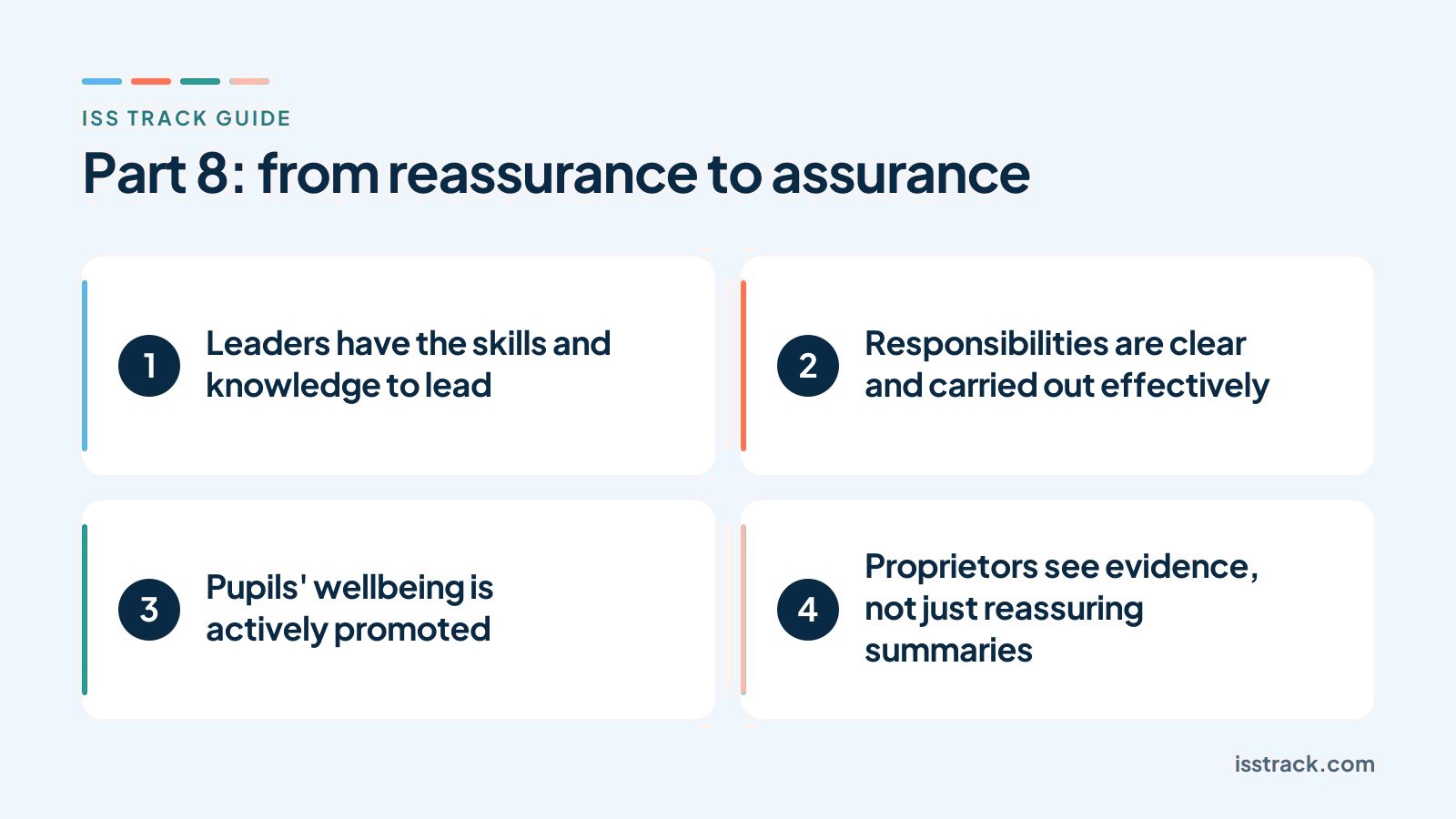
In short: Proprietor responsibilities under Part 8 of the Independent School Standards come down to paragraph 34: the proprietor must make sure the people who lead and manage the school have the skills and knowledge for their roles, fulfil their responsibilities so the other standards are met consistently, and actively promote pupils’ wellbeing.
This guide explains what Part 8 asks, why it is rarely met when other standards are not, and the practical ways proprietors and leaders can gain genuine assurance. For an overview of all eight parts, see our complete guide to the Independent School Standards.
What does Part 8 of the Independent School Standards require?
Part 8 requires the proprietor to make sure leaders have the skills and knowledge for their roles, fulfil their responsibilities so the standards are met consistently, and actively promote pupils’ wellbeing.
Part 8 is paragraph 34. It asks the proprietor to make sure that the people with leadership and management responsibilities in the school:
- Demonstrate good skills and knowledge appropriate to their role, so that the standards are met consistently.
- Fulfil their responsibilities effectively, so that the standards are met consistently.
- Actively promote the wellbeing of pupils.
Three phrases are worth noticing. “Consistently” means all the time, not only at inspection. “Effectively” means it has to work in practice, not only on paper. And “actively promote” means wellbeing is something leaders work at, not something they simply avoid harming.
Who is the proprietor of an independent school?
The proprietor is the person or body responsible for running the school. Depending on how the school is set up, that might be an individual owner, a company and its directors, the trustees of a charity, or a group that runs several schools. Where the proprietor is a body, a chair or nominated individual usually leads its oversight.
Proprietors do not have to do this alone. Governing bodies of schools in the Independent Schools Council can draw on the Association of Governing Bodies of Independent Schools (AGBIS) for governance guidance and training, and the Independent Schools’ Bursars Association (ISBA) supports the bursars and business leaders who often hold the compliance detail. Non-association schools, including many independent special schools and alternative provision, can find a similar network through NAISA.
Proprietors are not exempt from the standards. Part 4 requires checks on proprietors and, where the proprietor is a body, on the chair and the other members of the body, and the checks on members must be recorded on the single central record. Our guide to the single central record and Part 4 explains what is needed.
Why does Part 8 matter for children and young people?
Because strong leadership is what makes sure safeguarding concerns are acted on, the curriculum fits each pupil, records are accurate and parents are heard.
It can be tempting to read Part 8 as being about structures and meetings. It is really about whether the adults responsible for a school have the knowledge, time and grip to make it a good place for children.
When leadership is strong, safeguarding concerns are acted on, the curriculum fits each pupil, records are accurate, and parents are heard. When leadership is stretched or unclear, those things can slip, not through lack of care, but because nobody had the capacity or oversight to notice. Part 8 asks proprietors to make sure that does not happen.
Why is Part 8 not met when other standards are not met?
Because Part 8 asks the proprietor to make sure every standard is met consistently, so if any other standard is not met, Part 8 has not fully been met either.
This is one of the most common questions proprietors ask, and one of the most important to understand.
Part 8 asks the proprietor to make sure leaders fulfil their responsibilities so that the standards are met consistently. So if any other standard is not met, that has, by definition, not fully happened. That is why, in practice, a finding that another standard is not met usually means Part 8 is not met either.
Ofsted’s current approach reflects this. If any standard is not met, the leadership and governance evaluation area cannot reach expected standard, because it is the proprietor’s job to make sure every standard is met. Leadership and governance is also where inspectors consider standards that other activity does not naturally reach, such as premises, health and safety, provision of information and complaints. Our guide to how Ofsted inspects independent schools explains the toolkit further.
Common Misconception
“Part 8 is unfair, because we’ve been marked down twice for one mistake.” It can feel that way. But Part 8 is not a second penalty for the same gap. It is a question about whether leadership and oversight were strong enough to spot and prevent it. That is actually helpful, because it points to the real fix: not just correcting the detail, but strengthening the system that should have caught it.
What are the responsibilities of a proprietor of an independent school?
In practice, meeting Part 8 means proprietors make sure that:
- Leaders have the right skills and knowledge. The headteacher, designated safeguarding lead (DSL), SENCo and others understand the standards that apply to their areas and keep their knowledge current, including the 2026 changes to the standards.
- Responsibilities are clear. Everyone knows which standards they own, and nothing falls between roles.
- Leaders have the capacity to do the job. In small schools especially, one person can carry too many roles for any of them to be done well.
- There is honest, regular reporting. The proprietor sees where the school stands on every part, with evidence.
- Wellbeing is actively promoted. Leaders can show what they do to support pupils’ wellbeing, and how they know it is working.
- Problems are acted on. When something is not right, it becomes an action with an owner and a date, and someone checks it worked.
Every school’s circumstances are different, so how this looks will vary. A proprietor of a single small school will work very differently from the board of a large group. The principle is the same.
From Our Experience
We often see proprietors who are deeply committed to their schools but receive reports that tell them everything is fine. Many proprietors tell us they only discovered a gap when an inspection found it. The difference in the schools that feel most confident is that the proprietor asks to see the evidence, not just the summary, and leaders welcome that challenge.
How can proprietors get assurance that the standards are met?
By seeing evidence, not just being told: regular reports against every part, a live self-evaluation, sampling a few records themselves and an independent review from time to time.
There is an important difference between reassurance and assurance. Reassurance is being told things are fine. Assurance is knowing they are, because you have seen the evidence.
Proprietors who gain genuine assurance usually combine several approaches:
- Regular reports against every part. Not just headlines, but a current picture of each standard, with a clear rating and the reason for it.
- A live self-evaluation. Leaders keep an honest self-evaluation against the standards, and the proprietor sees how ratings change over time.
- Sampling. Looking at a few records directly: a handful of single central record entries, a recent complaint, a sample of restrictive intervention records.
- Visits and conversations. Spending time in school, talking with staff and pupils, and seeing practice first hand.
- Following up actions. Checking that agreed actions were completed and made a difference.
- Independent review. Occasionally asking someone from outside to test the picture with fresh eyes.
The key is the evidence behind each standard. A proprietor who regularly sees evidence of practice, not just policy, is in a far stronger position than one who relies on a reassuring summary.
Good Practice
In schools with strong governance, the proprietor receives a regular report on all eight parts, with ratings, reasons and the age of the evidence. The report is honest about what is not yet right. Board members ask good questions, sample records from time to time, and follow up actions at the next meeting. Leaders experience this as support, not suspicion.
A termly 40-minute assurance check for proprietors
Sampling works best when it is light, regular and agreed with the headteacher in advance, so it feels like support rather than a second inspection. One simple routine a proprietor or nominated board member could use each term:
- Read the self-evaluation first (10 minutes). Which ratings have changed since last term, and which evidence is oldest?
- Sample three records from different parts (15 minutes). For example, one pupil’s EHC plan outcomes against their timetable, the latest fire drill record and the record of serious sanctions.
- Look at the website as a parent would (5 minutes). Can you find the safeguarding policy, the complaints procedure and the chair’s details quickly?
- Talk to one member of staff (5 minutes). Ask what they would do if they were worried about a pupil today, and listen for confidence as well as accuracy.
- Write down what you found (5 minutes). Share it with the headteacher, agree any actions with a name and a date, and bring it to the next board meeting.
Rotate the records you sample each term, so that over a year you have looked directly at evidence from every part of the standards. Small, regular looks like this build the kind of shared understanding that helps leaders, and pupils, thrive.
What should proprietors ask their headteacher?
Ask which standards they are least confident about, when the single central record and safeguarding policy were last checked, which actions are overdue, and what support they need.
Good questions are one of the most useful tools a proprietor has. They do not need to be technical. They need to be specific and asked regularly, with genuine curiosity.
- Which standards are you least confident about at the moment, and why?
- When were the single central record and safeguarding policy last checked?
- What do our restrictive intervention records tell us?
- Is everything on our website current and accurate?
- Which actions are overdue, and what is getting in the way?
- What support do you need from us?
The last question matters most. Part 8 is about making sure leaders can succeed, and that includes giving them the time, resources and support they need.
How does Part 8 apply to groups of independent schools?
Each school in a group must meet every standard, and the proprietor is responsible for all of them. That brings particular opportunities and challenges.
The opportunity is that a group can see patterns. If the same gap appears in several schools, it may point to a group policy that needs updating, or a shared process that is not working. The challenge is that group-wide systems can hide local detail. One of the most common challenges we see is a group policy template published by several schools without being adapted, still carrying another school’s name or a review date that has passed.
Group leaders who do this well usually make sure each headteacher owns their school’s position, while the group can see every school by part, compare trends and spot common gaps. ISS Track’s groups view was built for exactly this, so proprietors can see the whole picture without taking ownership away from heads. Our guide to choosing an Independent School Standards tracker looks at the options.
What happens if Part 8 is not met?
If Part 8 is found not met, along with other standards, the DfE decides what happens next, usually asking for an action plan followed by a progress monitoring inspection. For Part 8, a strong action plan goes beyond fixing the specific gaps. It shows how leadership, oversight and reporting will change so that the same gaps do not happen again. Our guide to what happens if a school does not meet the standards explains the process calmly and in full.
Questions for Leaders
- Does our proprietor body see the real picture on every standard, or a reassuring summary?
- Do our leaders have the skills, knowledge and capacity their roles require?
- Is it clear who owns each part of the standards, and does anything fall between roles?
- How do we actively promote pupils’ wellbeing, and how do we know it is working?
- When did the proprietor last sample records or practice directly?
- What support do our leaders need that they are not currently getting?
Free download: Independent School Standards checklist
All 159 requirements in plain English, with space for a rating, evidence and owner. A practical tool for a board meeting or a proprietor’s visit. Download the checklist (PDF)
Our Perspective
Part 8 is not about adding another layer of paperwork. It is about proprietors and leaders working together so that every standard is met, every day, for every child. When proprietors move from reassurance to genuine assurance, leaders feel supported, gaps are caught early, and children benefit from a school that is consistently well led. Our guide to the Independent School Standards is a good place to start that conversation.
Sources and further reading
- Education (Independent School Standards) Regulations 2014, Schedule, Part 8: Quality of leadership in and management of schools
- Operating guide for standard inspections of non-association independent schools, for use from September 2026 (Ofsted)
- Education (Independent School Standards) Regulations 2014, Schedule, Part 4: Suitability of staff, supply staff, and proprietors
- Regulating independent schools: Independent school standards guidance (DfE, updated 2 April 2026)
Look up the requirements, paragraph by paragraph
Continue exploring
- Independent School Standards checklist: what to check in every part
- What an independent school must publish on its website, a common Part 8 blind spot
- The independent school complaints procedure and what Part 7 requires
- The policies an independent school needs, and how to keep them current
- ISS Track for groups: every school’s position in one place
- The most commonly unmet standards: what the official data shows, and how to stay ahead of it
- KCSIE in independent schools: how Keeping children safe in education connects to the standards
- Information for local authorities: the annual account and annual review information Part 6 asks for
- The Independent School Standards: a complete guide
- Part 1: Quality of education
- Part 1: EHC plans in independent special schools
- Part 2: SMSC and British values
- Part 3: Welfare, health and safety
- Part 3: Restrictive interventions (16A and 32A)
- Part 4: The single central record (SCR)
- Part 5: Premises and accommodation
- The accessibility plan
- Progress monitoring inspections: what Ofsted and ISI check against your action plan
- What does ISS mean in schools? The Independent School Standards and the terms around them
- Ofsted or ISI: who inspects your school, and what stays the same
Elsewhere on ISS Track: see how group reporting and the standards tracker help with this, browse our free downloads, compare pricing or read every guide.
How can Jarvis Education help?
ISS Track is supported by Jarvis Education, an education consultancy led by a former HMI that supports independent schools, independent special schools, alternative provision and groups. We work with proprietors and leaders through independent reviews, ISS health checks, Quality Marks, CPD and leadership support, including interim leadership and executive search.
If you are a proprietor who would like an independent, experienced view of where your school or group stands, or support in strengthening governance and oversight, we would be glad to help. Our reviews are designed to build confidence and give proprietors genuine assurance, never to find fault. Get in touch and tell us a little about your school or group.
How can ISS Track help?
Explore group-level reporting in ISS Track.
Proprietors and central teams see every school side by side, part by part, with board reports ready whenever you need them.
Also useful:Watch the two minute tourView pricingBuy nowAll featuresFor groupsThe complete guide to the standards
ISS Track is supported by Jarvis Education
Support from Jarvis Education
Sometimes an experienced pair of eyes helps. These services and guides from the Jarvis Education team go further on this topic.