How to self-evaluate against the Independent School Standards


It’s understandable that self-evaluation can feel uncomfortable. Rating your own school honestly means writing down the things that are not quite right yet, and many leaders tell us they worry about how that will look. There is a natural pull towards rating generously and hoping for the best.
From our experience, the schools that feel most confident do the opposite. They know exactly where they stand, including the gaps, because an honest picture is the only one you can improve from. If you would like a reminder of what the standards cover, our plain English guide to the Independent School Standards explains all eight parts.
In short: Independent school self-evaluation against the standards means rating every requirement as met, partially met or not met, writing down why, linking the evidence that shows it happens in practice, and turning every gap into an action. It works best when leaders share the same rating descriptors, area leads rate the parts they lead, and the headteacher signs off.
This guide explains how to self-evaluate against the standards in a way that is honest, consistent and genuinely useful, and how it fits alongside the wider self-evaluation many schools already do.
Why self-evaluate against the Independent School Standards?
The standards must be met every day, not only at inspection. Self-evaluation is how leaders know they are. It turns a long list of requirements into a clear picture: what is secure, what is nearly there and what needs attention now.
It also changes the culture. When area leads rate their own parts and explain their thinking, the standards stop being the headteacher’s private worry and become a shared responsibility. And because each standard protects something important for pupils, from safe staff to a fair complaints process, an honest evaluation is really a way of checking that children are getting what they deserve.
How do you self-evaluate against the Independent School Standards?
Break the standards into clear requirements, ask the people who lead each area to rate them against shared descriptors with a rationale and evidence, challenge the ratings together, then turn every gap into an action.
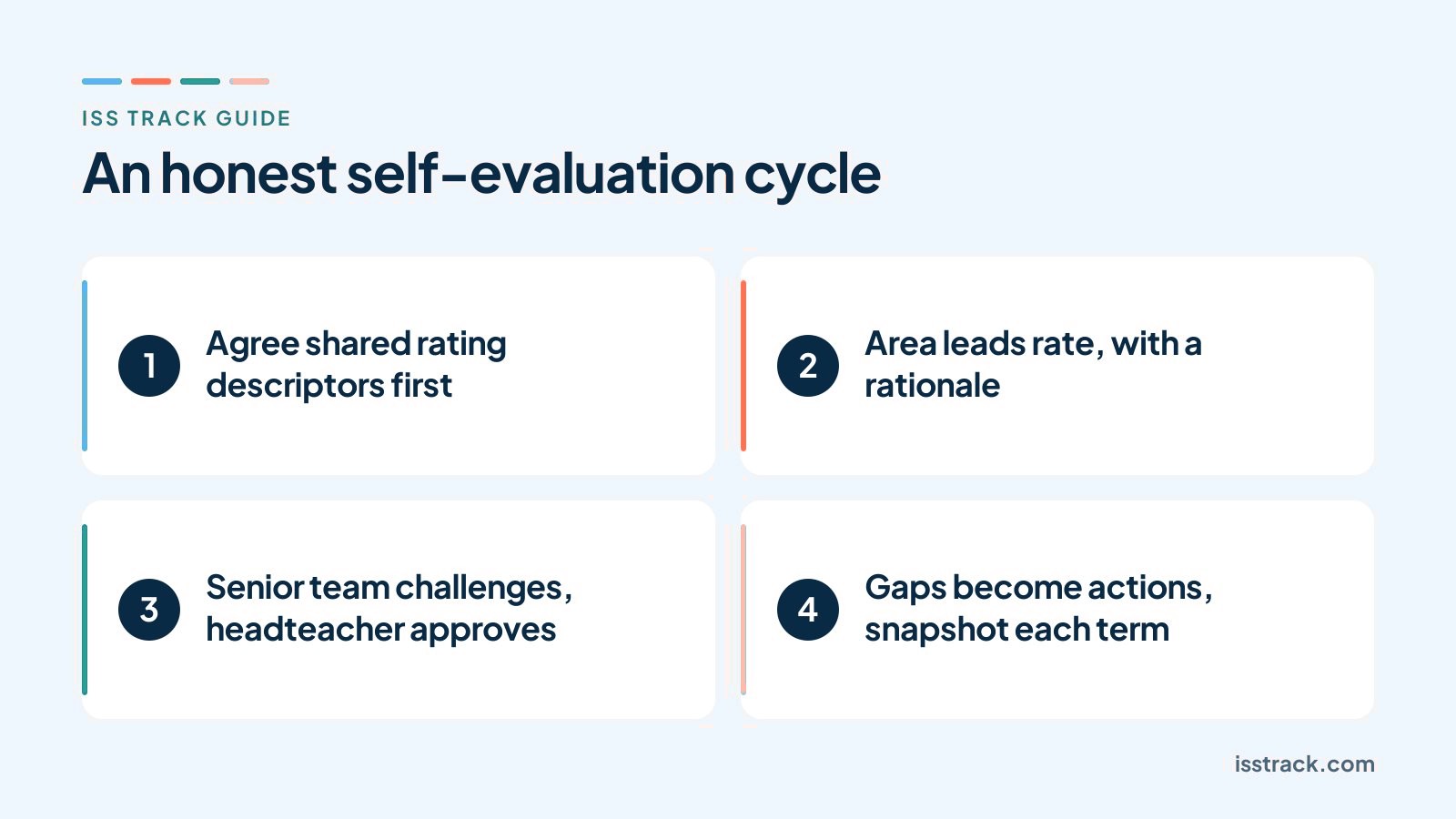
A practical approach that works in most schools looks like this:
- Start from clear requirements. Break the standards into separate, plain English items. Our Independent School Standards checklist shows how, part by part.
- Agree the rating scale and descriptors before anyone rates anything.
- Ask area leads to rate their own parts, with a short rationale and the evidence behind each rating.
- Challenge together. The senior team looks across the ratings, questions anything that seems generous or harsh, and agrees.
- Approve and share. The headteacher signs off the ratings and the proprietor sees the results.
- Turn gaps into actions with a name, a date and a way of checking the difference made.
- Take a snapshot and revisit. Keep a dated record, then update ratings as things change.
Should we use RAG ratings or met, partially met and not met?
For the standards, met, partially met, not met and not applicable usually work better than RAG colours, because they mean the same thing to everyone and map onto how inspectors record each standard.
Many schools are used to red, amber and green, and RAG ratings can work. But we often see the same colour meaning different things to different people. One leader’s amber means “almost there”, another’s means “we have a real problem”.
For the standards, plain words tend to work better: met, partially met, not met and not applicable. They map closely to how inspectors record each standard in a compliance record, as met or not met. “Partially met” is not a category inspectors use. It is an honest internal signal that something needs attention, and, in an inspection, a partially met standard is likely to be found not met.
Why do shared rating descriptors matter?
Without shared descriptors, ratings say more about the person rating than about the school. A cautious DSL and an optimistic business manager can look at similar situations and reach different conclusions.
Written descriptors fix this. Here is a simple set many schools adapt:
| Rating | What it means |
|---|---|
| Met | The requirement is in place, practice matches it consistently, and current evidence shows this |
| Partially met | Mostly in place, but with a gap in practice, consistency or evidence that needs action |
| Not met | Not in place, or practice does not match the requirement |
| Not applicable | Genuinely does not apply, such as boarding standards in a day school |
The key phrase is “practice matches it consistently”. A standard supported by a policy alone, with no evidence of practice, should rarely be rated met. Our guide to Independent School Standards evidence explains the difference.
Common Misconception
“A partially met looks bad, so we should only use it when we have to.” In fact, an honest partially met is one of the most valuable things a self-evaluation can contain. It shows leaders know their school, and it gives everyone time to put things right before it matters for pupils.
Why write a rationale for every rating?
A rating on its own is a conclusion with no reasoning. A sentence or two of rationale changes the conversation. “Met: policy reviewed in September, all staff trained this term, sanctions record reviewed half-termly by the deputy head” is something another leader can test. “Met” on its own is not.
The rationale also protects the school’s memory. When a leader moves on, their successor can see not only what was decided, but why.
Sample rationale wording you can adapt
A good rationale says what is in place, how leaders know it happens, and what, if anything, is missing. These examples are starting points. Replace the details with what is true in your school.
- Met: “All staff completed safeguarding training in September, including two supply staff on longer placements. The DSL tested understanding through a short quiz in October and followed up with the three staff who were unsure about low-level concerns.”
- Partially met: “The anti-bullying strategy is current and staff know it. Pupil voice this term suggests some pupils in the older group are unsure who to tell. Action: tutors to revisit this in PSHE by half term, owner the deputy head.”
- Not met: “The website does not yet include the number of formal complaints in the preceding school year. Action: business manager to add it by Friday and the headteacher to check.”
- Not applicable: “We have no pupils in the early years foundation stage, as confirmed by our registration details.”
Each one could be checked by someone else in a few minutes. That is the test of a useful rationale.
Who should be involved in self-evaluation?
The people closest to the work should rate it. The DSL rates safeguarding, the SENCo rates the requirements touching EHC plans, the business or site manager rates premises and the single central record, curriculum leaders rate Part 1. Each standard then has a named owner and a review date.
The headteacher’s role is to challenge and approve, not to rate everything personally. One of the most common challenges we see is a self-evaluation written by one person late at night. It gets done, but it misses what others know.
Involving the proprietor
The proprietor, whether an individual, a board or a group, should see the results and ask questions about them. Under Part 8, it is the proprietor’s responsibility to make sure leaders meet the standards consistently. They can only do that if they see the real picture. Our guide to proprietor responsibilities under Part 8 explains this in more depth.
Good Practice
Strong schools build a little friction into their ratings. Any leader can question a rating, the headteacher approves changes, and earlier versions are kept so everyone can see how a rating has moved over time. The proprietor receives a summary each term that includes the partially met and not met standards, not only the green.
How is ISS self-evaluation different from an Ofsted SEF?
A SEF is a broad, evaluative account of the school’s quality, while self-evaluation against the standards asks a narrower question: is each requirement met, and how do we know?
Many schools already write a self-evaluation form, often called a SEF, that describes the quality of education and care, its strengths, and its priorities for improvement. That kind of evaluation is broad and evaluative, and it is valuable.
Self-evaluation against the Independent School Standards asks a narrower and more precise question: is each requirement met, and how do we know? It is closer to a compliance record than a narrative. The two work best together. The standards closely match the “expected standard” in Ofsted’s toolkit, so if the standards linked to an area are not met, that area cannot be graded expected standard or above. Your standards evaluation sits underneath your wider SEF, and gaps in one will show in the other. For more on inspection, see how Ofsted inspects independent schools.
How often should an independent school self-evaluate against the standards?
Every school’s circumstances are different, but self-evaluation works best as a continuous habit rather than an annual event. A sensible rhythm for most schools is:
- A full review of every standard at least once a year.
- Higher risk areas, such as safeguarding, the single central record and restrictive interventions, every term.
- Ratings revisited whenever something changes: a new member of staff, a new policy, an incident, updated guidance such as the 2026 changes.
- A dated snapshot each term, so you can compare where you are with where you were.
Snapshots are often overlooked, but they are powerful. They show the proprietor whether the school is genuinely improving, and they give leaders a fair record of the progress they have made.
From Our Experience
Schools that recover well after a difficult inspection usually rebuild their self-evaluation first. They start rating honestly, give every standard an owner and look again every term. Many leaders tell us that within a year, the self-evaluation had become one of the most useful documents in the school, because people trusted it.
How can a tracker help with self-evaluation?
A tracker keeps self-evaluation current, with review dates, linked evidence and earlier versions in one place, which is the part that usually becomes hard on paper or in a spreadsheet.
Self-evaluation can be done well on paper or in a spreadsheet. What usually becomes hard is keeping it current: following up review dates, linking evidence and keeping earlier versions. That is why many schools move to a dedicated Independent School Standards tracker. In ISS Track, for example, ratings use shared descriptors, each has a rationale, an owner and a review date, the headteacher approves changes, and termly snapshots can be compared side by side.
Questions for Leaders
- Would two of our leaders rate the same standard in the same way?
- How many of our ratings have a written rationale someone else could test?
- Are any standards rated met on the strength of a policy alone?
- Does our proprietor see the partially met and not met standards, or only a summary?
- Could we show how our ratings have changed over the last year?
- Does our wider SEF agree with our evaluation of the standards?
Free download: Independent School Standards self-evaluation template
An Excel template with all 159 requirements in plain English, rating drop-downs, columns for your rationale, evidence, owner, review dates and actions, and a summary by part that updates itself. A simple way to run your first honest self-evaluation as a leadership team. Get the free template
Our Perspective
Self-evaluation is not about scoring well. It is about knowing your school honestly, so that leaders, staff and the proprietor can keep making it better for the children and young people in it. An honest picture, kept current, is the foundation of every good improvement plan. Our guide to the Independent School Standards is a helpful companion as you work through each part.
Sources and further reading
- Operating guide for standard inspections of non-association independent schools: for use from September 2026 (Ofsted)
- Independent school inspection: toolkit, operating guide and information (Ofsted)
- The Education (Independent School Standards) Regulations 2014, Schedule Part 8: Quality of leadership in and management of schools
- The Education (Independent School Standards) Regulations 2014
- Regulating independent schools (DfE), including Independent school standards guidance, April 2026
Look up the requirements, paragraph by paragraph
Continue exploring
- What evidence you need for the standards, and how to keep it current
- Independent School Standards checklist, what to check in every part
- Tracking the standards all year, from spreadsheets to dedicated trackers
- What happens if standards are not met, and how schools recover well
- How ratings, approvals and snapshots work in ISS Track
- The most commonly unmet standards: what the official data shows, and how to stay ahead of it
- Independent school compliance, all year: a calm routine for keeping every standard met
- Preparing for an independent school inspection: what to check, what evidence to have ready and the first 48 hours
- The Independent School Standards: a complete guide
- What policies does an independent school need?
- How to review school policies
- What does ISS mean in schools? The Independent School Standards and the terms around them
- What is ISS Track? The Independent School Standards tracker, explained
Elsewhere on ISS Track: see how the standards tracker helps with this, browse our free downloads, compare pricing, see ISS Track for groups or read every guide.
How can Jarvis Education help?
ISS Track is supported by Jarvis Education, an education consultancy led by a former HMI that supports independent schools, independent special schools and alternative provision with ISS health checks, independent reviews, Quality Marks, CPD and leadership support.
If you would like an experienced, independent view to sit alongside your own self-evaluation, testing your ratings and helping you plan next steps, we would be glad to help. Our reviews are designed to build confidence, never to find fault. Get in touch and tell us about your school.
How can ISS Track help?
See how ISS Track helps leaders rate every standard consistently.
Shared descriptors, a rationale for every rating and approval by senior leaders keep your self-evaluation honest and consistent.
Also useful:Watch the two minute tourView pricingBuy nowAll featuresFor groupsThe complete guide to the standards
ISS Track is supported by Jarvis Education
Support from Jarvis Education
Sometimes an experienced pair of eyes helps. These services and guides from the Jarvis Education team go further on this topic.