KCSIE in independent schools: how Keeping children safe in education links to the standards


Every September, independent schools turn to the new edition of Keeping children safe in education (KCSIE). The safeguarding policy is updated, staff are briefed, and the proprietor signs it off. It’s understandable that this can feel like an annual task to complete, especially in a small school where the DSL is also teaching, leading and responding to whatever the day brings.
From our experience, the schools where pupils are safest treat KCSIE differently. They see it less as a document to update and more as a set of habits that run through every week: how concerns are raised, how adults are checked, how leaders know that what is written is actually happening.
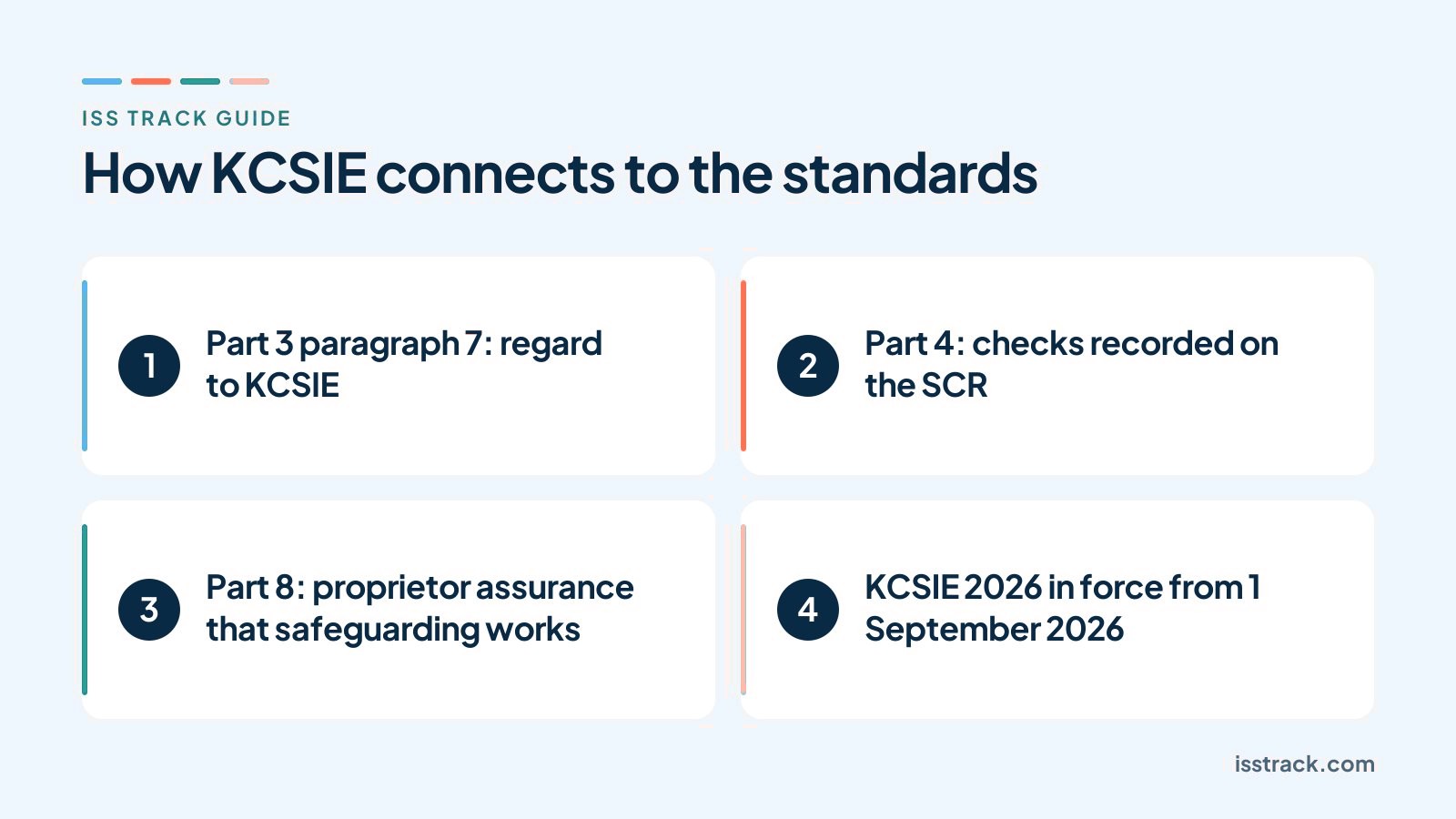
In short: KCSIE applies to independent schools through paragraph 7 of the Independent School Standards, which requires safeguarding arrangements that have regard to the Secretary of State’s guidance. KCSIE 2026 came into force on 1 September 2026, and it also shapes the Part 4 checks, the single central record (SCR) and the proprietor’s oversight of safeguarding.
This guide explains how KCSIE connects to the standards, what the 2026 edition means for independent and independent special schools, and a simple termly routine that helps the DSL, headteacher and proprietor keep it alive in daily practice.
Does KCSIE apply to independent schools?
Yes. Keeping children safe in education is statutory guidance from the Department for Education for schools and colleges in England. It sets out the legal duties schools must follow to safeguard and promote the welfare of children and young people under 18, and it applies to independent schools and independent special schools just as it does to maintained schools and academies.
For independent schools, the route in is the Independent School Standards themselves. That matters, because it means KCSIE is not simply good practice to draw on. Having regard to it is part of meeting a standard.
How does KCSIE link to the Independent School Standards?
Paragraph 7, in Part 3 of the Independent School Standards, is met if the proprietor makes sure that arrangements are made to safeguard and promote pupils’ welfare, and that those arrangements have regard to any guidance issued by the Secretary of State. On safeguarding, that guidance is KCSIE.
But KCSIE reaches further than paragraph 7. It touches three parts of the standards:
| Part of the standards | What it asks | Where KCSIE comes in |
|---|---|---|
| Part 3, paragraph 7 | Arrangements to safeguard and promote pupils’ welfare | The safeguarding policy, the DSL, staff training, records, allegations, online safety and the wider culture |
| Part 4, paragraphs 18 to 21 | Checks on staff, supply staff and proprietors, recorded on the SCR | Safer recruitment practice, including the checks for staff who have lived or worked outside the UK |
| Part 8, paragraph 34 | Leaders who fulfil their responsibilities and actively promote pupils’ well-being | The proprietor’s oversight of safeguarding and assurance that it works |
Our guide to Part 3: welfare, health and safety sets out what paragraph 7 looks like in practice, alongside behaviour, attendance and risk assessment.
KCSIE and the single central record (SCR)
Part 4 of the standards sets out the checks a school must make and requires them to be recorded on the single central record (SCR). Paragraph 18 refers directly to the Secretary of State’s guidance for the further checks on staff who have lived outside the UK. KCSIE’s safer recruitment section then turns the legal checks into everyday practice: how to recruit, what to do if someone starts before their DBS certificate arrives, and how to handle volunteers and contractors. Our guide to the single central record and Part 4 covers each check in detail.
KCSIE and the proprietor
Paragraph 7 places the duty on the proprietor, not only on the DSL. And Part 8 expects the proprietor to make sure leaders fulfil their responsibilities effectively and actively promote pupils’ well-being. In other words, signing off the policy is not enough on its own. Proprietors need to know that the arrangements work. Our guide to proprietor responsibilities under the standards explains how that assurance can work in practice.
Common Misconception
“KCSIE is the DSL’s document.” The DSL leads safeguarding day to day, but the standard is met, or not met, at proprietor level. Many leaders tell us that once the proprietor started asking regular, curious questions about safeguarding, the DSL felt better supported, not more scrutinised.
What changed in KCSIE 2026?
KCSIE 2026, in force from 1 September 2026, removed the condensed version of part one, so all staff now read the same part one, and removed the separate regulated activity scope document pending an update.
Keeping children safe in education 2026 was published on gov.uk in July 2026 and came into force on 1 September 2026, replacing the September 2025 version. The DfE’s publication page highlights two changes in particular:
- One version of part one for everyone. The shorter, condensed version of part one has been removed. All staff now follow the same safeguarding expectations, and proprietors should make sure all staff read part one, including those who do not work directly with children.
- Regulated activity scope removed pending an update. The separate document “Regulated activity in relation to children: scope” has been removed from the publication page while it is updated.
The DfE has also published “Part one: overview for all staff”, a short quick reference that complements part one rather than replacing it. A full summary of every change, part by part, is in Annex C of the 2026 document, and the annexes have been relettered, so references in your own policies may need updating. We would encourage every DSL to read Annex C carefully rather than relying on a second-hand summary.
The first change has a very practical consequence for independent schools. In many schools, office staff, cooks, cleaners, drivers and site staff were previously given the shorter version. They now need part one, and your induction and training records should show it. Our guide to the policies an independent school needs explains how the safeguarding policy should reflect the current edition.
What does KCSIE mean for independent special schools?
KCSIE applies in the same way to every school, but in independent special schools and alternative provision it often asks more of staff. KCSIE recognises that children with special educational needs and disabilities can face additional barriers to having abuse or neglect recognised. Changes in mood or behaviour may be put down to a pupil’s needs, and some pupils find it hard to tell anyone what has happened.
We often see the strongest special schools respond to this in a few deliberate ways:
- Knowing each pupil’s baseline. Staff know what is usual for each child, so changes are noticed and recorded rather than explained away.
- Giving every pupil a way to tell. Communication aids, symbols and trusted adults are part of safeguarding, not only teaching.
- Thinking about intimate care and one to one support. Clear plans and supervision protect pupils and staff alike.
- Covering every adult around the pupil. Therapists, transport staff, agency staff and off-site providers are all included in safer recruitment and in knowing how to raise a concern.
- Linking safeguarding and restrictive interventions. Records of force, restraint and seclusion are read by the DSL as well as behaviour leads. Our guide to restrictive interventions in independent schools explains the recording duties under paragraph 16A.
Local multi-agency arrangements matter too. Every school should know how its local safeguarding partners work and how to make a referral, in line with Working together to safeguard children. For schools whose pupils come from several local authorities, it helps to keep a simple contact sheet for each one.
From Our Experience
When we review safeguarding in independent special schools, the policy is rarely the weak point. The gaps tend to be at the edges: a visiting therapist unsure who the DSL is, a taxi escort who has never had a safeguarding briefing, a pupil on a part-time timetable whose afternoons nobody has asked about. Schools that recover well usually map every adult and every place a pupil spends time, then check that KCSIE reaches all of them.
How do we make KCSIE part of daily practice?
Turn it into a few reliable habits owned by named people, the DSL, the headteacher and the proprietor, and check them every term rather than only in September.
KCSIE is long, and no member of staff will hold all of it in their head. What makes it live is a small number of reliable habits, owned by named people and checked at a steady rhythm. The DfE’s independent school standards guidance, updated in April 2026, is a useful companion for how the standards are interpreted.
One of the most common challenges is that everything happens in September and then quietly drifts. A termly routine, shared between the DSL, the headteacher and the proprietor, keeps safeguarding visible all year without adding a heavy layer of paperwork.
KCSIE in a term: what the DSL, head and proprietor each check
| When | DSL checks | Headteacher checks | Proprietor checks |
|---|---|---|---|
| Start of term | Safeguarding policy reflects the current KCSIE; new staff and volunteers have read part one and had induction; local contacts are up to date | New starters are on the SCR with every check dated before they began; supply arrangements are clear at reception | Policy approved; board lead for safeguarding knows the term’s priorities; any change in proprietor body membership is on the SCR |
| Mid term | Sample of concern records: was each one followed through and closed properly? Filtering and monitoring alerts reviewed | A few staff asked, informally, what they would do with a concern today; low-level concerns reviewed for patterns | A short safeguarding update received and questioned; a sample of SCR entries checked against personnel files |
| End of term | Patterns across concerns, attendance and restrictive intervention records; training gaps for next term | Actions from the term completed or carried forward with an owner; pupil voice on feeling safe considered | Assurance recorded in minutes; any unresolved risks have a named owner and date |
Every school’s circumstances are different. A small AP may fold the head and DSL columns together, while a group of schools may want a central safeguarding lead to see every school’s routine. The principle is the same: three perspectives, checked regularly, with a light written record that shows it happened.
Good Practice
In strong schools, KCSIE shows up in ordinary moments. Briefings include a short case discussion. The DSL can show how a concern moved from first note to outcome. Staff who do not work directly with children know who to tell and why it matters. The proprietor asks to see evidence, not just reports, and pupils can name an adult they would talk to.
ISS Track supports this rhythm by giving paragraph 7 and each Part 4 requirement its own rating, owner and review date, and its policy register checks which edition of KCSIE each policy follows.
Questions for Leaders
- Does our safeguarding policy name KCSIE 2026 and reflect the changes in Annex C?
- Have all staff, including those who do not work directly with children, read part one this year?
- Does every adult around our pupils, including therapists and transport staff, know how to raise a concern?
- Is our single central record (SCR) current, including members of the proprietor body?
- How does the proprietor know, not just hope, that our safeguarding arrangements work?
- Which part of our termly routine do we skip when the term gets busy?
Free download: Independent School Standards checklist
Every requirement in all eight parts in plain English, including paragraph 7 and each Part 4 check, with space to record your rating, evidence and owner. Download the checklist (PDF)
Our Perspective
KCSIE changes a little each year, but its purpose never does: every child should be safe, listened to and protected by adults who know what to do. When the DSL, headteacher and proprietor each play their part, steadily and honestly, safeguarding stops being an annual update and becomes the way the school works. That is what keeps children and young people safe, and it is exactly what the Independent School Standards are there to protect.
Sources and further reading
- Keeping children safe in education 2026
- The Education (Independent School Standards) Regulations 2014, Schedule Part 3: Welfare, health and safety of pupils
- The Education (Independent School Standards) Regulations 2014, Schedule Part 4: Suitability of staff, supply staff, and proprietors
- The Education (Independent School Standards) Regulations 2014, Schedule Part 8: Quality of leadership in and management of schools
- Working together to safeguard children
- Regulating independent schools (DfE), including Independent school standards guidance, April 2026
Look up the requirements, paragraph by paragraph
Continue exploring
- Part 3: welfare, health and safety, paragraph by paragraph
- The single central record and Part 4: the checks and how to keep them current
- Proprietor responsibilities and how to gain real assurance
- Restrictive interventions in independent schools: recording, reporting and reducing
- The policies an independent school needs, including those expected through KCSIE
- The most commonly unmet standards: what the official data shows, and how to stay ahead of it
- Ofsted or ISI?: which inspectorate visits your school, and what stays the same
- How to review school policies: a step by step policy review, with a schedule and a worked example
- The Independent School Standards: a complete guide
- Part 1: Quality of education
- Part 1: EHC plans in independent special schools
- Part 2: SMSC and British values
- Part 5: Premises and accommodation
- Part 6: What to publish on your website
- Part 6: Information for local authorities
- The accessibility plan
- Part 7: The complaints procedure
Elsewhere on ISS Track: see how the standards tracker helps with this, browse our free downloads, compare pricing, see ISS Track for groups or read every guide.
How can Jarvis Education help?
ISS Track is supported by Jarvis Education, an education consultancy led by a former HMI that supports independent schools, independent special schools and alternative provision. Our consultants include experienced DSLs and safeguarding leads who understand the realities of keeping pupils with complex needs safe.
We can review your safeguarding arrangements against KCSIE 2026, audit your single central record (SCR), deliver safeguarding training for staff and proprietors, or look at paragraph 7 as part of a wider ISS health check. Our reviews are designed to build confidence, never to find fault. Get in touch and tell us about your school.
How can ISS Track help?
See how ISS Track gives paragraph 7 and every Part 4 check an owner, a rating and a review date, so KCSIE stays live all year.
Track safeguarding, the single central record and the policies that follow KCSIE in one place, with review dates that remind you.
Also useful:Watch the two minute tourView pricingBuy nowAll featuresFor groupsThe complete guide to the standards
ISS Track is supported by Jarvis Education
Support from Jarvis Education
Sometimes an experienced pair of eyes helps. These services and guides from the Jarvis Education team go further on this topic.