Single central record (SCR) for independent schools: what Part 4 requires


Many leaders tell us that the single central record (SCR) is the document they worry about most. It’s understandable. It is precise, it changes every time someone joins or leaves, it often sits with one person, and a single missing date can feel like it says something about the whole school. (The Independent School Standards call it a register; Keeping children safe in education calls it the single central record. They mean the same thing.)
From our experience, the schools that feel confident about their register are not the ones with the most complicated spreadsheet. They are the ones where safer recruitment is part of the culture, so the register is simply an accurate record of careful work that has already happened.
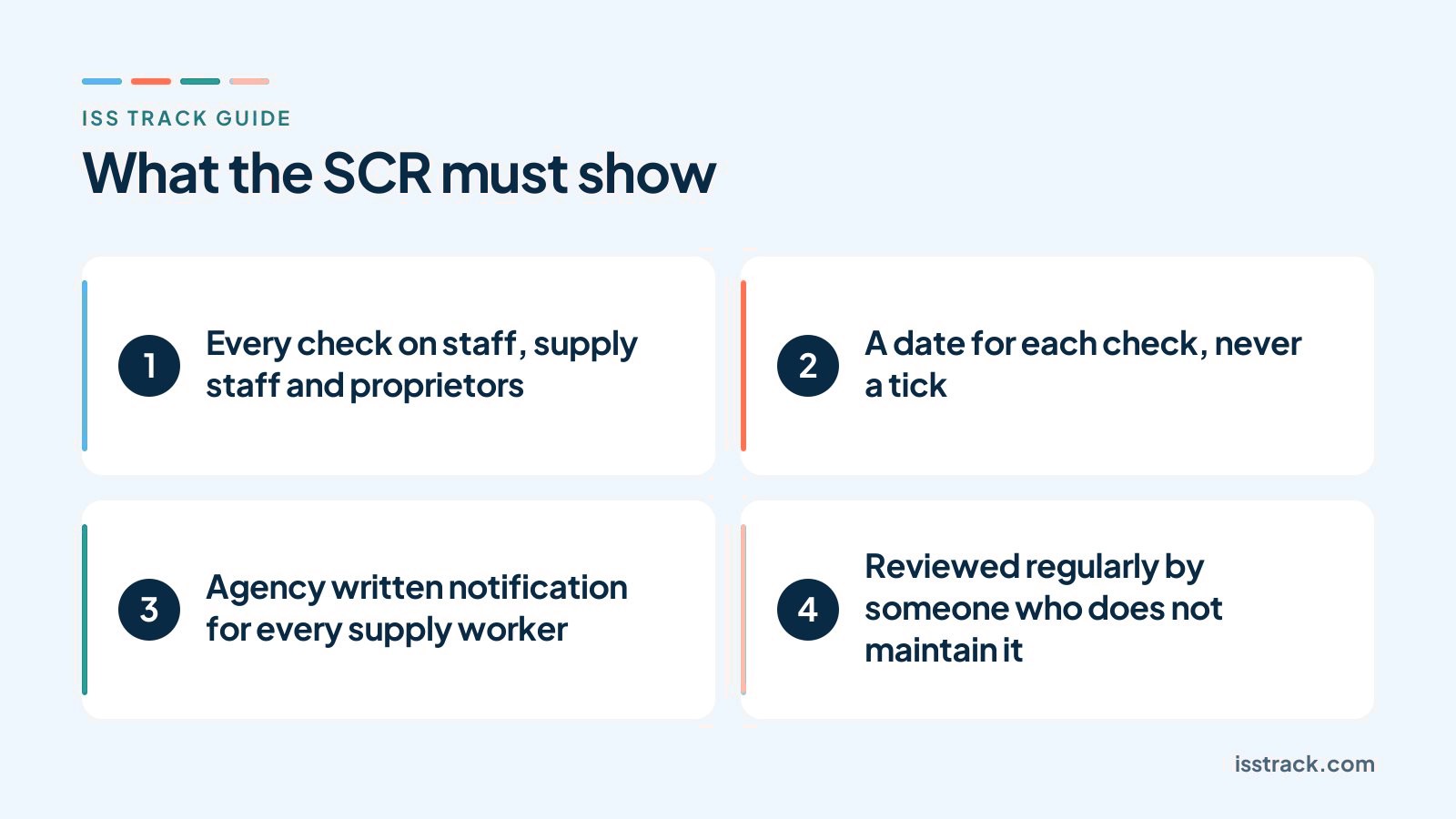
In short: The single central record in an independent school is the record, required by Part 4 of the Independent School Standards, of the checks made on staff, supply staff and proprietors. It shows identity, enhanced DBS, barred list, prohibition, right to work and qualification checks, and the date each one was completed.
This guide explains what Part 4 of the Independent School Standards requires, what the single central record should show, and the practical habits that keep it accurate all year. For the wider picture, see our guide to what the Independent School Standards are.
What does Part 4 of the Independent School Standards require?
Part 4 is about the suitability of staff, supply staff and proprietors. It exists for one reason: so that every adult working with pupils, and every person responsible for running the school, has been checked and is safe to be there.
It has four main paragraphs:
| Paragraph | What it covers |
|---|---|
| 18 | Checks on staff |
| 19 | Checks on supply staff |
| 20 | Checks on proprietors, including the chair of a proprietor body |
| 21 | The single central record that records all of these |
Part 4 sits closely alongside safeguarding in Part 3. Paragraph 7 asks schools to have regard to Keeping Children Safe in Education (KCSIE), and KCSIE sets out the detail of safer recruitment that turns these checks into good practice. Our guide to Part 3: welfare, health and safety explains the safeguarding side.
What checks does paragraph 18 require on staff?
Paragraph 18 asks the proprietor to make sure that the right checks are carried out on staff, before or as soon as practicable after their appointment. In plain English, the school needs to be satisfied that:
- the person is not barred from regulated activity with children
- the person is not prohibited from teaching, or subject to a direction preventing them from taking part in the management of an independent school, where that applies to their role
- their identity is confirmed
- they are medically fit for the role
- they have the right to work in the UK
- they hold the qualifications the role requires, where relevant
- an enhanced DBS certificate has been obtained, including a barred list check where the role involves regulated activity
- further checks have been made where the person has lived or worked outside the UK
Where someone starts before their DBS certificate arrives, KCSIE sets out what needs to be in place first, including a separate barred list check where relevant and appropriate supervision and risk assessment. It is worth making sure your safer recruitment policy describes this clearly, so it is never improvised.
What is a single central record?
The single central record is the record every independent school must keep of the checks carried out on its staff, supply staff and proprietors. Paragraph 21 requires it.
It is one record, held centrally, that lets anyone with the right access see at a glance that every required check has been done and when. It does not replace personnel files. It summarises them.
Is it the single central record or the single central register?
They are the same thing. Keeping Children Safe in Education calls it the single central record, and that is the term inspectors use, but many schools and recruitment agencies still say single central register, and both are often shortened to SCR. Whichever name you use, Part 4 of the standards and KCSIE ask for the same information.
What must be recorded on the single central record?
For each member of staff, the register should show whether each required check was carried out and the date it was completed or the certificate obtained. In practice, that means a clear entry for:
- identity
- barred list check
- enhanced DBS check, with the certificate date
- prohibition from teaching check, where relevant
- right to work
- qualifications, where the role requires them
- overseas checks, where the person has lived or worked abroad
- medical fitness, if you choose to record it (paragraph 21 does not require it on the register, although the check itself is required by paragraph 18)
KCSIE also recommends recording who carried out each check, and many schools find that helpful when they need to follow something up.
The register must also record the checks on supply staff and on proprietors, which are explained below.
Good Practice
Strong registers use dates rather than ticks, have a clear column for every check, show “not applicable” deliberately rather than leaving blanks, and record who carried out each check. Every entry can be matched to evidence in the personnel file. The register is dated each time it is reviewed, and the person reviewing it is someone other than the person who maintains it.
Worked example: checking one SCR entry line by line
KCSIE calls this document the single central record (SCR), while the standards call it a register. It is the same record. It can help to walk through a single entry. Imagine a teaching assistant who joined this term, previously worked abroad for two years, and does not carry out teaching work. A careful check of their line on the SCR might go like this:
- Identity: a date, matched to the copy of the document in the personnel file.
- Enhanced DBS with barred list check: the certificate date and who checked it. If they started before it arrived, the separate barred list check and the supervision arrangements are on file too.
- Prohibition from teaching: marked “not applicable” on purpose, because the role does not involve teaching work.
- Right to work: a date, with the evidence on file.
- Overseas checks: a date, and a note of what was obtained for the country where they worked.
- Medical fitness: a date.
- Qualifications: a date, or “not applicable” if the role does not require any.
The reviewer then chooses two more entries at random and repeats the same check. If every line shows a date or a deliberate “not applicable”, and every date matches the file, the SCR is doing its job: showing at a glance that every adult working with pupils has been properly checked.
Do supply staff need to be on the single central record?
Yes. Paragraph 19 sets out what the school must do for supply staff supplied by an agency.
The school must obtain written notification from the agency that it has carried out the checks the school would otherwise carry out itself. When the person arrives, the school must check their identity, so it knows the person in front of them is the person the agency checked. The single central record must then record that the written notification was received, along with the other details the regulations require.
One of the most common challenges is short-notice cover. Someone is needed tomorrow morning, the agency sends a name, and the written notification arrives later or not at all. Schools that manage this well usually agree a simple rule with reception and the cover lead: no supply worker starts without the notification in hand and an identity check at the door.
From Our Experience
We often see registers that are careful and complete for employed staff, but less consistent for supply staff, visiting therapists and staff who have been at the school for many years. The gaps rarely reflect a lack of care. They usually appear where the process was different, or where a check was done long ago and never written down in the way the register now needs.
Do proprietors and the chair need to be on the single central record?
Yes. Paragraph 20 requires checks on the people responsible for the school, not only those who work in it. Where the proprietor is an individual, the checks apply to that person. Where the proprietor is a body, such as a company, charity or trust, they apply to the chair and to the other members of the body.
Paragraph 21 then requires the single central record to record these checks and their dates. We often see registers that leave the proprietor body out altogether, or that were accurate when the board was formed but have not been updated as members changed. A change in the membership of the proprietor body should trigger an update to the register in the same way a new member of staff does.
Our guide to proprietor responsibilities under Part 8 explains why proprietors’ own suitability, and their oversight of the register, matter so much.
Do volunteers and contractors need to be on the single central record?
The standards themselves require the register to cover staff, supply staff and proprietors. KCSIE sets out the checks expected for volunteers and for contractors, which depend on their role and how much unsupervised contact they have with pupils.
Many schools choose to record volunteers, contractors, visiting therapists and transport staff on the register or on a clearly linked record. That way, every adult who works with pupils is accounted for in one place. Whatever you decide, the important thing is that the decision is deliberate, written into your safer recruitment policy (see our guide to the policies an independent school needs), and in line with the current edition of KCSIE.
Every school’s circumstances are different. An independent special school with a large therapy team and regular transport contractors needs a different level of detail from a small day school.
Common Misconception
“The single central record is an admin document.” It is held in the office, but it is a safeguarding record. Each line is a written promise that an adult has been checked before working with children. That is why inspectors look at it closely, and why it belongs in the safeguarding conversation, not only the HR one.
Is there a single central record template?
There is no official template. KCSIE sets out what the record must show, and schools are free to add more columns or keep it in a spreadsheet, an MIS or a dedicated system. What matters is that every required check has its own column with the date it was completed, and that the record covers everyone it should.
Most schools work best with one row per person and columns for: identity, enhanced DBS check and the date the certificate was obtained, barred list check where relevant, prohibition from teaching check, section 128 check for anyone in a management role, right to work, qualifications where the role needs them, and further checks for anyone who has lived or worked outside the UK. Supply staff need the date you received the agency’s written confirmation of its checks.
What do inspectors check on the single central record?
Inspectors usually ask to see the single central record early in an inspection. They check that it covers all staff, supply staff and, in an independent school, the proprietor or every member of the proprietor body, and that each required check is recorded with a date. They often pick a few people and compare the record with their personnel files, and they talk to leaders about how safer recruitment works.
A missing date or a check completed after someone started can lead to the related Part 4 standard being recorded as not met, even where the check was in fact done. Our guide to preparing for an independent school inspection includes the SCR in its list of things to check each term, not just when an inspection is near.
What are the most common gaps in a single central record?
From our experience, the gaps we see most often are small and fixable:
- ticks or “yes” instead of the date each check was completed
- missing prohibition checks for staff who carry out teaching work
- overseas checks not recorded for staff who have lived or worked abroad
- right to work or qualification checks missing for long-serving staff
- supply staff without a record of the agency’s written notification
- the chair or members of the proprietor body missing, or out of date
- entries that do not match the evidence in the personnel file
None of these needs to cause alarm. Each one has a clear fix, and finding them yourself is far better than having them found for you. For many schools, a careful audit of the register against personnel files is one of the most useful things a leader can do in a term. Working through Part 4 with an Independent School Standards checklist beside you makes it easier to be sure nothing is overlooked.
How often should the single central record be checked?
The register should be updated every time someone joins or leaves, and whenever a check is renewed or a new one is carried out. That keeps it live rather than periodically rebuilt.
Beyond that, most schools ask a senior leader, often the DSL or headteacher, to review it each half term or term, checking a sample of entries against personnel files. The proprietor body should review it too, as part of its oversight of safeguarding. Recording the date and the name of the reviewer makes the review itself part of your evidence.
In ISS Track, each of the Part 4 requirements has its own rating, owner and review date, so the register’s review sits alongside the rest of your self-evaluation rather than in a separate folder. A simple calendar reminder works too. The habit is what matters.
How do you audit a single central record?
An audit is a careful check that the record is complete, accurate and matches the evidence behind it. A short, regular audit is far more useful than a long one once a year. A simple approach:
- Compare the list of names with your current staff list, supply bookings, volunteers in regulated activity and the proprietor body.
- Check that every required column has a date, and that no check is dated after the person started.
- Pick a sample, for example five people each term, and compare each entry with their file, as in the worked example above.
- Check leavers have been handled in line with your retention arrangements, and that new starters were added before their first day.
- Record what you checked, what you found and the actions that follow, with a name and a date.
In ISS Track, each Part 4 requirement has an owner, a rating and evidence with a review date, so the audit itself becomes evidence and the next one is already in the calendar.
How do we build a safer recruitment culture?
The register records the checks. The culture is what makes them meaningful. Schools with a strong safer recruitment culture usually:
- Train the people who recruit. At least one person on each interview panel has up to date safer recruitment training.
- Ask about safeguarding at every stage. From the advert and application form to the interview questions and references.
- Explore gaps and inconsistencies. Gaps in employment history are discussed openly, not left on the form.
- Make sure no one starts early by accident. A simple sign-off before any start date, by someone who has checked the file.
- Treat the register as shared. The person who maintains it is supported, and others know how it works if they are away.
This connects directly to how pupils experience the school. When every adult has been properly checked, pupils are safer, families have good reason to trust the school, and staff work alongside colleagues they can rely on. Our guides to Independent School Standards evidence and self-evaluating against the standards show how to keep Part 4 visible all year.
Questions for Leaders
- Does every entry on our register show a date, rather than a tick?
- Are the chair and every member of our proprietor body on the register, and is it current?
- Do we have written notification for every supply worker, and do we check identity on arrival?
- Have we made a clear, written decision about how we record volunteers, contractors and therapists?
- When did someone other than the person who maintains it last check the register against personnel files?
- Does our safer recruitment policy reflect the current edition of KCSIE?
Free download: Independent School Standards checklist
Every requirement in all eight parts in plain English, including each Part 4 check and what the single central record must show, with space for your rating, evidence and owner. Download the checklist (PDF)
Our Perspective
The single central record is a short document carrying a big promise: that every adult in the school has been checked and is safe to be there. When it is accurate, current and part of a genuine safer recruitment culture, it gives pupils, families and staff real reassurance. It is one of the clearest ways a school can show it takes the Independent School Standards seriously, for the right reasons.
Sources and further reading
Look up the requirements, paragraph by paragraph
Continue exploring
- What must an independent school publish on its website?, the Part 6 list in plain English
- Independent school complaints procedure: what Part 7 requires
- How Ofsted inspects independent schools against the standards
- What happens if a school does not meet the standards, and how schools recover well
- Independent School Standards tracker: keeping Part 4 current all year
- KCSIE in independent schools: how Keeping children safe in education connects to the standards
- The most commonly unmet standards: what the official data shows, and how to stay ahead of it
- Preparing for an independent school inspection: what to check, what evidence to have ready and the first 48 hours
- How to review school policies, including the safer recruitment policy
- The Independent School Standards: a complete guide
- Part 1: Quality of education
- Part 1: EHC plans in independent special schools
- Part 2: SMSC and British values
- Part 3: Welfare, health and safety
- Part 3: Restrictive interventions (16A and 32A)
- Part 5: Premises and accommodation
- Part 6: Information for local authorities
- The accessibility plan
- Part 8: Leadership and proprietors
- Progress monitoring inspections: what Ofsted and ISI check against your action plan
Elsewhere on ISS Track: see how the evidence library helps with this, browse our free downloads, compare pricing, see ISS Track for groups or read every guide.
How can Jarvis Education help?
ISS Track is supported by Jarvis Education, an education consultancy led by a former HMI that supports independent schools, independent special schools and alternative provision. Our experienced consultants can audit your single central record against personnel files, review your safer recruitment practice, or look at Part 4 as part of a wider ISS health check.
Our reviews are there to build confidence and strengthen safeguarding culture, never to find fault. Get in touch and tell us a little about your school.
How can ISS Track help?
See how ISS Track keeps Part 4 evidence and actions current.
Rate each Part 4 requirement, link the evidence of your checks and set review dates, so nothing quietly lapses.
Also useful:Watch the two minute tourView pricingBuy nowAll featuresFor groupsThe complete guide to the standards
ISS Track is supported by Jarvis Education
Support from Jarvis Education
Sometimes an experienced pair of eyes helps. These services and guides from the Jarvis Education team go further on this topic.