What information must an independent school give to local authorities?


Many leaders tell us the relationship with a placing local authority is one of the most important they hold, and one of the most time consuming. Each authority has its own contacts, forms and ways of working, and with pupils placed by several authorities, keeping track of who needs what, and when, can quietly become a job in itself.
Part 6 of the Independent School Standards is mostly thought of as the part about parents and the school website. It also contains a few short duties owed directly to local authorities, and they matter a great deal to the authorities that fund your pupils.
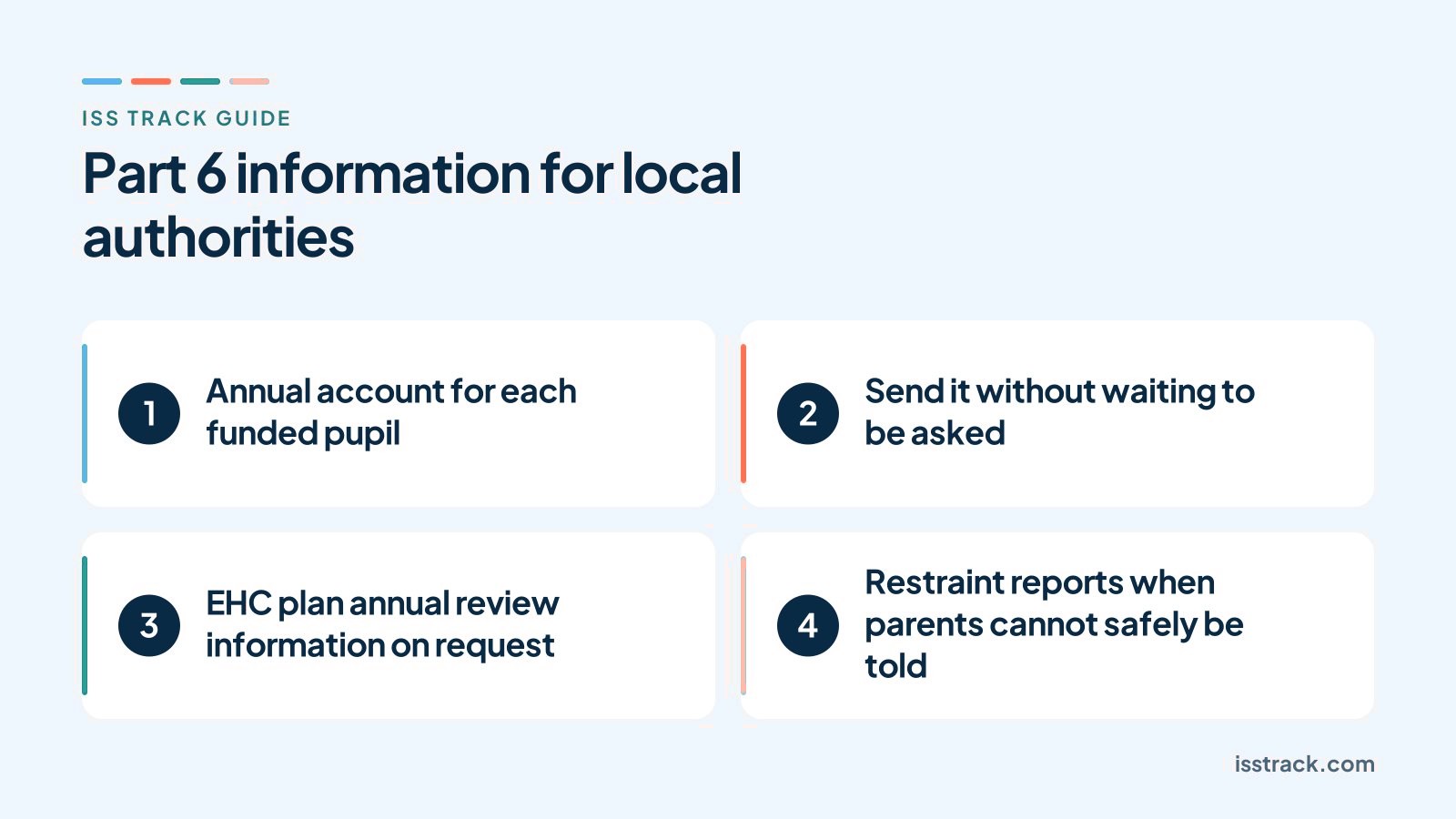
In short: The main independent school information for local authorities under Part 6 is an annual account of income and expenditure for each pupil an authority funds, sent without waiting to be asked, and the information an authority reasonably needs for the annual review of a pupil’s EHC plan. Paragraph 32A adds a duty to tell a local authority about restraint or seclusion in limited circumstances.
This guide explains each duty in plain English, with a sample covering note and a yearly calendar you can adapt.
What information must an independent school give to local authorities?
For each pupil a local authority funds, the school must send that authority an annual account of income and expenditure and the information it needs for any EHC plan annual review.
Part 6 sits alongside the other parts of the standards described in our guide to what the Independent School Standards are. Most of it is about parents, and our guide to independent school website requirements covers that side in detail. The duties that involve local authorities are set out in paragraph 32 of the Schedule to the 2014 Regulations and in paragraph 32A.
| Paragraph | What it asks | Who receives it |
|---|---|---|
| 32(1)(h) | An annual account of income and expenditure for each pupil a local authority wholly or partly funds | The funding local authority, and the Secretary of State on request |
| 32(1)(i) | Information reasonably required for the annual review of a publicly funded pupil’s EHC plan | The responsible local authority |
| 32A | Incidents of use of force, seclusion or restraint, where no parent can be told without likely significant harm to the pupil | The local authority where the pupil is ordinarily resident |
Part 6 of the Schedule is short and worth reading once. The DfE explains each paragraph in its April 2026 Independent School Standards guidance, on the Regulating independent schools page.
What is the Part 6 local authority annual account?
Where a registered pupil is wholly or partly funded by a local authority, the proprietor must make sure that authority receives an annual account of the income received and expenditure incurred by the school for that pupil. The Secretary of State can also request it, although the DfE guidance says this would be unusual.
- You send it without being asked. The DfE guidance is clear that the school should supply the account without waiting for the authority to request it. This is the detail most often missed.
- It is not only for EHC plans. Any pupil an authority wholly or partly funds is included, except where the funding is solely for free early years provision.
What should the annual account of income and expenditure include?
Neither the regulations nor the DfE guidance prescribe a format, a deadline or headings. That gives schools flexibility, but the account needs to make sense to someone who was not involved in the placement.
From our experience, a clear account usually shows:
- the pupil, the authority and the period covered
- the income received from the authority for that pupil, including any top up funding
- the expenditure on that pupil, grouped in ways the authority will recognise, such as staffing, therapies and other agreed provision
- how shared costs have been apportioned
- a named contact who can answer questions
Every school’s circumstances are different. Your placement agreement may set its own reporting expectations, so check it and line the two up. Where an authority has a preferred template, using it is usually quickest for everyone.
A sample covering note for the annual account
This is a template to adapt, not a required form of words. Replace everything in square brackets.
Dear [name of placement or commissioning officer],
Annual account of income and expenditure: [pupil initials or reference], [period covered]
As required by paragraph 32(1)(h) of the Independent School Standards, please find attached the annual account of income received and expenditure incurred by [school name] in respect of [pupil reference], whom [local authority] wholly or partly funds.
The account covers [start date] to [end date]. It shows the funding received from [local authority] and how it has been spent on [pupil reference]’s education and agreed provision, grouped under [your headings]. Shared costs have been apportioned by [brief method, for example the number of pupils in the class].
If you would like to talk this through, or would prefer a different format, please contact [name, role, email and telephone].
With best wishes,
[name], [role], on behalf of [proprietor name]
Send it securely and keep a dated record of what was sent, to whom and when. That record is your evidence that the standard is met.
Common Misconception
“The authority gets our invoices, so it already has the account.” Invoices show what the school has charged. The annual account shows the income received and how it was spent on the pupil over the year. The standard asks for the account, sent without waiting to be asked.
What information do local authorities need for EHC plan annual reviews?
Where a pupil with an EHC plan is wholly or partly funded by a local authority or another body through public funds, the proprietor must make sure the responsible local authority receives the information it may reasonably require for the annual review of the plan. The DfE guidance gives education, safeguarding and other pupil centred information as examples, and describes this as information provided when the authority asks for it.
Under section 44 of the Children and Families Act 2014, the authority must review each plan at least every 12 months. The process is set out in the SEND code of practice: 0 to 25 years, and our guide to EHC plans in independent special schools covers the review process itself.
For the standards, the question is simple: when the authority asks, can you give it accurate, current information about the pupil’s progress, provision and wellbeing in good time? Schools that do this well keep progress against EHC plan outcomes up to date all year, so the review summarises what they already know.
Good Practice
Strong schools keep one simple register of publicly funded pupils: the funding authority, the named officer, the last and next annual review dates, and when the annual account was sent. Review reports are shared in advance and written so the child and family can understand them.
When must a school tell a local authority about restraint or seclusion?
Paragraph 32A, in force from 1 April 2026, requires schools to tell parents about each incident of use of force, seclusion or restraint involving their child, as soon as practicable. Two parts involve local authorities.
- Information must not be given to a parent if it appears this would be likely to cause significant harm to the pupil. If no parent can be told safely, the information goes to the local authority where the pupil is ordinarily resident.
- For paragraph 32A, “parent” includes a local authority providing accommodation for the pupil under section 20 of the Children Act 1989, so that authority is told as a parent would be.
It helps to agree in advance with each authority who receives these reports and how. Our guide to restrictive interventions in independent schools explains the recording and reporting duties in full.
What happens if a school does not provide this information?
The DfE guidance says that if an authority finds a school has not supplied the account or the annual review information, it is likely to complain to the department, and an inspection may follow if appropriate. In practice, the bigger cost is usually to the relationship: an authority that has to chase basic information feels less confident in a placement.
From Our Experience
We often see schools where the annual review work is excellent but the annual account has never been sent, usually because nobody owns it. The finance team assumes education staff handle authorities; education staff assume finance does. Once a single person is named and the dates are in the calendar, it rarely slips again.
A simple yearly calendar: what goes to whom and when
The regulations fix few dates, so this calendar is an example to adapt. It separates what Part 6 requires from good practice.
| When | What | To whom | Status |
|---|---|---|---|
| September | Update the register of publicly funded pupils, funding authorities and named officers | Internal | Good practice |
| When a placement starts | Agree the account period, format and recipient, and who receives any 32A reports | Placing authority | Good practice |
| Before each annual review (at least every 12 months) | Information reasonably required for the review of the EHC plan | Responsible local authority | Required, 32(1)(i) |
| Once a year, at a date you have agreed (for example after your financial year end) | Annual account of income and expenditure for each funded pupil, with a covering note | Each funding local authority | Required, 32(1)(h) |
| On request | The annual account | Secretary of State | Required, 32(1)(h) |
| As soon as practicable after an incident | Restraint or seclusion information where no parent can safely be told, or the authority is the parent | Relevant local authority | Required, 32A |
| Each term | Report to the proprietor on accounts sent, reviews held and any requests outstanding | Proprietor | Good practice |
How does providing information build trust with placing authorities?
Clear, timely information shows a placing authority that the placement is well run and the child is known, which turns a contract into a partnership.
Placing authorities are responsible for public money and, more importantly, for children who often have complex needs. Clear, timely information tells them the placement is well run and the child is known. It turns a contract into a partnership.
From our experience, the schools authorities trust most send information before it is chased, explain their figures plainly and are honest when a placement is not working. That shapes every conversation that follows, including whether a child’s provision needs to change.
Part 8 asks proprietors to make sure the standards are met consistently, and a short termly report on these duties gives them that assurance. Our guide to proprietor responsibilities under Part 8 explains how.
Questions for Leaders
- Do we have a current list of every pupil funded by a local authority, and which authority funds each one?
- When did we last send each authority an annual account, and did we send it without being asked?
- Have we agreed with each authority who receives paragraph 32A reports for looked after pupils?
- Does our proprietor see a regular summary of what has been sent, and what is outstanding?
Free download: Independent School Standards checklist
Every requirement in plain English, including the Part 6 duties to local authorities, with space for a rating, evidence and owner. Download the checklist (PDF)
Our Perspective
The Part 6 duties to local authorities are few and modest in effort, yet they say a great deal about a school. An account sent on time and a review report that shows real knowledge of a child signal a school that is organised and open. That helps children get the right provision, in the right place, for as long as they need it.
Sources and further reading
- The Education (Independent School Standards) Regulations 2014, Schedule paragraph 32
- The Education (Independent School Standards) Regulations 2014, Schedule Part 6: Provision of information
- Regulating independent schools (DfE), including Independent school standards guidance, April 2026
- Children and Families Act 2014, section 44: reviews and re-assessments
- SEND code of practice: 0 to 25 years (DfE)
Look up the requirements, paragraph by paragraph
Continue exploring
- Independent school website requirements: the rest of Part 6, for parents
- EHC plans in independent special schools, including annual reviews
- Restrictive interventions in independent schools: recording and reporting
- Independent School Standards checklist, every requirement in one place
- The independent school accessibility plan: what the Equality Act asks of you, and how to keep the plan alive
- Independent school compliance, all year: a calm routine for keeping every standard met
- The Independent School Standards: a complete guide
- Part 1: Quality of education
- Part 2: SMSC and British values
- Part 3: Welfare, health and safety
- Part 3: KCSIE in independent schools
- Part 4: The single central record (SCR)
- Part 5: Premises and accommodation
- Part 7: The complaints procedure
- Part 8: Leadership and proprietors
Elsewhere on ISS Track: see how the standards tracker helps with this, browse our free downloads, compare pricing, see ISS Track for groups or read every guide.
How can Jarvis Education help?
ISS Track is supported by Jarvis Education, an education consultancy led by a former HMI that supports independent schools, independent special schools and alternative provision. We work with schools and local authorities, so we understand what each needs from the other.
If you would like an experienced, independent pair of eyes on any part of the standards, we are always happy to help. Our reviews build confidence, never find fault. Get in touch and tell us about your school.
How can ISS Track help?
See how ISS Track keeps every Part 6 duty, including information for local authorities, owned, dated and evidenced.
Each requirement with an owner, a date and the evidence that it was done.
Also useful:Watch the two minute tourView pricingBuy nowAll featuresFor groupsThe complete guide to the standards
ISS Track is supported by Jarvis Education
Support from Jarvis Education
Sometimes an experienced pair of eyes helps. These services and guides from the Jarvis Education team go further on this topic.